Best practice management software for dietitians (2026)
Practice management platforms for RDs compared: Practice Better, Healthie, SimplePractice, Kalix, AI scribes and Duo Practice, by how your practice runs.
 By Javier Alvarez · 5 min read
Disclosure: this guide is written by the team behind Duo Practice, which appears in the comparison. We've kept the criteria objective and the descriptions of other platforms factual. Which software fits depends on how your practice runs, and no single tool wins every scenario.
The practice-management market for dietitians has excellent options and one trap: picking software by feature count. What cuts your weekly admin hours is different: how much happens without you touching it?
Start with your practice type, not the feature list
Three questions sort the whole market:
- Revenue model: insurance-based, cash-pay, or hybrid?
- Biggest time sink: documentation, billing, or client communication?
- Tool tolerance: one platform, or best-of-breed apps stitched together?
If you're cash-pay only, most general wellness platforms serve you well and billing depth doesn't matter. If insurance is (or will be) your engine, the billing pipeline is the decision. Everything else is furniture.
The main platforms
| Platform | Strongest at | Insurance billing depth | Best fit |
|---|---|---|---|
| Practice Better | Wellness workflows: programs, protocols, client portal, packages | Superbills; claims workflows on higher tiers | Cash-pay & wellness-focused practices |
| Healthie | All-round platform + API; nutrition roots | Integrated claims (CMS-1500) via clearinghouse | Group practices, hybrid models, startups building on its API |
| SimplePractice | Polished general private-practice UX; huge template library | Solid claim submission & tracking | Multi-disciplinary or therapy-adjacent practices |
| Kalix | Dietitian-specific EHR; MNT-aware documentation | Claims support with nutrition context | Solo RDs who want RD-specific structure |
| AI scribes (Heidi, Twofold, etc.) | Turning session audio into clinical notes | None; documentation only | Add-on for practices whose bottleneck is charting |
| ChatGPT (generic) | Ad-hoc drafting help | None, and PHI/BAA is on you | Occasional writing aid, not a system (details below) |
| Duo Practice | The revenue pipeline: session → note → codes → claim → payment | Eligibility checks through your Claim.MD, codes drafted from the session, claim checks before you submit, ERA matching, denial explanations and resubmission | Insurance-based RDs who want the claim work drafted for them |
For a head-to-head of the three platforms RDs compare most, see Practice Better vs Healthie. A few notes on each:
Practice Better has some of the best wellness-program tooling in the space. If your model is packages, protocols, and coaching relationships, it's a strong home base. Insurance-heavy RDs tend to outgrow the billing side (see Practice Better alternatives and what the Practice Better + Claim.MD stack leaves manual).
Healthie is a platform play: solid, extensible, widely used by nutrition startups. For a solo RD it can feel like more machine than you need.
SimplePractice is beautifully executed general practice software. It isn't nutrition-specific, and that shows up in small ways (templates, intake, MNT billing nuances). Full review: SimplePractice for dietitians.
Kalix speaks dietitian natively, with MNT workflows and documentation built for RDs.
AI scribes are the fastest-growing add-on because they address the biggest single time sink. Their limit is architectural: a scribe ends at the note. The note still has to become codes, a claim, a status to track, and a payment to post, by hand, in other software.
The three-app problem
A common setup in insurance-based practices: an EHR for charts, an AI scribe for notes, and a generic AI chatbot for drafting patient summaries. That's three subscriptions, with the RD as the integration layer, copying output from one tool into the next.
Beyond the cost, the stitching fails in specific ways. Context gets lost: the scribe doesn't know what the EHR knows, a generic chatbot forgets the instructions you gave it last week, and keeping straight which patient you're working on across tools is on you. A chatbot that mixes details between patients is a clinical documentation risk.
Compliance gets more complex too. Every tool touching session content needs HIPAA compliance and a BAA. Consumer AI tools don't come with one by default.
And money leaks in the gap. None of the three tools watches your claims. The note gets written, but whether it turns into revenue (clean claim out, denial worked, payment posted) belongs to no app in the stack. Every handoff between tools is a place where time goes and claims quietly die.
What "automated billing" should mean
When platforms say they "support insurance billing," ask what happens without your involvement. Six questions for any software you're evaluating:
- Eligibility: does it verify a new client's nutrition benefits before the first session, or do you still call the payer?
- Coding: are CPT units and ICD-10 pairings generated from the session and its real duration, or typed in by you?
- Validation: are claims checked against payer rules before submission, or do errors come back as denials three weeks later?
- Tracking: will you be told when a claim is rejected or stuck, or do you have to remember to look?
- Posting: when the ERA arrives, are payments posted to sessions automatically?
- Denials: does the software tell you why and suggest a fix, or hand you a CARC code and wish you luck?
Manual answers to all six cost a typical insurance practice 15 to 25 hours a month (we break down the math in the insurance billing guide). Each automated answer wins hours back.
Where Duo Practice fits, and where it doesn't
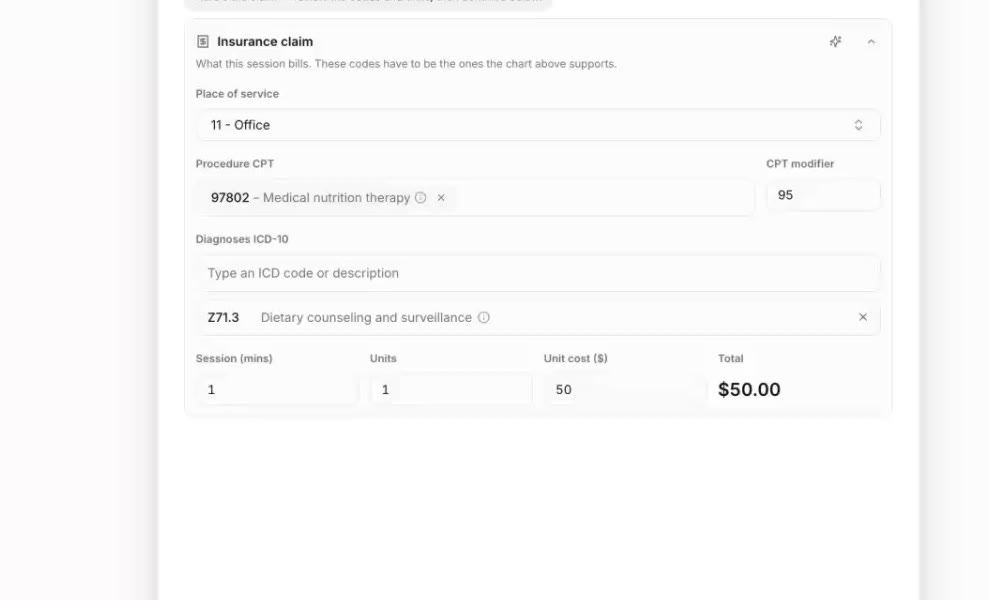
Duo Practice is built so the claim work after a visit is drafted for you. It records the session (with consent), drafts the note, and drafts the claim from it: CPT, units from the real session time, ICD-10, modifiers and place of service. You review it and press Submit, and it goes out under your NPI through your own Claim.MD account. Eligibility checks run through that account too. When the ERA comes back, Duo matches the payment, explains any denial, and fixes and resends denied or rejected claims. It does not do appeals, prior authorizations or credentialing. The same visit can hold the client's meal plan too: Hands, the assistant in Duo, drafts it from your targets, as our page on meal planning software for dietitians shows.
If you run a cash-pay coaching practice built on programs and protocols, a wellness platform like Practice Better fits your model better than a billing-first system. Duo Practice is built for insurance-based practices first.
Which one fits
- Cash-pay / wellness model → Practice Better (or Healthie for platform depth).
- Multi-disciplinary or therapy-adjacent → SimplePractice.
- Solo RD wanting nutrition-native records → Kalix.
- Charting is your only bottleneck → add an AI scribe to what you have.
- Insurance is your engine and admin is eating your evenings → you want the note-to-claim work drafted for you. Duo Practice was built for that. Create your free account. The EHR is free; billing is 3.9% of what an insurer pays, plus your own Claim.MD plan.
Frequently asked questions
What software do most private-practice dietitians use?
The most common platforms are Practice Better, Healthie, SimplePractice, and Kalix, often paired with an AI scribe (like Heidi or Twofold) for note-taking and sometimes a separate billing service. Insurance-heavy practices increasingly look for platforms that automate the claims side.
What's the difference between an EHR and practice management software?
An EHR focuses on the clinical record (charts, notes, documents). Practice management covers operations (scheduling, intake, billing, payments, reminders). Most modern platforms for dietitians bundle both. The difference is in depth: how much of the insurance billing pipeline they automate versus support.
Is it worth paying for an AI scribe as a dietitian?
If you spend 15 to 30 minutes per session on notes, an AI scribe typically pays for itself in the first week. The caveat: a standalone scribe only solves documentation. The note still has to move into your EHR and turn into codes and claims by hand. Platforms that connect the recording directly to billing capture more of the value.
Part of Software & workflow.