SimplePractice for dietitians: what works, what doesn't
An honest SimplePractice review for dietitians: its polish and mature claims pipeline, the nutrition-specific gaps like MNT coding, and who it fits.
 By Javier Alvarez · 4 min read
Disclosure: this review is written by the team behind Duo Practice, a free EHR with insurance billing built in, so we compete with SimplePractice for some practices. We have kept this review factual and fair. SimplePractice is good software, and for a meaningful share of RDs it is the right choice.
Ask in any RD community which software to use and SimplePractice comes up within three replies, usually from someone who's happy with it. It's one of the most widely adopted private-practice platforms in the country, and for good reason: the product is more polished than most healthcare software.
So the question is fit. Does software built for private practice in general suit a practice built on medical nutrition therapy in particular? That's what this review looks at.
What works
The UX polish is real. Scheduling, the client portal, telehealth, payments and reminders all feel finished. Clients rarely get confused, and you rarely hunt for a setting. That day-to-day smoothness matters more than it sounds.
The claims pipeline is mature. This matters most for insurance-based RDs. Electronic claim creation, submission through an integrated clearinghouse, status tracking and ERA handling have been refined across an enormous user base and years of edge cases. Claims that leave SimplePractice are formatted correctly and get where they're going. If you've been hand-filing CMS-1500s, this alone is a big step up.
Wide adoption means most questions are already answered. Tutorials, community answers and support articles exist for nearly everything. Your biller has probably used it. Your therapist office-mate definitely has.
The template library is large and customizable. You can build ADIME notes, nutrition intake forms and consent flows. The raw material is there.
Where dietitians feel friction
None of what follows is a defect. It's the predictable result of software designed around general private practice, which historically has meant mostly behavioral health.
The concepts lean therapy. "Treatment plans," diagnosis-centric workflows and progress-note framings map naturally onto counseling and less naturally onto MNT. RDs adapt them every day, but you're translating, and the translation is setup work the software won't do for you. If you chart in ADIME rather than SOAP, you'll be building that structure yourself.
MNT billing details are on you. SimplePractice will submit whatever claim you build, correctly and reliably. Building it correctly is your job:
| What you handle | Why it matters |
|---|---|
| Code and unit selection | You pick 97802 vs. 97803 and count 15-minute units yourself, including the 8-minute-rule math. A 58-minute follow-up is 4 units of 97803; nothing stops you from typing 1. |
| Preventive vs. medical routing | Many commercial plans pay nutrition counseling under the preventive benefit with specific diagnosis pairings (and some payers reject Z71.3 as primary, so check the payer's policy). The codes you enter decide whether a claim routes preventive or medical, and the software has no nutrition-specific guardrails to warn you. |
| MNT-specific payer rules | Medicare MNT's referral requirement and hour caps, visit-limit tracking against verified benefits, and unit ceilings per payer are all tracked in your head or your spreadsheet. |
Eligibility is still your morning phone call. SimplePractice offers eligibility features, but confirming nutrition-specific benefits (visit limits, preventive coverage, telehealth rules) typically still means a call or a portal search before each new client.
AI notes are an add-on. SimplePractice's Note Taker drafts notes for $35 a month (checked on simplepractice.com on October 15, 2026), so AI charting means a second subscription on top of the plan.
Scorecard
| Area | Verdict for RDs |
|---|---|
| Scheduling, portal, telehealth, payments | Excellent; best-in-class polish |
| Claim submission & tracking | Mature and reliable: you build, it delivers |
| Nutrition-specific documentation | DIY: adaptable templates, therapy-leaning defaults |
| MNT coding & unit math | Entirely manual; errors surface as denials |
| Eligibility verification | Largely manual for nutrition benefits |
| Ecosystem & support | Massive; answers exist for almost everything |
Who it fits well
- Multi-disciplinary practices. If you share a practice with therapists, psychologists or other license types, one polished platform everyone knows beats two specialized ones nobody shares.
- Therapy-adjacent RDs. Eating-disorder-focused practices working closely with behavioral health teams often find the therapy-shaped concepts helpful.
- RDs who want reliability over specialization. If you know your MNT billing cold and want claims delivered without errors, SimplePractice does that.
Who outgrows it
The pattern we see: an RD's insurance caseload grows, and the manual layer grows linearly with it. That layer is verification calls, code and unit entry, detective work on rejected nutrition claims, and ERA review. SimplePractice carries out your instructions perfectly, but it never gives them. At 15 to 25+ insurance sessions a week, that gap is measured in evenings.
Complement or replace?
You can keep SimplePractice as your practice hub and accept the manual MNT layer as the cost of its polish. That's reasonable for lighter insurance volume or multi-disciplinary settings.
If you're nutrition-only and insurance-heavy, consider replacing it (or not adopting it) in favor of a platform where the MNT layer is the product: nutrition-native records, or full billing automation. Our platform-by-practice-type guide maps the options, and Practice Better vs Healthie compares the nutrition-focused alternatives directly.
Either way, decide based on the manual hours, not the demo. SimplePractice won't let you down on reliability. What matters is how much of your week it leaves on your desk.
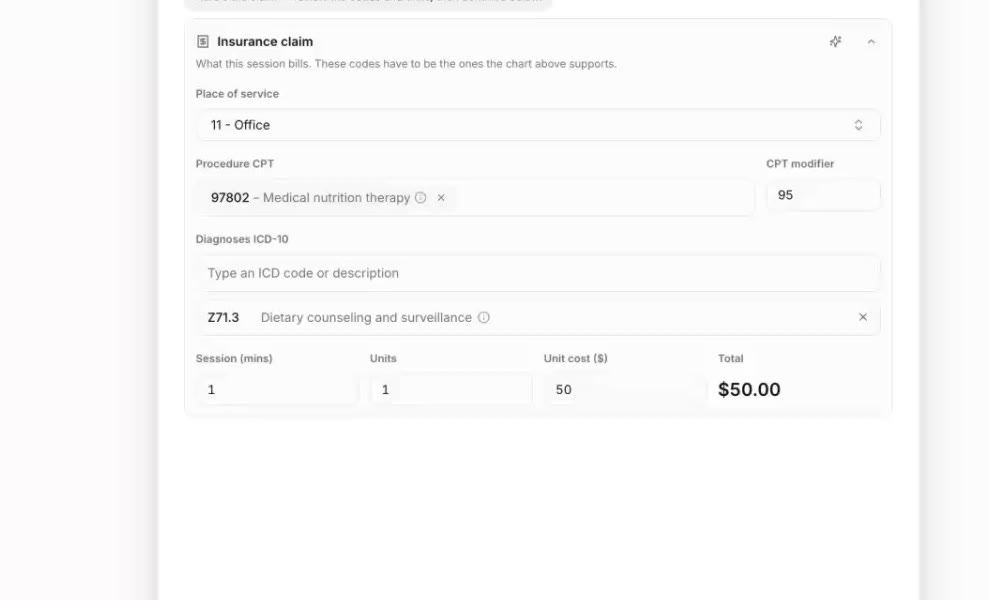
Duo Practice handles the part SimplePractice leaves to you. It records the session, drafts the note and the claim (CPT, units from the session time, ICD-10, modifiers, place of service), checks eligibility through your own Claim.MD account, and matches the ERA when the payment comes back. Create your free account. The EHR is free; billing is 3.9% of what an insurer pays, plus your own Claim.MD plan.
If you're comparing options for insurance billing, the comparisons are on separate pages: SimplePractice alternatives with SimplePractice's October 2026 claim pricing, Practice Better alternatives, Healthie alternatives and Practice Better vs Healthie, each with where the other product wins.
Frequently asked questions
Is SimplePractice good for dietitians?
Yes, with caveats. It is polished, reliable general private-practice software with a mature insurance claims pipeline. But it was not built for nutrition, so MNT-specific work (code and unit selection, preventive versus medical benefit routing, nutrition documentation structure) stays with you. Many RDs run happily on it; some outgrow the generic fit.
Can SimplePractice submit insurance claims for nutrition services?
Yes. SimplePractice supports electronic claim creation, submission through its integrated clearinghouse, status tracking, and ERA handling. It does not choose your MNT codes or count your 15-minute units. You enter 97802 or 97803, the units, and the diagnosis pairing yourself, and errors there come back as denials.
Does SimplePractice have nutrition-specific templates?
It has a large template library and customizable forms, and you can build ADIME or nutrition-focused SOAP templates yourself. Out of the box, though, its documentation concepts lean toward therapy (treatment plans, diagnoses, progress notes framed for behavioral health), so RDs typically spend setup time adapting templates to MNT workflows.
Part of Software & workflow. Start with Best practice management software for dietitians (2026).