One-page business plan for a nutrition practice (template)
A one-page business plan template for dietitians in private practice: 9 blocks covering niche, offer, channels, unit economics, and 90-day priorities.
 By Javier Alvarez · 5 min read
Many dietitians opening a private practice either write no business plan at all, or lose a weekend to a 30-page document built from a generic template (market analysis, mission statement, five-year projections) that never gets opened again.
Both fail the same way: neither is in the room when you make actual decisions. Should I credential with a third payer? Raise my rate? Spend on ads or physician outreach? Those choices get made week to week, and a plan only helps if it's short enough to re-read and current enough to trust.
A one-page plan fixes that: nine blocks, a few lines each, reviewed monthly in 20 minutes. Below is the structure adapted to an RD practice, a fill-in template, and a worked example.
Why does one page beat thirty?
A long plan is a prediction document: it pretends to know year three. A one-page plan is a working document. It states your current bets so you can check them against reality every month and change the ones that are wrong. For a solo or two-person practice, the second kind is the only kind that earns its keep.
One page also forces the discipline long plans let you dodge: if your revenue goal and your session math don't fit in adjacent boxes without contradicting each other, you find out now, not in November.
The 9 blocks, adapted to an RD practice
- Niche & ideal client. Who exactly, with what condition, insured by whom. "Adults with type 2 diabetes and prediabetes on [regional payer] and Medicare" beats "people who want to eat better." Choosing this well is its own decision; see which nutrition niches reimburse best.
- Offer & care model. Session structure, care plan length, cash vs. insurance vs. hybrid, telehealth or office.
- Channels. Where clients come from, ranked: physician referrals, payer directories, past-client referrals, local partnerships, content. Pick 2 or 3; more is a channel strategy, not a practice.
- Revenue target + unit economics. The target and the math that produces it: net revenue per session × sessions per week × working weeks, with your assumed sessions-per-client. If you haven't built this model, do it first. The full walkthrough is in how many clients you need to make $100k.
- Costs. Fixed monthly (software, insurance, rent, marketing) and per-client costs. Count your admin time honestly; it's a cost even when it's unpaid.
- Tools. EHR/charting, billing/claims, telehealth, scheduling, intake. Name them; "figure out billing" is not a tool.
- Metrics (3 to 5 max). For example: new clients/month, average sessions per client, net revenue per session, claim denial rate, admin hours per week.
- Risks. The 2 or 3 things most likely to sink the year: credentialing delay, a dominant payer, denial backlog, burnout from admin.
- 90-day priorities. Three or fewer. If everything is a priority, the plan is a wish list.
The template
ONE-PAGE PRACTICE PLAN | [Practice name] | Updated: [date]

1. NICHE / IDEAL CLIENT
   Who: __________  Conditions: __________  Coverage: __________

2. OFFER & CARE MODEL
   Care plan: ___ visits over ___ weeks. Model: cash / insurance / hybrid.
   Delivery: telehealth / office / both.

3. CHANNELS (max 3, ranked)
   1) __________  2) __________  3) __________

4. REVENUE TARGET & UNIT ECONOMICS
   Target: $______/yr = $____ net/session x ____ sessions/wk x ___ wks
   Assumes ____ new clients/mo staying ____ sessions each.

5. COSTS
   Fixed: $____/mo (list): __________________________________
   Admin time: ____ hrs/wk (mine). Plan to automate/delegate: Y/N

6. TOOLS
   Charting: ______ Billing/claims: ______ Scheduling: ______
   Telehealth: ______ Intake/eligibility: ______

7. METRICS (review monthly)          Target    Last month
   New clients ......................  ____      ____
   Avg sessions/client ..............  ____      ____
   Net revenue/session ..............  ____      ____
   Denial rate ......................  ____      ____
   Admin hrs/week ...................  ____      ____

8. TOP RISKS + MITIGATION
   1) ____________________ -> ____________________
   2) ____________________ -> ____________________

9. NEXT 90 DAYS (max 3)
   1) ____________  2) ____________  3) ____________
A worked example (fictional)
Everything below is a fictional illustration, not a real practice.
Maya Lindqvist, RD is launching a virtual diabetes-focused practice in a midsize metro.
- Niche: adults with T2D/prediabetes; dominant regional BCBS plan + Medicare.
- Offer: 6-visit care plans over 4 months; hybrid, insurance-first; telehealth.
- Channels: (1) PCP/endo referrals, (2) payer directory listings, (3) past-client referrals.
- Revenue: $95k = $125 net/session × 16.5/wk × 46 wks; assumes 6 new clients/mo averaging 7 sessions.
- Costs: $450/mo fixed (practice platform, billing automation, liability insurance, phone/fax, bookkeeping). Admin: currently 6 hrs/wk → automating eligibility, charting, and claims.
- Tools: named, one per job, with no overlaps and no gaps.
- Metrics: new clients (6), sessions/client (7), net/session ($125), denial rate (<5%), admin hrs (<3).
- Risks: BCBS credentialing slips past month 3 → start Medicare enrollment in parallel; single-payer concentration → add second commercial payer in Q3.
- 90 days: finish credentialing; send 15 physician intro letters; get billing pipeline live before client #1.
Look at block 4: the revenue target is derived, not declared.
How to review your plan each month
Pick the same calendar slot every month and follow these five steps:
- Fill the "last month" column in block 7 from your actual numbers (5 min).
- Circle the worst gap between target and actual (2 min).
- Ask why once: channel problem, retention problem, rate problem, admin problem? (5 min).
- Adjust one thing: a priority in block 9, or a stale assumption in blocks 1 to 6 (5 min).
- Update the date at the top. Done.
Twelve of these reviews outperform any 30-page plan ever written. Across months, watch for divergence: one metric drifting the wrong way for two consecutive reviews is a trend, not noise. Catching a rising denial rate or a shrinking sessions-per-client number in month two costs you one adjustment; catching it at tax time costs you the year.
The review only takes 20 minutes if the numbers are already sitting somewhere. If assembling "last month" means digging through payer portals and a shoebox of EOBs, you'll skip the review by March. Pick tools in block 6 that surface these metrics without an archaeology session.
What are the most common planning mistakes?
Revenue goals without session math are the first. "$120k" means nothing until it's rate × sessions × weeks with a retention assumption you actually believe.
Ignoring admin time is the second. Six unpaid hours a week of eligibility calls, charting, and claims is a cost, and usually the cheapest one to eliminate.
Then there's running five channels at once (two channels done weekly beat five done sporadically) and skipping a denial metric. Insurance practices that don't track denial rate are planning on gross numbers they don't actually collect.
And writing the plan once. Its value is the monthly collision with reality, not the document.
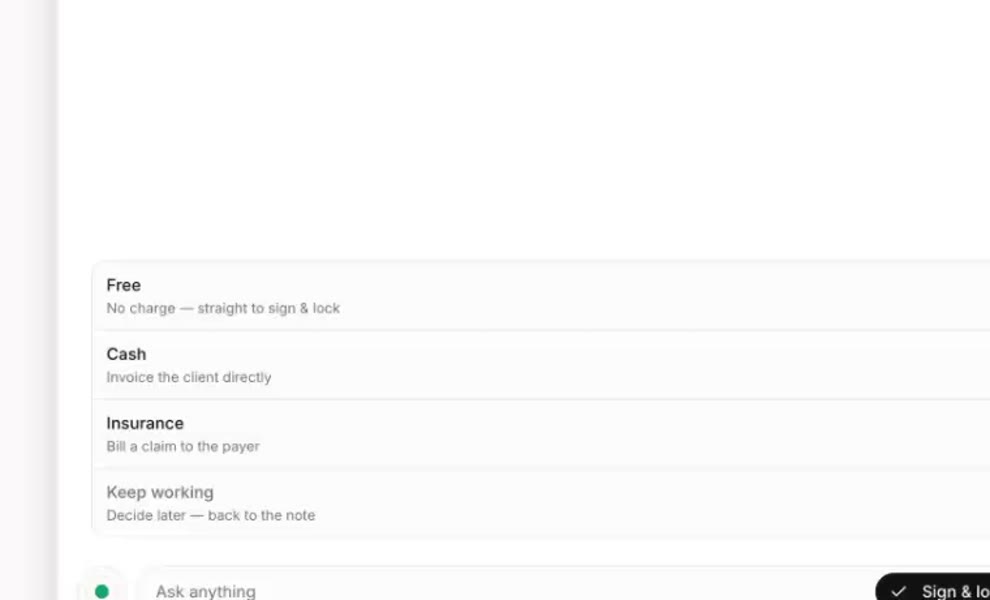
Two lines of this plan, admin hours and denial rate, are where Duo Practice works. It records the session, drafts the note and the claim for you to review and submit, runs eligibility checks through your own Claim.MD account, matches each payment from the ERA, and explains denials.
Frequently asked questions
Does a dietitian private practice need a business plan?
Yes, but not a 30-page one. Unless you're seeking a bank loan, a one-page plan covering niche, offer, channels, revenue math, costs, and 90-day priorities is more useful because you'll actually review and update it monthly.
How much revenue can a solo dietitian practice make?
It depends on your rate, caseload, and retention. As a modeling anchor, 15 to 20 sessions per week at $100 to $160 net per session across 46 working weeks grosses roughly $70k to $150k per year. Your plan should show this math explicitly rather than stating a revenue goal without session-level backing.
Part of Superbills & cash pay. Start with Superbill vs. insurance claims for nutrition practices.