Which nutrition niches reimburse best? Picking a specialty
The best nutrition niches for insurance reimbursement compared for RDs: diabetes, CKD, GLP-1 support, GI, eating disorders and more.
 By Javier Alvarez · 4 min read
"Pick a niche" is the most repeated advice in private practice, and the least specific. For an insurance-based practice, niches are not equal. Two specialties with identical clinical skill can differ two to three times in how reliably payers cover the work, how referrals arrive, and how long clients stay.
If most of your revenue comes from insurance, your niche is a billing decision as much as a clinical one. Choose a niche payers already believe in, and coverage, referrals, and long care plans come with it. Choose one payers treat as elective, and you'll fight for every session or end up cash-pay by default.
Below are the criteria for judging a niche on reimbursement, then an honest niche-by-niche comparison.
What makes a niche reimbursement-friendly
Four criteria decide most of it:
- Covered diagnoses. Do the niche's typical ICD-10 codes map to conditions payers routinely cover for MNT/nutrition counseling? A niche built on E11.9 (type 2 diabetes) bills very differently from one built on general wellness.
- Referral flow. Is there a physician specialty that must send these patients somewhere? Built-in referral sources beat any marketing plan.
- Care-plan length. Chronic conditions justify many visits over months or years, clinically and to payers. Retention is where insurance practices earn.
- Group potential. Some niches support group MNT (CPT 97804, billed in 30-minute units), which raises revenue per clinical hour.
Score any niche against those four and the picture gets clear fast.
The niche-by-niche table
One caveat before the table: commercial coverage varies by payer, plan, and state. Treat this as a map of tendencies, and verify payer policies in your market before betting your practice on any row.
| Niche | Coverage strength | Referral flow | Care-plan length | Notes |
|---|---|---|---|---|
| Diabetes / prediabetes | Strong: Medicare MNT + broad commercial | Excellent (PCPs, endos) | Long, recurring yearly | The benchmark niche |
| CKD / renal | Strong: Medicare covers non-dialysis CKD | Good (nephrology) | Long | Underserved; few RDs compete here |
| GLP-1 / weight management support | Growing, uneven | Strong and rising (PCPs, obesity medicine) | Medium to long | Commercial coverage still evolving |
| Eating disorders | Variable by plan | Good (therapists, physicians) | Longest in outpatient nutrition | May involve prior auth; complex billing |
| GI (IBS, celiac, IBD, fatty liver) | Moderate to good | Good (GI practices) | Medium | Diagnosis coding matters a lot |
| Bariatric (pre/post-op) | Good where programs exist | Built-in (surgical programs) | Medium, protocol-driven | Often tied to hospital programs |
| Oncology | Variable | Moderate (oncology centers) | Medium | Deeply needed, coverage inconsistent outpatient |
| Pediatrics | Variable; Medicaid rules differ by state | Good (pediatricians) | Medium to long | Family involvement; verify state programs |
A few rows need more detail.
Diabetes is strong for a structural reason. Medicare Part B covers MNT for diabetes (and non-dialysis CKD) with a physician referral: 3 hours the first calendar year, 2 hours in later years, and G0270/G0271 can add hours after a condition change. The referral requirement sounds like friction, but it protects you. It forces exactly the physician relationships that keep a practice full. The mechanics are in our Medicare MNT billing guide.
CKD/renal shares Medicare coverage with diabetes but faces far less competition. Nephrologists struggle to find renal-savvy RDs to refer to. If you develop the clinical depth, I think this is the best opportunity-to-competition ratio on the table.
GLP-1 support is the fastest-growing demand in outpatient nutrition. Patients on semaglutide-class medications need help with protein adequacy, GI side effects, muscle preservation, and what happens after the prescription. Commercial coverage for the nutrition visits is evolving and inconsistent (some plans route them through preventive benefits generously, others don't), so verify per client. The coding and coverage details are in our guide to GLP-1 nutrition billing.
Eating disorders offer the longest care plans in the field, and payers increasingly recognize nutrition's role in treatment. But plan-by-plan variation is wide. Visits may route through medical rather than preventive benefits, and prior authorization shows up more often than elsewhere. It's a strong niche for RDs with specialized training who can handle heavier benefits-verification work.
Pediatrics and oncology both carry real clinical demand with the least predictable coverage. They can anchor a practice, but do the payer homework in your state and market first, and expect a mix of cash and insurance.
Matching the niche to your background
The reimbursement table is half the decision. The other half is you and your market.
Start with your clinical history. If you worked a hospital renal floor, CKD is a shortcut, not a stretch. Behavioral health experience points to eating disorders or GLP-1 support.
Then look at the market. A retiree-heavy region strengthens every Medicare-covered niche; a young metro strengthens GI, eating disorders, and GLP-1 work.
Payer mix matters as much. Which payers dominate locally, and what do their policies cover well? A niche that's strong nationally but weak with your two biggest local payers is weak for you. Whether visits route through preventive or medical benefits changes the client's cost, and so your retention, niche by niche.
Finally, be honest about how much billing complexity you want. Diabetes billing is well-trodden. Eating disorder billing rewards diligence.
Test before you commit
You don't have to declare a specialty on day one. A low-risk sequence:
- Verify coverage first. Run benefits checks on 5 to 10 prospective clients in the candidate niche. If most come back covered with low cost-share, the niche works in your market. If most come back "not covered," believe it.
- Pilot with 5 to 10 clients in the niche while keeping a general caseload. Track sessions per client, denial rate, and how referrals felt.
- Send three physician letters in the niche's referral specialty and see what comes back.
- Commit and rebrand only after the numbers agree. Then bring your website, directory listings, and outreach in line with the niche.
Niching down feels like turning clients away. In an insurance practice, it does the opposite. It points one referral stream, and one set of payer benefits, straight at you.
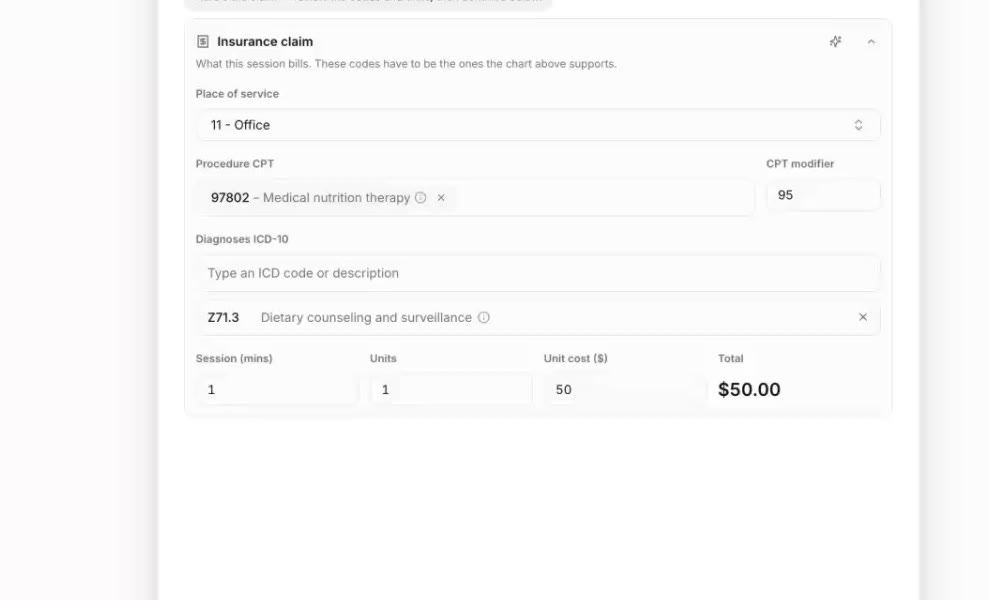
Every niche decision above depends on what plans in your market actually cover. Duo Practice runs eligibility checks through your own Claim.MD account on every prospective client, and after each session it drafts the note and the claim for you to review and submit.
Frequently asked questions
Does insurance cover nutrition counseling for weight loss or GLP-1 support?
Often, but it varies. Many commercial plans cover nutrition counseling under a preventive benefit that applies to obesity-related visits, and demand from patients on GLP-1 medications is growing fast. Coverage for weight management differs a lot by payer and plan, so verify benefits per client rather than assuming.
Should a dietitian pick a niche before or after credentialing with insurance?
Ideally before, because your niche shapes which payers matter most. A Medicare-heavy niche like CKD means enrolling with Medicare early, while a pediatric niche points to the commercial plans and Medicaid programs dominant in your market. You can test a niche with a handful of clients before fully committing.
Part of Coverage & benefits.