Charting for medical necessity: notes that survive review
Medical necessity for MNT charting: what reviewers check, a per-note checklist, and phrases that help or hurt.
 By Javier Alvarez · 5 min read
A paid claim can still be taken back. A records request arrives, a reviewer reads two thin paragraphs, and the payer recoups the money. Medical necessity isn't settled when the claim is adjudicated. It's settled whenever a human finally reads your note, which might be 18 months later.
Most MNT notes denied on review are not clinically wrong. They lack key information: no time documented, no diagnosis linkage, an intervention described in four words. Longer notes won't fix that. Notes with the six elements reviewers check will.
What "medical necessity" means operationally
Forget the legal definition. For MNT, reviewers answer three questions from your note alone:
- Why was this patient here? A diagnosed condition (or a covered preventive indication) that nutrition care addresses.
- Did the service match the problem? The assessment and intervention described must plausibly treat that condition and match the CPT billed.
- Was the amount of service justified? The documented time supports the units; the visit frequency matches a plan.
If your note answers all three without the reviewer needing to guess, it survives. If it makes them infer anything, you're relying on their generosity.
The six elements reviewers look for
| Element | What it looks like | What its absence costs |
|---|---|---|
| Reason for visit / dx | Referral dx or condition named, matching the claim's ICD-10 | "Not medically necessary" denial |
| Assessment tied to dx | Findings connected to the condition (glucose logs, weight trend, intake vs. needs) | Note reads as generic wellness coaching |
| Intervention consistent with CPT | Content matching 97802/97803: MNT, not a chat summary | Down-coding or full recoupment |
| Time | Start/end or total face-to-face minutes | Units unsupported (the most common finding) |
| Plan | Goals, follow-up interval, anticipated course | "Ongoing necessity not established" for later visits |
| Signature + credentials + date | Every note, no exceptions | Note is legally incomplete |
Paid is not permanent
Clearinghouse acceptance and even payment don't mean your documentation passed review. Most claims pay without anyone reading a note. Payers run post-payment audits because it's cheaper to recoup than to review up front. When an insurance audit pulls 20 charts and 12 have no documented time, the payer doesn't just deny those 12. It may extrapolate the error rate across your claim history.
Thin notes create compounding liability. Every under-documented visit you bill adds to a pool of revenue you only provisionally own.
The necessity checklist (run it before you sign)
- Diagnosis or reason for visit stated, matching the claim's ICD-10
- Referral source noted (required for Medicare; wise everywhere)
- Assessment findings explicitly connected to that diagnosis
- Intervention described specifically: what you taught, adjusted, counseled
- Start/end time or total minutes, supporting the billed units
- Measurable goals and a follow-up plan
- Progress vs. prior goals (follow-ups), showing necessity of this visit
- Signed, credentialed, dated
Eight items. If your template surfaces all eight, necessity documentation stops being a skill and becomes a habit.
Phrases that help vs. phrases that hurt
Helps a reviewer say yes:
- "Seen for MNT for type 2 diabetes per referral from Dr. [name]; A1c 8.1% on [date]."
- "Reviewed 14-day glucose log; post-dinner readings 180 to 240 mg/dL correlate with recall showing ~90 g carb at evening meal."
- "Instructed on carbohydrate distribution using plate method; patient teach-back accurate."
- "Total face-to-face time 53 minutes (3:00 to 3:53pm)."
- "Weight down 4 lb since initial visit; goal 1 met, goal 2 partial. Continue MNT; follow-up 3 weeks."
Invites a denial:
- "Discussed diet." (What, why, tied to what condition?)
- "Patient doing well." (Then why is continued care necessary?)
- "Provided nutrition education." (Consistent with which CPT? For what problem?)
- "Follow-up as needed." (No plan means no established ongoing necessity.)
- Any note with no time, on a time-based code.
The helpful phrases contain numbers, dates, and causal links. The hurtful ones are summaries that could describe any patient on any day.
Keep the note and the claim telling the same story
Reviewers read your note next to your claim, and they check three things.
Diagnosis: every ICD-10 on the claim appears in the note as something you assessed or addressed. Don't carry codes onto claims "because they're in the chart" if the visit didn't touch them.
CPT: an initial-assessment code needs an initial-assessment note. Billing 97802 vs. 97803 correctly is a documentation question as much as a coding one.
Units: the minutes in the note must support the units on the claim under the 8-minute-rule logic. Four units with no documented time is the single easiest recoupment a reviewer will ever make.
Necessity across a series of visits
MNT is a course of care, and reviewers evaluate the series, not one well-documented visit. Visit six needs its own justification: what changed, what's still unresolved, why continued care is reasonable.
State the anticipated course at the initial visit. "Anticipate 6 visits over 4 months" turns every follow-up into part of a stated plan rather than an open-ended subscription.
Show movement every visit: goals met, partially met, or revised; weights, logs, or labs trending. A follow-up note that could have been written before the visit happened is a necessity problem.
When progress stalls, document the pivot. If nothing has changed in three visits, the note you need is the one explaining what you're changing about the approach, not a fourth identical entry. Reviewers deny continued care that shows neither progress nor adaptation.
Diagnosis-specific limits matter here too. Medicare's MNT hours, commercial visit caps, and plan-year resets all mean the number of visits you document toward one condition is itself reviewable. Your plan-of-care language should match the benefit reality you verified up front.
Where session-grounded AI notes change the math
The elements that fail review (time, specifics, patient-reported details) fail because they depend on memory. A note reconstructed at 9pm estimates the time, generalizes the intervention, and loses the numbers that make evidence measurable.
A note drafted from the session recording works the other way: the elapsed time is real, the intervention description comes from what you said, and the patient's reported data is captured verbatim. You review and sign instead of reconstructing, and the note is more defensible because it's grounded in the session rather than in recall.
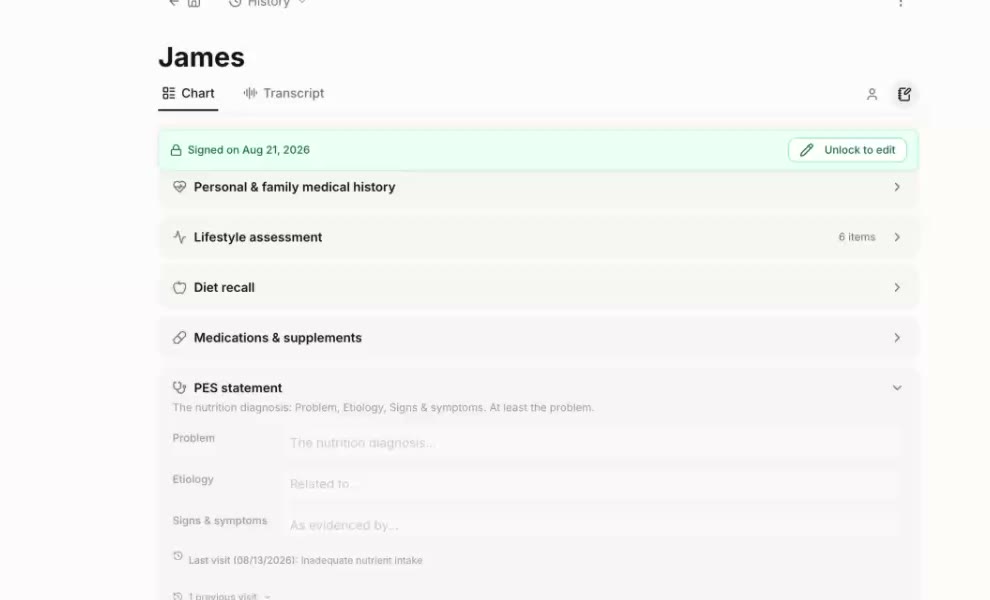
Duo Practice drafts each note from the recorded session (with consent), with the real face-to-face time, the intervention you delivered and the data the patient reported. It drafts the claim from the same session (CPT, units from the session time, ICD-10, modifiers), so the note and the claim tell the same story. You review and submit.
Frequently asked questions
What does medical necessity mean for nutrition counseling?
Operationally, it means your documentation shows the service was reasonable and required to treat or manage a diagnosed condition. For MNT, the note must connect a covered diagnosis to a nutrition problem, an intervention appropriate to that problem, and a plan. Showing that a session happened is not enough.
Can a payer take back money for claims they already paid?
Yes. Post-payment review is standard: a payer can request records months or years later and recoup payment on any visit whose note does not support the billed service. A paid claim is only provisionally paid until the documentation behind it has survived review.
Part of MNT documentation. Start with How to write an MNT note that gets paid.