Should you pay a credentialing service? $300 per contract
Credentialing service vs. DIY for dietitians: what $300 to $350 per contract buys, honest DIY time estimates, how to decide, and contract red flags.
 By Javier Alvarez · 5 min read
Around your third payer application, you'll wonder: someone will do this for about $300 a contract, so should I just pay them? It's a fair question. Credentialing is the least clinical, most bureaucratic task in starting an insurance-based practice, and your time is worth real money.
The $300 question usually gets answered badly, in both directions. Some RDs pay for a service and assume they've bought speed and good rates. They haven't. Others grind through DIY to save money and lose a committee cycle (a month of revenue) to a missed document request. The right answer depends on what credentialing services do, what they can't do, and what your hours are worth.
What a credentialing service actually does
For roughly $300 to $350 per payer contract, a typical service will:
- Set up or clean up your CAQH ProView profile and keep it attested during the engagement
- Complete and submit payer applications with your documents
- Answer payer requests for additional documentation
- Follow up with payers on a regular schedule and report status to you
- Track the contract through to countersignature and effective date
That's paperwork plus follow-up, and it matters. The biggest self-inflicted credentialing delays are incomplete applications and stalls nobody followed up on, and a competent service prevents both.
What a credentialing service cannot do
The marketing won't mention this part.
They can't make payers faster. Primary-source verification and monthly credentialing committee meetings set the timeline. The 60 to 120 day payer-side timeline is theirs to control, and no vendor can rush it.
They usually don't negotiate your rates. Most services deliver a contract, not a good contract. Reviewing the fee schedule for 97802/97803 and pushing back is your job.
They don't know your market. Which payers dominate among your target clients, which plans reimburse MNT well in your area, whether a panel is worth joining: those are business decisions a form-filler can't make for you.
They can't fix a closed panel. If a payer isn't accepting new dietitians, the service gets the same rejection you would, and often keeps the fee.
So you're buying administrative reliability, not speed, rates, or strategy.
The DIY math
What does doing it yourself cost? A realistic estimate for a solo RD:
| Task | Time (one-time or per payer) |
|---|---|
| NPI (Type 1 ± Type 2) | ~30 min, one time |
| CAQH ProView profile setup | 2 to 3 hours, one time |
| Application per payer | 1 to 2 hours each |
| Biweekly follow-ups per payer | 10 to 15 min each, over 2 to 4 months |
| Document requests / fixes | 30 to 60 min total, per payer |
Plan for 3 to 6 hours of setup plus ongoing follow-ups. That's roughly 5 to 8 total hours for your first payer. Each additional payer takes less time, since your CAQH and document folder are already set up.
Now the comparison: four payers cost about $1,200 to $1,400 with a service, or roughly 15 to 25 hours DIY. If your billable hour is worth $100 or more and your schedule is already full, the service can make sense. If you're pre-launch with open afternoons and limited revenue (the most common case), DIY usually wins. The hours also teach you how payer bureaucracy works, which helps every time you fight a denial later.
How to decide
Four questions answer it.
- How many contracts? One or two payers: DIY almost always. Six or more contracts, multiple states, or a group practice with several providers: the burden grows fast, and a service can justify its cost.
- What's your hour worth right now? Not your target rate; your actual opportunity cost this quarter. A full caseload at $120/hour changes the math compared with a launch phase with open afternoons.
- How do you handle forms and follow-up? Be honest. If bureaucratic tasks pile up in your inbox, the real cost of DIY is a month of delays from unanswered document requests. Paying someone to be your follow-up system is legitimate.
- Will you have to learn it anyway? Re-credentialing, CAQH re-attestation, adding payers, updating your practice address: credentialing recurs. Doing the first round yourself makes every later round easy.
The middle path: DIY with a system
Most solo RDs do best in the middle: do it yourself, but don't improvise. The process is 90% checklist.
Follow a written sequence. Our step-by-step credentialing guide walks you from NPI to effective date. The free credentialing checklist for dietitians puts it on two printable pages and shows where each payer takes applications.
Build your document folder once: license, malpractice certificate, W-9, resume with no gaps, diploma. Then reuse it for every payer. Complete CAQH ProView fully before your first application. It's one of the highest-value steps in the whole process. Then add biweekly follow-ups to your calendar, one per payer, and keep a log of names and dates.
That system covers most of what a service sells, at the cost of discipline rather than dollars.
Red flags in credentialing service contracts
If you do hire, read the agreement for these:
- Vague deliverables. "Credentialing assistance" isn't a deliverable. You want per-payer scope: application submitted, follow-ups performed, contract delivered.
- Fees due regardless of outcome, with no closed-panel policy. Ask what happens to the fee if a panel is closed or the application is rejected.
- Auto-renewing monthly retainers that quietly outlive the actual work.
- Ownership of your data. The service should hand over every application, confirmation number, and contact log at the end. If they treat payer correspondence as their records, walk away.
- Guarantees of speed or approval. No one can promise a payer's timeline or decision. A vendor who does is telling you how they market, not how they work.
- Rate promises without negotiation scope. If they claim they'll "get you great rates," ask what negotiation they actually perform. Usually the honest answer is none.
Either way, own your CAQH login
This applies to both paths. Your CAQH ProView profile is your permanent professional record. Every payer you credential with pulls from it, and you must re-attest every 120 days, forever. If a service creates the account under their email or keeps the password after the engagement ends, you lose access to your credentialing identity. Future applications stall, attestations lapse silently, and you depend on a vendor you already left.
Create the account yourself, under your email. Grant the service access if needed, and change the password when the engagement ends. You can authorize a service to work in the profile, but the account stays yours.
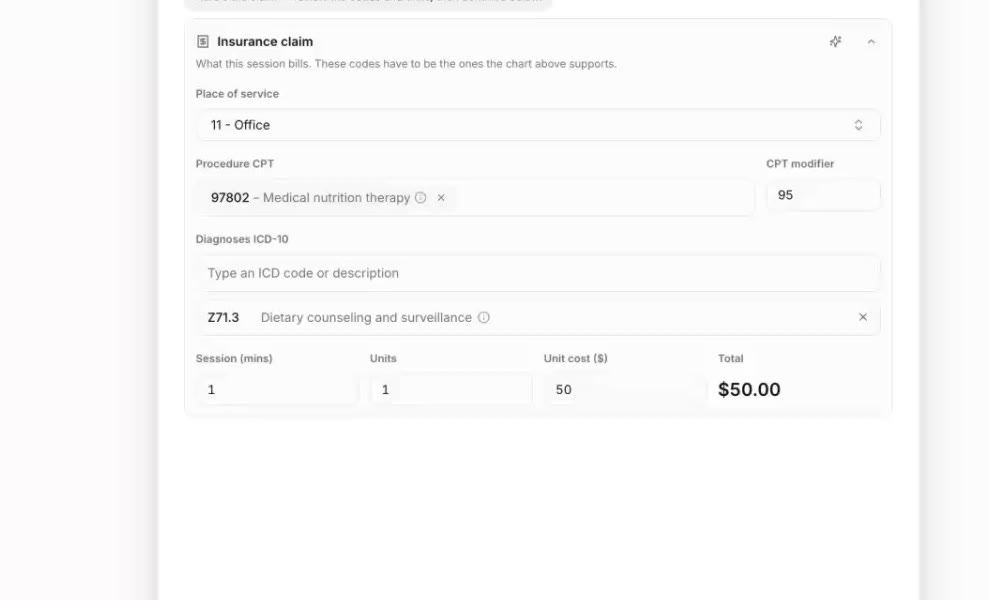
Credentialing happens once; billing happens after every visit. Duo Practice records the session, drafts the note and the claim for you to review and submit, matches the payment, and fixes and resends denied claims, so staying paid doesn't cost you your evenings.
Frequently asked questions
How much does a credentialing service cost for a dietitian?
Commonly around $300 to $350 per payer contract, so credentialing with four payers typically runs $1,200 to $1,400. Some services charge monthly retainers or add fees for CAQH setup and re-credentialing, so read the fee structure carefully before signing.
Does a credentialing service make credentialing faster?
Not fundamentally. Services can prevent self-inflicted delays (incomplete applications, missed document requests, no follow-up), but they can't speed up primary-source verification or make a payer's credentialing committee meet sooner. The 60 to 120 day payer-side timeline applies either way.
Part of Credentialing & enrollment. Start with Insurance credentialing for dietitians: step by step (2026).