Dietitian liability insurance: from $229/yr
Dietitian liability insurance: the $1M/$3M limits payers ask for, one published price from $229 a year, where RDs buy it and what it covers.
 By Javier Alvarez · 6 min read
Dietitian liability insurance means professional liability, also called malpractice or errors and omissions insurance, and payers ask for it before they credential you. The usual limits are $1 million per claim and $3 million a year ($1M/$3M). For a solo RD it is inexpensive: one seller publishes a dietitian package from $229 a year (checked October 17, 2026). General liability (a client slips in your office) and cyber liability (a breach of your charts) are separate policies.
| Question | Short answer |
|---|---|
| Which policy do payers check? | Professional liability, on a certificate of insurance you upload to CAQH |
| Limits payers usually ask for | $1M per claim / $3M aggregate |
| What it costs a solo RD | From $229 a year for one published package; HPSO and CM&F quote online |
| Covered by your employer? | Often only for that job's duties. Private clients on the side need your own policy |
| Telehealth across state lines | Covered where you are licensed to practice; confirm in writing |
| When to buy | Before you start credentialing: the application asks for the certificate |
You can't get in network without it. A missing certificate sends your application back, and the credentialing process already takes 60 to 120 days.
Where dietitians buy liability insurance
These carriers and brokers sell policies to dietitians. What each one publishes, checked on its own site on October 17, 2026:
| Seller | What it says about dietitian coverage | Price |
|---|---|---|
| HPSO | Lists dietitians and dietetic technicians. Individual policies up to $1M per claim / $3M a year, with up to $25,000 of license protection | Online quote |
| CM&F Group | Occurrence coverage (no tail to buy later), up to $1M per claim, defense costs paid outside the limits, license defense up to $35,000 per claim, telehealth included | Online quote |
| Insurance Canopy | Professional plus general liability in one package, $1M per occurrence. Not designed for RDs employed by hospitals, clinics, schools or nursing homes | From $229 a year ($21.08 a month) |
We don't sell insurance and get nothing from these links. Prices depend on your state, limits, revenue and claims history. Treat the table as a starting point and compare at least two quotes at the same limits.
This is what payers ask for, not insurance advice. Coverage varies by state, practice model and carrier, so confirm the details with a licensed insurance professional before you buy.
The three types of liability insurance
| Type | What it covers | Who needs it |
|---|---|---|
| Professional liability (malpractice, errors and omissions) | Claims that your professional advice or services caused harm: alleged negligence, errors in counseling, failure to refer | Every practicing RD; required by most payers for credentialing |
| General liability | Bodily injury and property damage unrelated to your advice, such as a client slipping in your office or damage to a rented suite | RDs with a physical office; often required by landlords, rarely by payers |
| Cyber liability | Data breaches and cyber incidents: breach notification costs, forensics, regulatory fines and defense | RDs storing PHI electronically (today, nearly everyone) |
When people say "malpractice insurance," they mean professional liability. That's what payers check. General liability matters mostly if clients come to a physical office. Cyber is newer and often overlooked.
Why credentialing forces the issue
Every payer credentialing application asks for a certificate of insurance, sometimes called a face sheet. It shows your carrier, policy number, limits and effective dates. You'll upload it to CAQH ProView and often to individual payer applications too. An expired or missing certificate is one of the most common reasons applications get kicked back, and every kickback restarts the review timeline.
Buy coverage before you apply, not after: you can't complete most applications without an active policy. Set a renewal reminder 30 days before the policy expires, because CAQH will ask you to re-attest with a current certificate. A lapsed certificate can suspend your profile. Keep the PDF where you can find it. You'll upload it for credentialing, re-credentialing, group contracts, and some EHR and clearinghouse enrollments.
The limits payers typically expect
You'll see this figure over and over: $1 million per occurrence and $3 million aggregate, written as $1M/$3M. Per occurrence is the most the policy pays for a single claim. Aggregate is the most it pays across all claims in one policy year.
Not every payer asks for exactly these limits. Some states or hospital contracts ask for more. Check the credentialing requirements of each payer before you buy. If you're unsure, $1M/$3M meets most commercial payers' requirements.
What professional liability covers for RDs
Policies written for dietitians typically pay for your defense (attorney fees and court costs, often the largest real expense even with a claim that has no merit) and damages from professional negligence claims, up to your limits. Many also include some coverage for defending your license before a state board, which is probably the most likely proceeding a solo RD will face. Some include limited coverage for HIPAA proceedings, though that doesn't replace cyber coverage.
What they generally don't cover: intentional wrongdoing, practicing outside your legal scope, fee disputes and refund demands, and most data breach costs. Read the exclusions, because they differ between carriers.
What it costs
Nutrition counseling is low-risk from an underwriting view, so professional liability for RDs is comparatively affordable. Solo private practice policies typically run in the low hundreds of dollars per year at $1M/$3M limits. Your price depends on state, revenue, services offered and claims history. Adding general liability (a "business owner's" bundle) and cyber raises the total, but the combined cost usually stays well under what most clinicians expect.
Get quotes from at least two carriers that actively write RD policies; prices vary widely. Check whether the policy is claims-made or occurrence. Claims-made covers claims filed while the policy is active, so you may need "tail" coverage if you switch carriers or retire. Occurrence covers incidents that happened while the policy was active, whenever the claim is filed. It costs more and avoids that problem later.
Telehealth and multi-state practice
Telehealth adds two questions. First, are telehealth services covered at all? Most current RD policies cover them, but get it in writing. Second, are you covered in every state where your clients are? Coverage typically follows legal practice, so your state licensure comes first. If you're not permitted to practice in a client's state, no policy covers you there. Some carriers ask you to list practice states; keep that list current as your telehealth panel grows.
Some carriers ask you to list practice states. Keep that list current as your telehealth panel grows. If you see a meaningful share of clients by video, tell your carrier. An accurate application is what keeps the policy enforceable when you need it.
When to add cyber liability
A solo RD's practice holds PHI: intake forms, charts, insurance details, session recordings. A stolen laptop, a phished email account or a compromised cloud tool can trigger breach notification obligations, forensic costs and regulatory exposure. Professional liability policies generally don't pay for any of it.
Cyber policies typically cover breach notification and credit monitoring for affected clients, forensic investigation, regulatory defense, and sometimes ransomware response. If you hold PHI, price a cyber policy alongside your malpractice policy. It works with the security basics in the HIPAA checklist for solo dietitians (BAAs with every vendor that touches PHI, encryption, access controls), not instead of them.
What to buy, in order
If you bill insurance or see clients at all, buy professional liability at $1M/$3M before you start credentialing. Add general liability if clients come to a physical office (your lease may require it anyway). Price cyber liability if you store PHI electronically, which for most practices means yes. If you see clients by telehealth across state lines, confirm licensure first and then confirm in writing that your carrier covers those states.
Set two recurring reminders: the policy renewal, and uploading the new certificate to CAQH and to any payer that asks for it. The full launch order is in how to start a dietitian private practice.
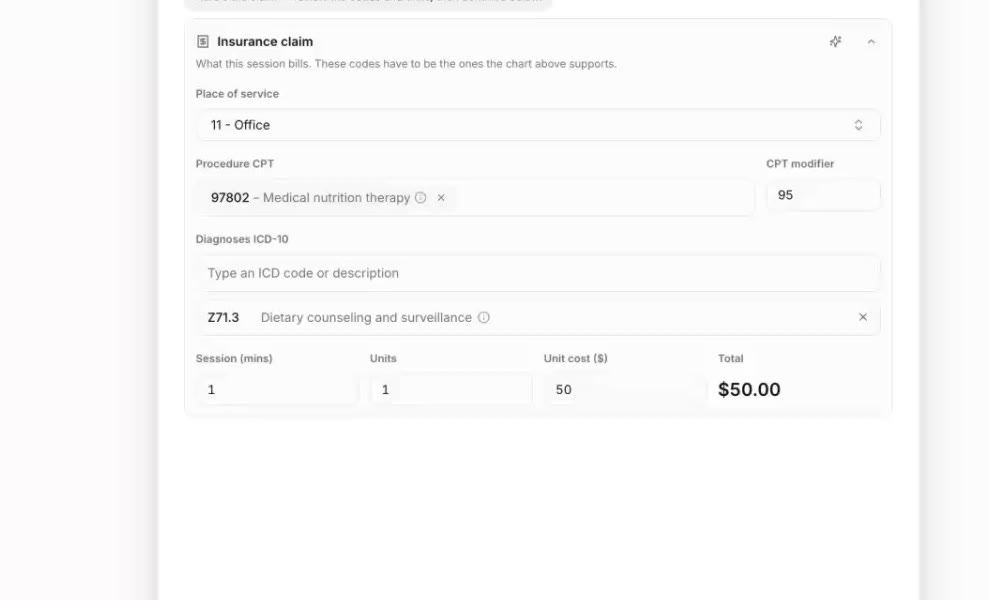
Once you're in network, the codes come next: CPT 97802 for the initial visit, and Z71.3, the dietary counseling diagnosis code. If you'd rather not file the claims yourself, here is what a dietitian billing service does and what it costs.
Once you're in network, Duo Practice drafts the note and the claim from each recorded visit, and you review it and press Submit. Try Duo Practice free
Sources
- HPSO: professions covered, dietitian listed (checked October 17, 2026)
- HPSO: everything you need to know about your coverage, limits and license protection (checked October 17, 2026)
- CM&F Group: dietitian liability insurance (checked October 17, 2026)
- Insurance Canopy: dietitian insurance package and price (checked October 17, 2026)
- CAQH ProView: provider data profile used in credentialing
Sources checked . Payer rules change; verify the member's benefits.
Frequently asked questions
Do dietitians need liability insurance?
Yes, if you bill insurance. Most payers ask for proof of professional liability (malpractice) coverage during credentialing, and many contracts require you to keep it active. In a cash-pay practice, liability insurance still protects you against claims of professional negligence and covers your defense before a licensing board.
How much does liability insurance cost for a dietitian?
Less than most RDs expect. Insurance Canopy publishes a dietitian package (professional plus general liability, $1M per occurrence) from $229 a year, checked October 17, 2026. HPSO and CM&F Group quote online based on your state, limits and practice details. Employed RDs and higher limits cost more, so get at least two quotes.
Does malpractice insurance cover telehealth sessions in other states?
Often, but not automatically. CM&F says its policies cover telehealth within your legal scope of practice. Coverage generally follows where you are allowed to practice, so licensure and state telehealth rules come first. Some carriers ask you to list the states where you see clients. Get written confirmation of multi-state telehealth coverage before you rely on it.
Part of Credentialing & enrollment. Start with Insurance credentialing for dietitians: step by step (2026).