Insurance credentialing for dietitians: step by step (2026)
Insurance credentialing for dietitians, step by step: prerequisites, CAQH, choosing payers, the 60 to 120 day timeline, fee schedules, and common stalls.
 By Javier Alvarez · 7 min read
Credentialing is the tollbooth between you and insurance revenue. Every in-network payment you'll ever collect starts here, and the process is slow, bureaucratic, and unforgiving of small mistakes. A single stale attestation or unexplained resume gap can silently add two months to a timeline that was already running 60 to 120 days.
Credentialing is a checklist, not a skill. Payers aren't judging your clinical philosophy; they're verifying documents and matching data across systems. RDs who treat it as a paperwork project (complete, consistent, tracked) get through in the normal window. This guide covers the whole pipeline, from prerequisites to re-credentialing.
Step 1: Prerequisites to have before you apply
Nothing moves until these exist. If you're opening a practice from scratch, see the phase-by-phase private practice roadmap first.
| What | Notes |
|---|---|
| RD/RDN credential | Current with CDR. |
| State license or certification | If your state requires one for dietetics practice. Most do, and payers verify it. |
| Professional liability insurance | Payers commonly expect limits around $1 million per occurrence / $3 million aggregate. You'll upload the certificate ("face sheet") repeatedly, so keep a current PDF handy. If you're still shopping, see our guide to malpractice insurance for dietitians. |
| NPI Type 1 | Your individual National Provider Identifier, free at NPPES, usually issued within days. If you've formed an entity (LLC, PLLC) and want to bill under it, you'll also want a Type 2 (organization) NPI. Our guide to NPI Type 1 vs. Type 2 for dietitians covers when the entity route pays off. |
| W-9 | Matching exactly how you'll bill (your SSN as an individual, or the entity's EIN). |
| Practice basics | Service address (not a P.O. box), phone, an email you actually check, and a bank account for eventual EFT payments. |
Step 2: Build your CAQH ProView profile
CAQH ProView is the shared database nearly every commercial payer pulls credentials from. You fill it once; every payer application references it. It is also the most common place credentialing quietly dies: expired attestations and work-history gaps stall more applications than anything payers do.
(CAQH renamed itself DataSpring in June 2026, and ProView is now the Provider Data Portal; same login, same profile, same rules.) The short version: create the profile, upload license/liability/W-9, enter a gap-free work history, authorize payers to access it, and re-attest roughly every 120 days forever. The long version, including every classic error, is in our dedicated guide to CAQH ProView for dietitians. Do this step carefully. A clean CAQH profile is 80% of a smooth credentialing run.
For all of this on two printable pages (the document list, the order to file in, where each payer takes applications and the published timelines), download the free credentialing checklist for dietitians.
Step 3: Choose payers strategically
Don't apply everywhere. Each contract is an ongoing obligation (its own rules, its own fee schedule, its own re-credentialing cycle), so start with 2 to 4 payers chosen on evidence.
Ask your actual audience. Your waitlist, Instagram followers, referring physicians' front desks: "which insurance do you carry?" Five answers beat any market report. Then look at the dominant local employers; their plan carriers are your patients' carriers.
Consider Medicare separately. Medicare MNT covers diabetes and CKD with real volume behind it, but enrollment is its own process; see Medicare enrollment for dietitians.
Weigh rates, not just logos. A payer that dominates your market at a rate you can't live on is not a growth strategy. That's what Step 5 is for.
Step 4: What happens in the application pipeline
Every payer's process runs through the same stages, whether you file it yourself or pay someone to (the trade-off is in should you pay a credentialing service?):
| Stage | What happens | Typical time |
|---|---|---|
| 1. Application submitted | Online portal or a "request to join network" form; payer confirms receipt | Day 0 |
| 2. Primary source verification | Payer (or its CVO) verifies license, education, liability, work history, mostly via CAQH | 2 to 8 weeks |
| 3. Committee review | A credentialing committee approves your file (it often meets monthly; miss a cycle, wait for the next) | 2 to 6 weeks |
| 4. Contracting | You receive the participation agreement and fee schedule; you review, negotiate, sign, return | 1 to 4 weeks |
| 5. Countersignature + effective date | Payer executes the contract and loads you into their system with an effective date | 1 to 4 weeks |
Total: typically 60 to 120 days per payer. The stages you control (1 and 4) should take you days, not weeks. The calendar pressure comes from the middle, so don't add your own delays at the ends.
Two rules while you wait. First, follow up every 2 to 3 weeks, in writing where possible, and log every contact (date, name, reference number). Applications do fall into holes, and polite persistence gets them out.
Second, do not see insurance patients before your effective date. Claims for earlier dates of service are generally denied, and backdating is rare. Get the effective date in writing before you book anyone.
Step 5: Request the fee schedule before you sign
The contract packet is dense, but one exhibit matters more than all the rest: the fee schedule: what this payer will actually pay you per unit of 97802, 97803, and (if you'll run groups) 97804. Ask for it explicitly if it's not enclosed. Payers provide it on request during contracting; some are slower about it, but "I can't tell you what we pay until you sign" is not something you should accept.
Do the math against reality: rate per 15-minute unit × typical units per visit × realistic weekly volume. Compare across the payers you're contracting with. The spread can be large, and it should shape which networks you prioritize. Our guide to dietitian reimbursement rates walks through how to evaluate a fee schedule and when a rate is worth pushing back on. New solo providers rarely win big negotiations, but asking for the top of the payer's range costs one email.
While you're reading the contract, also note: timely filing limits, telehealth terms, termination clauses, and the re-credentialing obligation.
Step 6: The common stalls (and the fixes)
Most "slow credentialing" is a stalled application nobody told you about:
- Expired CAQH attestation. The payer pulls your profile, finds it un-attested, and stops. Fix: re-attest on a calendar, every ~110 days.
- Work-history gaps. Any unexplained gap (commonly 6+ months) in your history triggers a request for explanation, or silence. Fix: pre-explain every gap in CAQH, even "parental leave" or "graduate study."
- Mismatched data. Name, address, or Tax ID that differs between your W-9, CAQH, NPI record, and application. Payers match these systems literally. Fix: one canonical version of every fact, everywhere.
- Missing liability documentation. Expired face sheet, or limits below the payer's minimum.
- Committee timing. File complete on the 5th, committee met on the 3rd: you just gained a month. Nothing to fix; know it exists and keep your end instant.
- No response to a payer email. Requests for corrections often go to the email on the application and quietly expire. Fix: check that inbox (and spam) weekly during credentialing.
Step 7: Stay in-network
Credentialing doesn't end at the contract. Re-credentialing comes at least every 3 years per payer (NCQA's credentialing standard is 36 months; UnitedHealthcare, for one, runs a 3-year cycle). It's lighter than the initial round, but ignoring the notice can get you termed from the network, with claims denying until you're reinstated. Put it on your calendar when you sign.
Report changes promptly: new address, new entity or Tax ID, new NPI, added providers. Claims deny when the payer's file and your claims disagree.
And keep CAQH current. The ~120-day attestation cycle continues forever, and re-credentialing pulls from it too.
Individual vs. group contracts
If you're solo with no legal entity, you'll contract as an individual under your Type 1 NPI, and payments report under your SSN. If you've formed an LLC/PLLC, or ever plan to hire another RD, a group contract under a Type 2 NPI changes the structure: the entity holds the contract, clinicians are linked to it, claims carry both a rendering (Type 1) and billing (Type 2) NPI, and payments report under the EIN.
Group contracts are more setup now and far less friction later: adding your first hire to an existing group contract is much faster than credentialing a new practice. Converting from individual to group after the fact means re-contracting with each payer. It's doable, but you walk the slow path twice. The full decision framework is in NPI Type 1 vs. Type 2.
New to the CAQH step? What is CAQH covers the profile, the 120-day attestation and the blockers that stall an application.
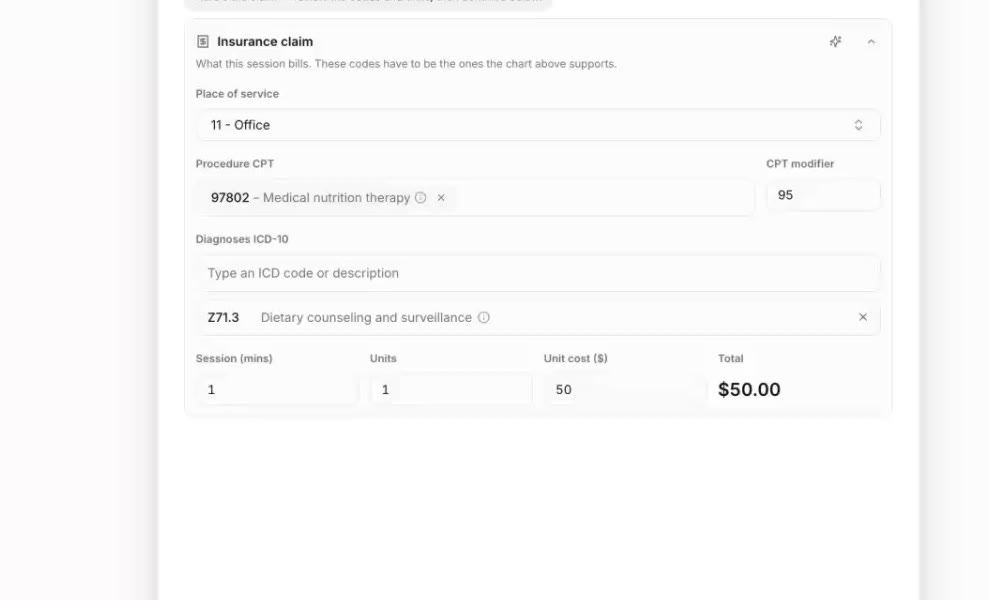
Credentialing gets you in-network; Duo Practice handles the billing after it. Once your effective dates land, Duo checks each patient's eligibility, drafts the note and the claim from the session for you to review and submit, and matches the payments. Try Duo Practice free
Sources
- DataSpring (CAQH): Provider Data Portal FAQs
- NCQA: Credentialing standards
- UnitedHealthcare: Join our network: medical providers
Sources checked . Payer rules change; verify the member's benefits.
Frequently asked questions
How long does insurance credentialing take for a dietitian?
Typically 60 to 120 days per payer from a complete application to a countersigned contract with an effective date. Some payers finish faster, some slower, and any missing document or stale CAQH attestation resets the clock. Apply to several payers in parallel rather than one at a time.
Can I see insurance patients while my credentialing is pending?
Not as in-network. Sessions delivered before your contract's effective date are generally denied or paid at out-of-network rates, and most payers don't backdate. Options in the meantime are cash-pay with a superbill or waiting for the effective date in writing before scheduling insurance patients.
Part of Credentialing & enrollment.