Recording client sessions: consent rules for dietitians
One-party vs. all-party consent states, telehealth wrinkles, HIPAA rules for session recordings, and a consent workflow for dietitians using AI charting.
 By Javier Alvarez · 4 min read
AI charting has changed the math on recording sessions. A tool that listens to your session and drafts the note can hand you back several hours a week; for many RDs it's the biggest time win in AI charting for dietitians. But the moment you hit record, two bodies of law apply at once: state recording statutes and HIPAA.
The compliant version costs you one intake-form clause and one sentence at the start of each session. The risk is in skipping that sentence. Recording statutes carry civil and, in some states, criminal penalties, and "I didn't know my patient was in Florida" is not a defense.
Below: the state rules, the telehealth wrinkle, and a consent workflow you can start using today.
The two consent regimes
US recording law splits by state into two models:
| Regime | Rule | Practical meaning |
|---|---|---|
| One-party consent | Recording is lawful if one participant consents | You, as a participant, can consent for yourself |
| All-party consent | Every participant must consent | Your patient must agree before you record |
The majority of states are one-party. The commonly cited all-party (two-party) states are:
- California
- Florida
- Illinois
- Maryland
- Massachusetts
- Montana
- New Hampshire
- Pennsylvania
- Washington
Two caveats. First, laws change: statutes get amended, courts reinterpret "consent" and "expectation of privacy," and some states have hybrid rules that don't fit cleanly in either column. Treat any list, including this one, as a snapshot to verify, not settled truth. Second, and more decisive for your workflow: telehealth crosses state lines, which makes the state-by-state question mostly moot.
Telehealth: the patient's state matters
When you're in Texas and your patient joins from Miami, which law applies? Possibly both, and you should assume the stricter one governs. Recording statutes are generally written around where the parties are located, and a Florida patient doesn't lose Florida's protection because her dietitian sits in a one-party state.
Your license works the same way. In telehealth, the patient's location at the time of service drives the rules, which is why multi-state caseloads also raise licensure questions across state lines. If you're tracking patient location per session for licensure anyway (you should be), you already have the data point that matters for recording law too.
That leaves one rule that scales:
Get everyone's consent, always, in every state. Universal consent satisfies one-party states, all-party states, hybrid states, and whatever a legislature amends next year. It costs nothing, takes the map out of your workflow, and it's also the ethically right standard for a clinical relationship.
The HIPAA layer on top
State law decides whether you may record. HIPAA governs what happens to the recording afterward, because a recording of an identifiable patient discussing their health is PHI:
- BAA required with every tool that touches the audio: the recording app, the AI scribe processing it, the cloud storage holding it. A scribe without a BAA is off the table regardless of how good its notes are.
- Storage follows the same rules as any clinical record: encrypted, access controlled, not sitting in a personal downloads folder.
- Retention and deletion: decide upfront whether recordings are transient processing artifacts (deleted once the note is finalized, the cleaner default) or part of the record (then your state's retention rules apply). Write the policy down; it belongs in the compliance folder from your solo-practice HIPAA checklist.
- Access requests: if you retain recordings, patients can request copies like any other record.
The practical consent workflow
Three layers, each cheap, that together hold up in an audit:
- Intake form clause. A recording-consent section in your intake paperwork, signed once, explaining what's recorded, why, what tool processes it, and that consent is revocable. This is your durable documentation.
- Verbal confirmation each session. One sentence before you hit record: "Quick reminder, I record our sessions so software can draft my notes. Is that still okay today?" It takes thirty seconds, and it catches the patient who signed the form without reading it, the new household member on camera, and the revoked consent. In all-party states, a "yes" captured at the top of the recording itself is the strongest evidence you can have.
- A line in the chart. Each session note says consent was confirmed verbally and the recording was made (or declined).
Template consent language
A starting point for your intake form. Adapt it to your practice and have your attorney review it; this is not legal advice.
Session Recording Consent

To support accurate clinical documentation, [Practice Name] records
counseling sessions (audio and/or video). Recordings are processed by
HIPAA-compliant software under a business associate agreement to
generate my session notes, are stored securely, and are [deleted once
the note is finalized / retained as part of your clinical record for
X years].

Recordings are never used for marketing or shared outside your care
without separate written authorization.

Consent is voluntary and not a condition of receiving care. You may
decline or withdraw consent at any time, for any session, by telling
me. Your care will not be affected.

[ ] I consent to the recording of my sessions as described above.
Signature: ____________________  Date: __________
When a client says no
Some will, and the answer is to not record. Document the refusal in the chart, chart that session manually or by dictation immediately afterward, and never frame recording as a requirement for care. Conditioning treatment on recording consent is an ethical problem and, in some states, a legal one. A refusal today also isn't permanent; clients who see that you handle the question respectfully often opt in later.
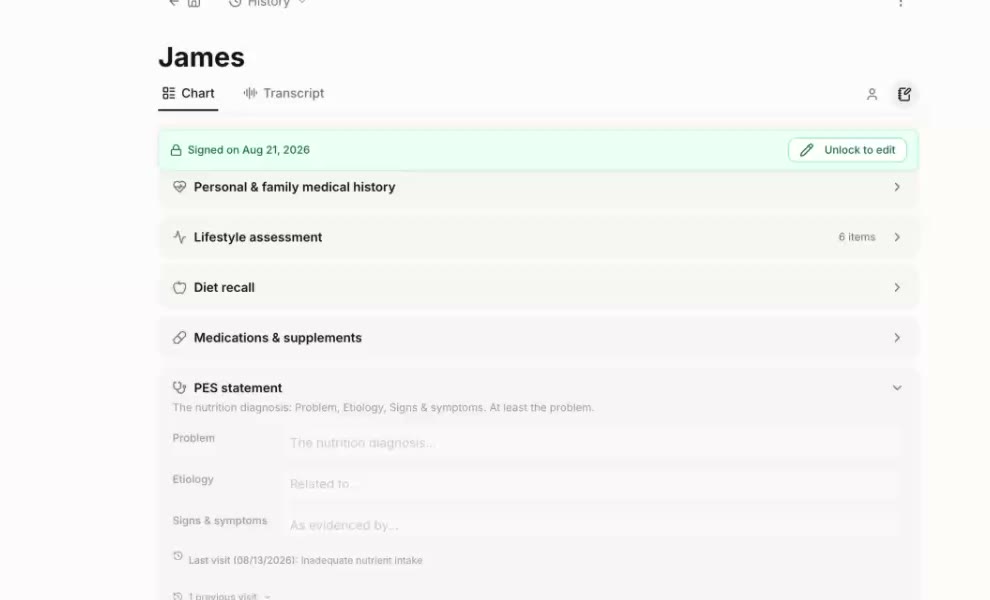
Duo Practice records the session, drafts the note and the claim from it, and leaves both for you to review and sign before anything goes out. Charting, codes, and claims in the same platform. Try Duo Practice free
Frequently asked questions
Which states require all-party consent for recording?
Commonly cited all-party (two-party) consent states include California, Florida, Illinois, Maryland, Massachusetts, Montana, New Hampshire, Pennsylvania, and Washington. Statutes are amended and interpreted by courts over time, so treat any list as a starting point and verify current law, or avoid the question by always obtaining everyone's consent.
What if a client refuses to be recorded?
Proceed without recording and document the refusal. Recording should never be a condition of care. Chart manually or from memory immediately after the session, and note in the record that the client declined recording. Many AI charting tools also work from a typed or dictated summary instead of audio.
Part of Telehealth. Start with Telehealth billing for dietitians: POS 10, 02 & modifier 95.