AI charting for dietitians: from session to paid claim
What AI charting does well for RDs, where standalone scribes and ChatGPT fall short, and why the note should flow straight into codes and claims.
 By Javier Alvarez · 4 min read
Whether RDs should use AI for charting is settled. What's left is how, and that decides whether AI charting saves you two hours a week or quietly creates compliance and billing problems.
Which architecture? What about HIPAA? And the overlooked question: what happens to the note after it's written?
The three ways RDs use AI for notes today
1. Generic chatbots (ChatGPT and friends)
This is where most clinicians start: paste in bullet points, get back a formatted note. As a writing aid it works. As a charting system it fails on three fronts.
HIPAA. Consumer AI accounts don't sign BAAs. Session details pasted into one are PHI leaving your control, and removing the name doesn't reliably fix that.
Memory. It forgets the fixed instructions you gave it last week, so you re-teach your template every session. Worse, in long sessions it can blur details across patients. A note with another patient's details in it is a clinical documentation failure.
Dead end. The output is text in a chat window. You still copy it into your EHR, still code it, still bill it.
2. Standalone AI scribes
Purpose-built tools (Heidi, Twofold, and a growing field) record the session and draft a clinical note from the transcript, with healthcare-grade compliance and BAAs. For documentation alone they're a real upgrade, and for many RDs they're the first AI tool that clearly pays for itself.
Practice platforms now sell their own AI note add-ons too: Practice Better from $10 a month and Healthie at $35 a month for 40 hours (prices compared in Practice Better vs Healthie).
Their limit is architectural: the scribe's job ends at the note. The note lands in the scribe's app, your chart lives in the EHR, and your billing lives in a clearinghouse. You are still the courier between them, and the units, diagnosis codes, and claim still get produced by hand. If insurance is your main source of revenue, the scribe automates the middle of your pipeline and leaves both ends manual.
3. AI-native practice platforms
This is the newest category. Here, the recording, note, codes, and claim are one flow instead of three tools:
- The session is recorded (with documented consent) and transcribed.
- The note drafts itself in your format (SOAP, ADIME, or a custom template), grounded in the transcript, with real elapsed session time.
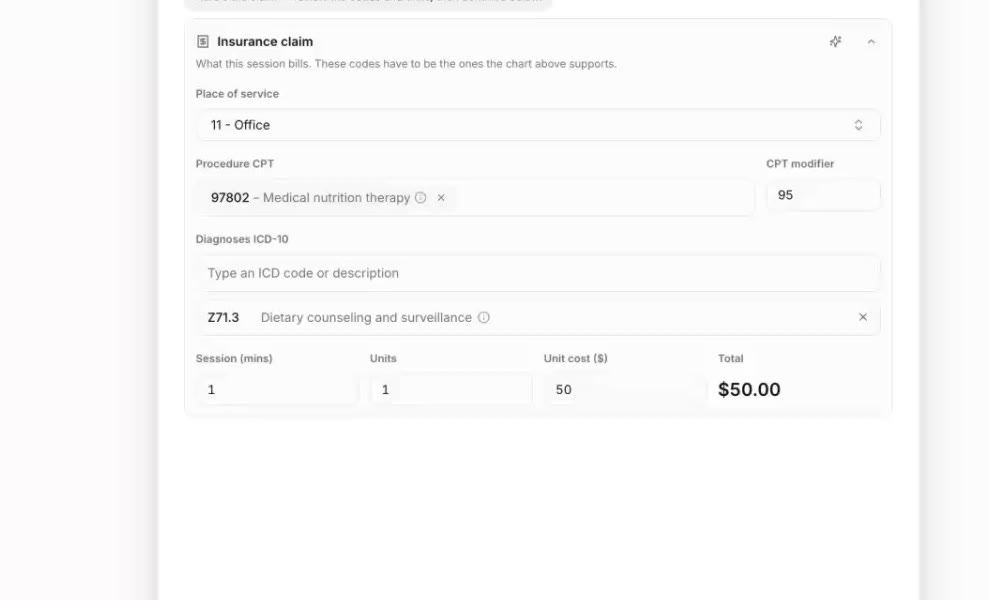
- Billing codes generate from the note: CPT units computed from actual duration (no more guessing whether that was 3 or 4 units), ICD-10 pairings checked against the payer's policy.
- The claim is created, validated, and submitted; its status is tracked; payment posts when the ERA arrives.
What changes is where errors die. In a fragmented stack, every handoff (scribe to EHR to codes to claim) is a place where time disappears and mistakes start. We've written about what those mistakes cost in claim denials: units that don't match documented time, diagnosis pairings that don't match payer policy. When the note and the claim come from the same source, the actual session, that whole class of error goes away.
The compliance checklist (whatever tool you pick)
- ☐ BAA signed. Non-negotiable. No BAA, no PHI, no exceptions.
- ☐ Encryption. Data encrypted in transit and at rest.
- ☐ Consent workflow. Written consent to record, ideally in intake forms, confirmed verbally. Required by law in two-party consent states.
- ☐ No training on your data. Confirm the vendor doesn't use your sessions to train shared models.
- ☐ You review and sign every note. AI drafts; the clinician owns. This is good practice, and it's what makes the note defensible in an audit.
- ☐ Reliability. Ask what happens if the recording drops mid-session. A lost session leaves a gap in the legal record and, if you bill by time, costs you revenue. (This failure is more common with browser-tab recorders than vendors like to admit.)
An honest buying guide
If you run a cash-pay practice, like your EHR, and just hate typing, a standalone scribe is the right, cheap answer. Add it and move on.
For non-clinical writing (emails, handouts, blog posts), generic AI is fine. Never with PHI. Meal plans sit in between: a free AI meal plan generator works from calories and preferences, never names, and gives you a draft to check.
In an insurance-based practice, charting feeds billing. The note is the input to your revenue, and automating it alone captures a fraction of the value. You want session, note, codes, claim and payment as one system.
That third case is what Duo Practice is: AI charting that keeps going after the note. It checks eligibility before the session, drafts the note from the recording, generates validated codes with real session time, submits the claim, and matches the payment. The EHR is free, and billing is 3.9% of what an insurer pays (plus your own Claim.MD plan), typically less than the combined cost of the scribe and EHR it replaces, before counting the hours. Create your free account.
Comparing EHRs on their AI notes? See the best EHR with AI notes for a solo dietitian, with the add-on prices dated.
Frequently asked questions
Is it HIPAA-compliant to use AI for charting?
It can be, if the vendor signs a Business Associate Agreement (BAA), encrypts data in transit and at rest, and doesn't train public models on your patients' data. Consumer tools like standard ChatGPT accounts don't offer a BAA, so pasting session details into them is a HIPAA problem regardless of how you anonymize.
Will AI-generated notes hold up in an insurance audit?
Auditors care about accuracy, not format. AI-drafted notes hold up when they document real session time, a defensible assessment, and the elements that support your codes, and when the clinician reviewed and signed them. Notes generated from an actual session recording are often stronger in audits than notes written from memory, because the time and content come from what happened.
How much time does AI charting actually save?
RDs typically spend 15 to 30 minutes per session on manual notes. AI drafting from a recording cuts that to 2 to 5 minutes of review and sign-off, roughly 8 to 12 hours a month at full caseload. If the tool also generates codes and claims, the total admin saving roughly doubles.
Part of Software & workflow. Start with Best practice management software for dietitians (2026).