Reimbursement course vs. billing software for dietitians
Insurance billing courses for dietitians cost $79-$499/month or $4,000+ upfront. Learn which parts you need to master and which parts software handles.
 By Javier Alvarez · 3 min read
A whole education industry is built on one promise: we'll teach you how to get paid by insurance as a dietitian. Cohort programs run $4,000 to $5,000. Membership academies charge $79 to $499 a month. Add done-for-you credentialing at $300+ per contract, template packs and masterclasses, and a motivated RD can spend a five-figure sum before submitting her first claim.
Some of that education is good. But before you buy, ask a question that didn't exist when these programs were designed: which parts of this do you need to learn, and which parts should a system do for you?
The two kinds of billing knowledge
Everything in insurance billing falls into one of two buckets.
Judgment work covers decisions that depend on your goals, market and risk tolerance:
- Should my practice be insurance-based, cash-pay, or hybrid?
- Which payers are worth credentialing with in my state, for my niche?
- Is this fee schedule acceptable, or should I negotiate?
- Should I hire, and how do I credential a second RD under my group?
Execution work covers repetitive, rule-based tasks with a correct answer:
- Calling payers to verify nutrition benefits before each new client
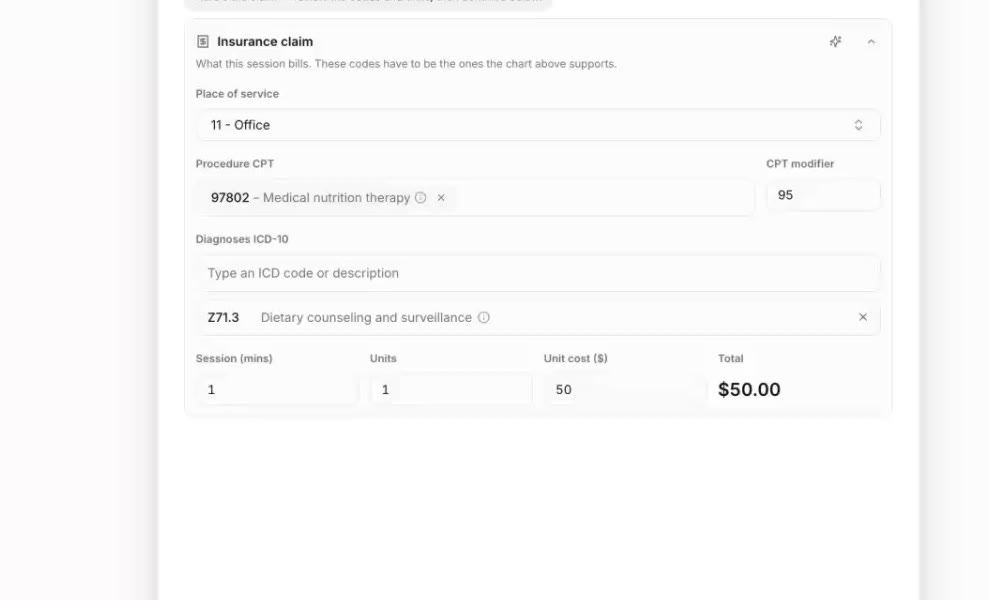
- Choosing 97802 vs. 97803 and counting time-based units
- Pairing diagnosis codes to each payer's policy
- Filling out and submitting CMS-1500 claims
- Checking claim statuses, catching rejections, working denials
- Posting ERAs and reconciling payments
Courses charge you to learn both buckets, but 80% of the curriculum and 95% of your weekly time is bucket two. You pay thousands to learn checklist work: repetitive, rule-based tasks that software now does reliably.
What the math looks like
Take a typical insurance-based solo practice running 50 sessions a month:
| Path | Upfront | Ongoing | Your weekly admin |
|---|---|---|---|
| DIY after a course | $4,000 to $5,000 course | EHR + clearinghouse ~$80 to $150/mo (+ optional academy membership) | 4 to 6 hrs of execution work you now know how to do |
| Outsourced billing service | $0 | Often 4 to 8% of collections (≈$300 to $600/mo at volume) | 1 to 2 hrs coordinating with the biller |
| Automation platform | $0 | Duo Practice: 3.9% of what insurers pay (≈$290/mo at the same volume) + your own Claim.MD plan | Minutes: review and approve |
The course path doesn't remove the execution work. It trains you to do it yourself, forever. Read the fine print: the tuition buys you a second job you're newly qualified for.
Where courses earn their price
Education wins in bucket one, and that matters:
- Strategy and pricing. A mentor who has run an insurance practice for a decade will save you from real mistakes: joining the wrong panels, accepting a bad fee schedule, structuring your entity wrong before credentialing.
- Community and accountability. For some people, the cohort is the product. If you know you won't act alone, that has real value.
- Edge cases. Audits, recoupments, and complex payer disputes call for judgment from experience, not a checklist.
When you're weighing a program, judge it on bucket one. Ask the seller: "If software handled verification calls, coding, claim submission, and payment posting, what portion of your curriculum remains?" The answer tells you what you're actually buying.
The pattern to watch for
One sign that you're being sold execution training as strategy: the recommended "stack" at the end of the course is an EHR + a clearinghouse + an AI scribe + ongoing membership. That's three or four subscriptions with you as the integration layer, doing the copy-paste work the course taught you. (We've written about this three-app problem before.) The course teaches you to operate the fragmented stack that makes the course necessary.
What we'd tell a new RD
- Learn the concepts for free. CPT codes, units, diagnosis pairing, credentialing steps and verification questions are all public. Start with our guides on billing insurance as an RD, CPT codes, and claim denials. You need enough literacy to supervise the process, not the mastery to perform it by hand.
- Spend money on judgment, not execution. If you hire help, hire it for strategy. A consult on payer selection in your state is worth more than forty hours of claim-form training.
- Automate the execution from day one. Don't learn a manual workflow you'll want to leave right away. With a free EHR and billing at 3.9% of what an insurer pays, Duo Practice records the session, drafts the note and the claim, sends it when you press Submit, and matches the payment when it comes back. Creating an account costs less than a course deposit: nothing.
The reimbursement-education economy was built for a time when the only way to get billing done right was to train the dietitian to do it. Learn the strategy, and skip the second job.
Frequently asked questions
Is a reimbursement course worth it for a new private-practice dietitian?
It depends on what you're buying. Courses help with judgment calls: choosing payers, pricing, and practice strategy. They cost too much for execution work (verification calls, claim submission, payment posting), which is repetitive, rule-based, and automatable.
What parts of insurance billing can't be automated?
The strategic decisions: which payers to join, how to negotiate fee schedules, whether to run insurance-based or hybrid, and how to handle edge cases like audits. Those benefit from education or mentorship. The pipeline itself (eligibility checks, coding, claim submission, tracking, ERA posting) is what software automates well.
Can I learn insurance billing for free?
Mostly yes. The mechanics (CPT codes, ICD-10 pairings, credentialing steps, verification questions) are public knowledge. Payer manuals, CMS documentation and guides like ours cover them at no cost. What paid programs add is structure, accountability and community; whether that's worth thousands depends on how you learn.
Part of Software & workflow. Start with Best practice management software for dietitians (2026).