The true cost of a DIY billing stack for dietitians
What the DIY insurance billing stack really costs a private-practice dietitian: subscriptions, error costs, and 15-25 hours a month of your own time.
 By Javier Alvarez · 5 min read
Disclosure: this article is written by the team at Duo Practice, a free EHR with insurance billing built in. We sell an alternative to the stack described below, so read our math skeptically and check it against your own numbers.
Ask an insurance-based RD what her billing setup costs and she'll usually quote the software: roughly $200 a month. That number is real, but it's the smallest cost on the bill. The DIY stack (an EHR here, an AI scribe there, a clearinghouse login, maybe a course that taught you to wire it all together) has one component that never appears on a credit card statement: you, working as the unpaid link between four tools that don't talk to each other.
This article breaks down the whole bill: subscriptions, labor and error losses. It also shows when DIY still wins.
What subscriptions cost
Subscriptions are the most visible cost, though prices vary by vendor and tier. These are commonly seen ranges. Check current pricing before you decide:
| Component | Typical monthly cost | What it does |
|---|---|---|
| EHR / practice management | ~$60 to $150 | Scheduling, charts, client portal |
| AI scribe | ~$50 to $120 | Turns session audio into a clinical note |
| Clearinghouse | $0 to $75 + per-claim fees on some plans | Transmits CMS-1500 claims, returns ERAs |
| Course or membership (amortized) | ~$30 to $200 | A $4,000 course over 24 months, or an academy tier |
| Subscriptions total | ~$150 to $350+/mo |
(Whether the course line is worth it is its own question; we cover it in reimbursement course vs. billing software.)
That's the number most RDs quote, and it matters least.
Your biggest cost: your time
None of those tools finishes the billing pipeline. The scribe stops at the note. The EHR stops at the chart. The clearinghouse starts at a finished claim. Between each pair sits manual work, and you're the one doing it:
- Calling or checking portals for eligibility and benefits before new clients
- Translating the note into CPT/ICD codes and time-based units (97802/97803, unit counting)
- Keying claims into the clearinghouse and fixing rejections
- Tracking statuses, chasing denials, filing corrections
- Posting ERAs, reconciling payments, catching underpayments
- Invoicing copays and following up on client balances
Solo RDs running a real insurance caseload typically report 15 to 25 hours a month on this work. Price it at what the hour is worth to you, not at zero and not at a biller's wage: a clinical hour you could have billed, or personal time you wanted back. If your effective session value is $100 to $150 per hour, the labor line looks like this:
| Hours/month | At $100/hr | At $150/hr |
|---|---|---|
| 15 | $1,500 | $2,250 |
| 20 | $2,000 | $3,000 |
| 25 | $2,500 | $3,750 |
Full TCO, worked example. Say your stack costs $220 per month in subscriptions and you spend 18 hours a month running it, valued at $120 per hour:
| Line | Monthly |
|---|---|
| Subscriptions | $220 |
| Labor: 18 × $120 | $2,160 |
| Total cost of ownership | ~$2,380, of which 91% is invisible |
You can argue the hourly value down, since maybe some of those hours weren't bookable anyway. Cut it in half and the labor line is still 4 to 5× the software line. Under any reasonable assumption, in a DIY stack you are the most expensive component.
How much do billing errors cost?
Manual handoffs leak money in ways that never show as a subscription:
- Denials that die in the queue. A claim denied for a fixable reason, like a diagnosis pairing the payer rejects or a missing modifier, earns $0 unless someone reworks it. When that someone is a tired clinician at 9 p.m., some of them never get reworked.
- Underpayments. If nobody reconciles each ERA line against the contracted fee schedule, payers who pay short keep the difference.
- Timely filing misses. Most payers allow 90 to 180 days from the date of service (limits vary by payer). A claim that sits in a "to submit" pile past that window is usually gone for good, a full session's revenue lost to a deadline.
Even two or three of these a month can exceed the entire software budget.
When DIY still makes sense
The answer isn't always "automate," and we'd be selling, not analyzing, if we said so. DIY math holds up in three cases.
At very low volume, 5 to 10 insurance sessions a month, the labor might be 2 to 3 hours: annoying, but not economically significant. A spreadsheet and a free clearinghouse tier can be the right answer.
If you're cash-heavy and insurance is a minor side channel in a cash-pay practice, superbills may cover it and the whole question shrinks.
Some RDs like the control. They treat billing fluency as a core skill and enjoy the mechanics. That's a legitimate preference, as long as you price the hours honestly.
As a rough break-even, once you're past about 15 insurance sessions a month the labor curve bends upward fast, and every new client adds admin hours the subscriptions never warned you about.
The consolidated alternative
The fix is fewer handoffs, not a fifth tool. A consolidated platform runs verification, charting, coding, claim submission, tracking and payment posting as one pipeline, so the integration labor (the $2,000+ line) mostly disappears instead of moving elsewhere. We've compared the options in our guide to practice management software for dietitians, and if a course is part of your stack, read our take on what courses teach versus what software should do.
So compare the $2,380 total above with a free EHR, 3.9% of what insurers pay, and your own Claim.MD plan. What you'd be replacing is the 18 hours of your time, more than the EHR.
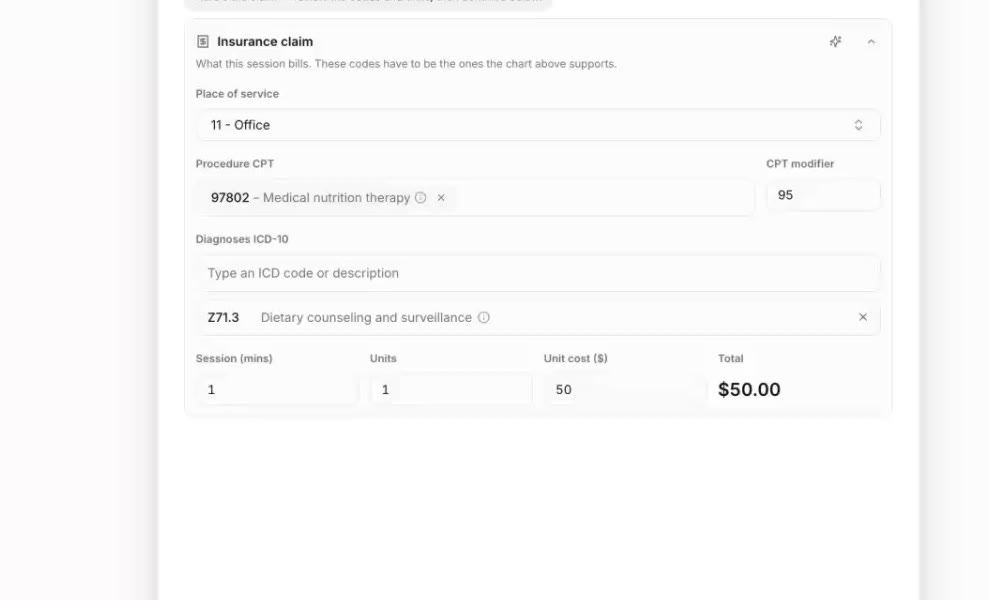
Duo Practice records your sessions, drafts the note and the claim, sends the claim through your own Claim.MD account when you press Submit, checks eligibility there, and matches each ERA payment to its claim. The EHR, recording and AI notes are free, so the EHR and scribe lines leave the budget along with most of the labor.
Billing in Duo Practice is 3.9% of what an insurer pays, plus your own Claim.MD plan; the EHR, recording and AI notes are free. Try Duo Practice free
Frequently asked questions
How much does it cost a dietitian to bill insurance themselves?
The subscriptions alone commonly run $150 to $350 per month: an EHR at roughly $60 to $150, an AI scribe at $50 to $120, clearinghouse fees, and often an amortized course or membership. The larger cost is labor. Solo RDs typically spend 15 to 25 hours a month on verification, coding, claim submission and payment posting, which at a clinical hourly value of $100 to $150 adds $1,500 to $3,750 in opportunity cost.
When does it make sense for a dietitian to keep billing manually?
DIY can be rational at very low insurance volume (a handful of claims a month) or in a mostly cash-pay practice where insurance is a side channel. Below roughly 10 to 15 insurance sessions a month, the labor is small enough that a spreadsheet and patience may be cheaper than changing systems.
Do billing errors really cost that much?
They can. A denied claim that never gets reworked is 100% lost revenue for that session, underpayments slip through when nobody reconciles ERAs against the fee schedule, and claims that miss a payer's timely filing window (commonly 90 to 180 days) are usually unrecoverable. A few of these a month can erase what the stack was supposed to earn.
Part of Software & workflow. Start with Best practice management software for dietitians (2026).