Z71.3 denied? Why payers reject it and what to use
Why Z71.3 triggers claim denials, how preventive vs. medical benefits split it, and how to verify what your payer accepts before you bill.
 By Javier Alvarez · Published · Updated · 8 min read
A nutrition claim can be billed correctly, backed by a solid note, and still come back denied, with the only clue a diagnosis code you've used a hundred times: Z71.3, dietary counseling and surveillance.
This is one of the most common quiet leaks in an insurance-based nutrition practice, and it's badly documented on the open web, mostly by code-lookup pages that repeat the definition you already know. This guide explains the mechanic: why the same service pays under one benefit and denies under another, and what Z71.3 signals to a claims engine.
It won't hand you a table of "Aetna accepts this, Cigna rejects that." Such a table would be wrong somewhere the day it published. Payer policies vary by plan, state, employer group, and plan year. Acting on a stale table costs real money. What you get instead is the method to find the answer for your payer and your patient, which stays current as policies change.
If you only need the code itself (definition, where it sits, what it pairs with), the reference page is Z71.3: dietary counseling code & billing rules. This post is about the denial.
What Z71.3 actually is (and isn't)
Z71.3 lives in ICD-10-CM's Chapter 21: Factors influencing health status and contact with health services. That chapter title explains most of it. Z codes describe a reason for the encounter: a circumstance, a status, a service being sought. They do not describe a disease.
So when Z71.3 arrives on a claim as the primary diagnosis, the payer's adjudication logic reads it as: this patient came in for dietary counseling. Not this patient has a condition requiring medical nutrition therapy. Those are different assertions, and they hit different parts of the benefit plan.
You haven't made a coding error. Z71.3 is an accurate code for what happened. Accuracy and payability are answering different questions.
The preventive door and the medical door
Almost every commercial plan has two ways a nutrition visit can process:
| Preventive benefit | Medical benefit | |
|---|---|---|
| What triggers it | A wellness/screening-type encounter, often keyed to Z71.3 and sometimes a BMI code | A covered medical diagnosis, usually from the referral |
| Patient cost | Frequently $0: no copay, no deductible | Copay, coinsurance, deductible as usual |
| Visit limits | Often generous, sometimes capped per year | Tied to medical necessity, may need prior auth |
| What kills the claim | Member has no preventive nutrition benefit, or the limit is used | Diagnosis isn't on the plan's covered list, or documentation doesn't support necessity |
The same 45-minute session, with the same note, can pay at 100% through one door and deny completely through the other, purely because of which diagnosis sends it where.
That's the trap. Z71.3-primary is the key to the preventive door on plans that have one. On plans that don't, or plans whose policy explicitly requires a medical diagnosis in the first position, that same key opens nothing. The claim doesn't get rerouted helpfully. It denies.
It can go the other way too. Some plans tie preventive processing so tightly to Z71.3 that leading with the medical diagnosis pushes the visit into the medical benefit, where the patient suddenly owes a deductible they were told they wouldn't. Technically paid. Practically, an angry phone call.
The denial codes you'll see
On the ERA, diagnosis-driven denials usually surface as:
- CO-50: "these are non-covered services because this is not deemed a medical necessity by the payer." The classic. Despite the wording, this often means the diagnosis you submitted doesn't establish necessity under our policy, not that a reviewer read your note and disagreed.
- CO-96: non-covered charge, frequently with a remark code pointing to a benefit exclusion.
- CO-11: the diagnosis is inconsistent with the procedure.
- CO-167: this diagnosis is not covered (common when Z71.3 goes to Medicare, which covers MNT only for diabetes and renal disease).
- Plan-specific remark codes about preventive services, routine care, or benefit category.
Codes vary by payer and clearinghouse, and the same underlying reason shows up under different CARCs at different plans. Read the remark line, not just the number. The remark text is where the actual policy reason hides. Our guide to nutrition claim denials maps the broader denial taxonomy if you're triaging a stack of these, and the denial codes reference explains each CARC in MNT terms.
How to find out what YOUR payer accepts
Three sources, in order of reliability.
1. The payer's own medical policy
Nearly every major commercial payer publishes clinical coverage guidelines or medical policies on its provider site. Search the provider portal (not the member site) for "medical nutrition therapy," "nutritional counseling," or the CPT codes 97802, 97803, 97804. The document you want is usually titled something like Clinical Policy Bulletin, Medical Coverage Policy, or Clinical Coverage Guideline.
Once you have it, read for four things:
- The covered indications list. Which conditions the plan considers MNT medically necessary for.
- Explicit diagnosis-code language. Some policies name codes directly, including whether Z codes are acceptable and in which position.
- The benefit category statement. Look for phrasing like "considered preventive" or "covered under the preventive services benefit." That sentence tells you which door the plan expects.
- The effective date and revision history. A policy revised last quarter beats anything you remember from last year.
Save the PDF with the date you pulled it. When you appeal, quoting the payer's own current policy back to them is the strongest argument you have.
2. The benefits verification call
Policy documents tell you the plan type's rules. The call tells you what this member's plan actually does. The benefits verification checklist has these questions alongside others for a first visit. Ask these, verbatim:
- "Is medical nutrition therapy, CPT 97802 and 97803, covered under this member's preventive benefit, the medical benefit, or both?"
- "If preventive: does the claim need a specific diagnosis in the primary position for preventive processing? Does Z71.3 need to be first?"
- "If medical: does the plan exclude Z71.3 as a primary diagnosis? What diagnosis does the policy require in that position?"
- "Are there visit limits, and do they differ between the preventive and medical benefit?"
- "Is prior authorization required, and does that change based on the diagnosis?"
Then read the answer carefully. "Nutrition counseling is covered" is only the start of an answer. You need the benefit category and the diagnosis rule, or you don't have what you called for. Get a reference number and the rep's name, log the date, and keep it. Payer reps make mistakes; a documented reference number is what turns their error into your appeal.
Coverage varies by plan, state, employer group, and year. Verify with the payer for the specific member before you bill, every time, not once per payer.
3. Your own remits
This source rarely gets mentioned, and it's the most honest one you have. Pull six months of paid claims for a given plan and look at which diagnosis configurations actually paid. Your own ERA history is the only payer-specific evidence that isn't someone's recollection. If Z71.3-primary has paid twelve times on a plan this year, that tells you more than any blog post.
Coding strategy, stated honestly
Once you know the rule, the general shapes are simple. Medical-benefit plans typically want the medical diagnosis from the referral in the primary position (the condition actually being treated), with Z71.3 available as a secondary code describing the service. Preventive-benefit plans may require Z71.3 first, sometimes with a BMI code, and sometimes as the only code.
Sequencing is the lever, not invention. Reordering codes you can already support is legitimate. Adding one you can't isn't.
Now the non-negotiable part, because it's where the real risk lives:
The diagnosis on the claim must reflect what the record documents. Never what pays best.
If the referral says E11.9 and your note assesses and treats the diabetes, code it. If the referral says nothing medical and the session was general healthy-eating counseling, Z71.3 is the truthful code. The correct response to a denial is then to determine whether the service was covered at all, not to graft on a condition to make it look covered. Dietitians don't diagnose medical conditions; you code from the referring provider's documented diagnosis and the record. Coding toward payment is how a billing problem becomes a fraud problem.
If the claim is already denied
Don't write it off. A diagnosis-driven denial is one of the more winnable appeals, because the dispute is about policy application rather than clinical judgment. Pull the payer's current policy, confirm what it actually requires, and if you can support a corrected diagnosis order from the existing record, correct and resubmit. If the coding was right and the denial was wrong, appeal it with the policy language attached. Our walkthrough on appealing a denied nutrition claim covers the letter structure and deadlines.
One caution: if you can't support a change from the record as it stands, leave the record alone. Appeal on what you have, or accept the denial and fix the verification step for next time.
The audit connection
Honesty here also protects your revenue. A diagnosis on the claim that the note doesn't support is precisely what auditors look for. When a payer audits, they check whether the ICD-10 on the claim matches the referral and your note's assessment. A claim billed under a medical diagnosis with a note that never addresses that condition is an unsupported claim, and in a post-payment review, that's a recoupment.
So the fix runs in the other direction: make the note carry the diagnosis. If the condition is genuinely being treated, your assessment, intervention, and plan should show it. Our guides to charting for medical necessity and documentation requirements by payer cover what reviewers actually read, and insurance audits for dietitians covers what happens when they ask.
Z71.3 answers a question most payers weren't asking. Find out which question each plan is asking (from the policy, from the call, from your own remits) and the denial pile shrinks on its own.
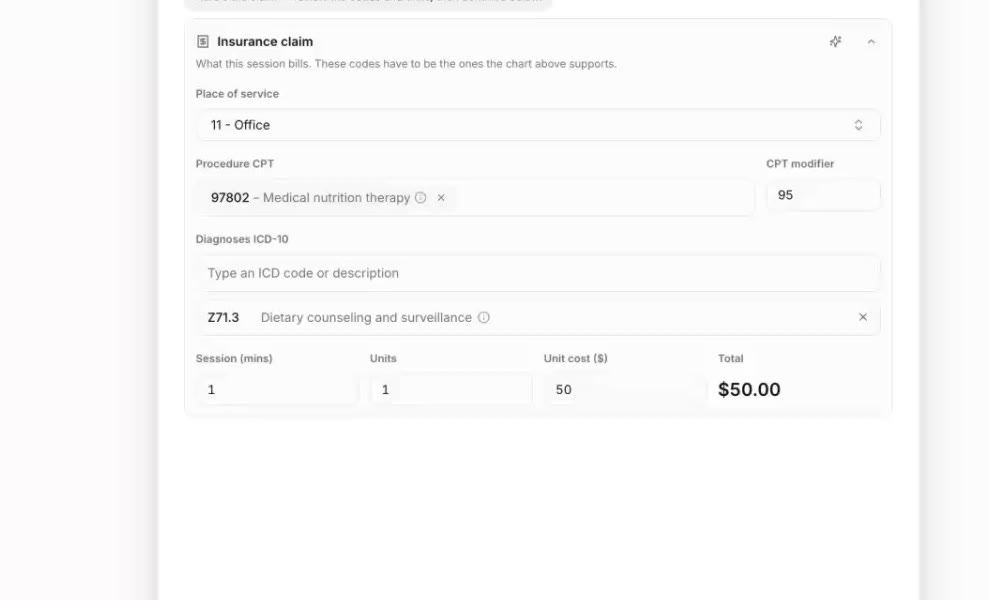
Duo Practice drafts the claim's ICD-10 codes from your session note, so what you bill starts from what you wrote. It can't tell you a given plan's policy; that part stays with your verification. When a claim is denied, Duo explains the denial and fixes and resends it.
Sources
- CMS: ICD-10 code sets and ICD-10-CM Official Guidelines
- NCD 180.1: Medical Nutrition Therapy (Medicare covered conditions)
- HealthCare.gov: Preventive care benefits for adults
- X12: Claim Adjustment Reason Codes
Sources checked . Payer rules change; verify the member's benefits.
Frequently asked questions
Why do my claims with Z71.3 keep getting denied?
Usually because the plan routes that claim to a benefit it doesn't cover. Z71.3 is a Z code (a reason for the encounter, not a disease), so many plans read it as preventive or routine counseling. If the member has no preventive nutrition benefit, or the plan requires a medical diagnosis in the primary position, the claim denies even though the service was legitimate and well documented.
Can Z71.3 be used as a primary diagnosis?
It depends entirely on the plan. Some commercial plans require Z71.3 first to route the visit to a preventive benefit at zero cost-share. Others exclude it as primary and want the medical diagnosis from the referral. There is no universal answer, which is why you verify per payer and per plan rather than building one claim template for everyone.
Does Medicare cover MNT billed with Z71.3?
Not as the qualifying diagnosis. CMS's national coverage determination for medical nutrition therapy (NCD 180.1) limits the benefit to diabetes, non-dialysis renal disease, and the 36 months after a kidney transplant, with a treating physician's referral stating that diagnosis. Z71.3 doesn't establish any of those, so it can't carry a Medicare MNT claim on its own.
Part of ICD-10 codes for MNT. Start with ICD-10 codes for dietitians: Z71.3, Z68, E66 & more.