Payer documentation requirements for dietitians
Payer documentation requirements for dietitians: the baseline every payer checks, Medicare MNT specifics, records requests, and retention rules.
 By Javier Alvarez · 5 min read
Payers don't read your notes when you submit a claim. They pay first and check later. The check arrives as a records request: five charts, sometimes twenty, due in 30 days or so. Your response depends on whether you built your documentation to be checked or to be finished by 9pm.
Payer requirements overlap about 90%. Master one baseline, learn the Medicare specifics and a couple of commercial wrinkles, and a records request becomes a ten-minute export instead of a lost weekend.
What baseline does every payer check?
| Element | Why it's required | Who checks it |
|---|---|---|
| Patient identity + date of service | Ties the note to the claim line | Everyone, first |
| Reason for visit / diagnosis | Establishes medical necessity | Everyone |
| Referral documentation | Proves the care was ordered (where required) | Medicare always; many commercial plans |
| Assessment tied to the dx | Shows the service addressed the condition | Clinical reviewers |
| Intervention matching the CPT | 97802 note must read like an initial assessment | Coding reviewers |
| Time (start/end or total minutes) | Supports units on time-based codes | Everyone; the easiest recoupment there is |
| Plan and follow-up | Establishes ongoing necessity for later visits | Clinical reviewers |
| Signature, credentials, date | Legal completeness | Everyone, last |
If every note in your practice carries these eight elements, you've satisfied the core of every payer's policy. The rest is payer-specific. (For how these elements translate into phrasing, see charting for medical necessity.)
What does Medicare require?
Medicare Part B publishes its MNT rules, which makes it demanding but predictable:
- Referral on file, always. A physician referral must exist before you treat, and it should be renewed as required. No referral, no coverage, however good your clinical notes are.
- Covered diagnosis only. Diabetes, non-dialysis CKD, or post-kidney-transplant within 36 months. Your documentation must reflect one of these, and so must the claim.
- Hours tracking. The benefit is 3 hours the first calendar year, 2 hours each subsequent year. Since the benefit is measured in time, your documented minutes support units and also draw down a bank. Track a running total per patient per calendar year, and document the physician's new referral when a condition change justifies additional hours (G0270/G0271).
The Medicare MNT billing guide covers the claim side; the chart side is: referral, covered dx, minutes, running hours.
How do commercial payers differ?
Commercial plans check the same baseline, but two variations change what your documentation must emphasize.
The first is preventive vs. medical routing. Many commercial plans cover nutrition counseling under a preventive benefit (often tied to codes like Z71.3, though some payers reject it as the primary diagnosis, so check the payer's policy) with different visit limits than the medical benefit. Your documented diagnosis determines which benefit route the claim takes. A note that clearly supports the intended dx (preventive counseling vs. management of a diagnosed condition) decides whether the visit falls under the right benefit. Learn the preventive vs. medical benefits distinction well.
The second is plan-level variation. Two patients with cards from the same insurer can have different documentation-relevant rules (visit limits, referral requirements, telehealth rules) because one plan is self-funded. Your chart should record what verification told you: reference number, quoted benefits, date. Then a later dispute is your documentation against a phone call no one remembers.
How do records requests work?
Requests come in a few kinds, and knowing which one you have sets the stakes. A pre-payment review holds the claim until you submit records, so a slow response means slow (or no) payment. A post-payment audit re-examines paid claims and recoups unsupported ones, sometimes with error-rate extrapolation across your history. That's the expensive one; see insurance audits for dietitians. Routine or credentialing samples are smaller and lower stakes, with the same documentation standard.
Every kind has a deadline, commonly around 30 days. Missing it turns defensible claims into automatic losses. Put the deadline on your calendar the day the request arrives.
When do payers check your documentation?
Payers examine your documentation at predictable moments, and the timeline tells you which habits pay off:
| When | What's checked | Your exposure |
|---|---|---|
| Claim submission | Codes and claim data only, not the note | Rejections/denials, fixable |
| Pre-payment review | Full note for flagged claims | Payment delayed until records land |
| Post-payment audit (months to years later) | Notes, referrals, time, signatures across a sample | Recoupment, possibly extrapolated |
| Credentialing/re-credentialing | Sample charts, policies | Network participation |
| Patient or provider records request | Completeness and timeliness | Compliance, reputation |
The note itself is usually read last, long after the visit. So "I'll clean it up if anyone ever asks" fails: by the time anyone asks, you're reconstructing dozens of visits from memory against a deadline. What works is producing review-ready notes by default. That takes a template and a workflow more than diligence.
How long should you keep patient records?
Retention rules stack: state law sets one floor, payer contracts another, Medicare-related records carry their own expectations. Commonly the answer lands at 6 to 7 years or more, and pediatric records typically must be kept years past the age of majority. Rules vary by state and payer, so verify yours, and when two rules conflict, the longest period wins. Storage is cheap; producing nothing in year five of an audit is not.
How do you make records requests a ten-minute task?
Practices that shrug at records requests and practices that panic differ in retrieval more than in note quality:
- Keep one chart per patient: note, referral, intake, consents, verification record, and claim history retrievable together, not spread across a PDF folder, an inbox, and a billing portal.
- Finish and sign the note the day of service, so it never needs reconstruction under deadline. Late-signed, retro-edited notes are audit red flags in themselves.
- File referrals on receipt, linked to the patient, with renewal dates tracked.
- Make sure you can export a date-range chart in minutes. If you can't today, fix that this month, not during a request.
Run the drill once: pick a patient, pretend a payer wants all records for last year, and time yourself. If it takes over ten minutes, the risk is your system, not your charting.
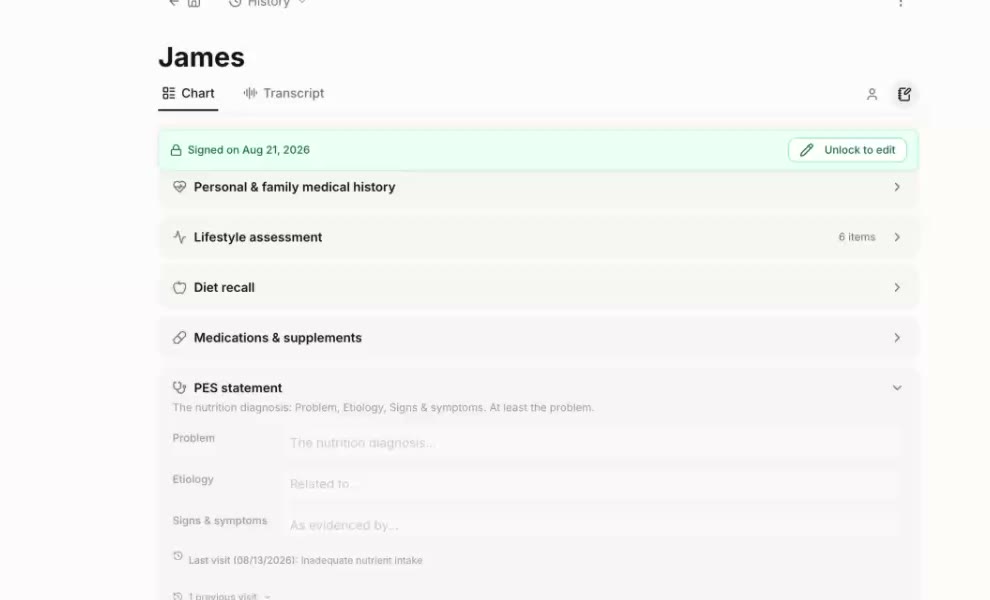
Duo Practice drafts each visit's note from the recorded session the same day and keeps it with that visit's codes, time and claim history, so the records a payer asks for sit in one chart. Try Duo Practice free
Frequently asked questions
How long do dietitians need to keep patient records?
Commonly 6 to 7 years or more, but the real answer is the longest period among your state's law, each payer contract, and Medicare's requirements. Pediatric records often must be kept years past the patient reaching adulthood. Check your state and your contracts, and when rules conflict, keep records for the longest applicable period.
What does Medicare require in a dietitian's chart?
For MNT, Medicare requires a physician referral on file before treatment, a covered diagnosis (diabetes, non-dialysis CKD, or post-kidney-transplant within 36 months), and documentation of time per visit because the annual benefit is measured in hours: 3 in the first calendar year, 2 in subsequent years. A new referral is needed for additional hours after a condition change, billed with G0270/G0271.
What happens if I cannot produce records a payer requests?
Claims tied to records you cannot produce are typically treated as unsupported and recouped, even if they paid long ago. Repeated failures can trigger broader audits or affect network participation. With organized, retrievable records, a records request is an errand instead of an emergency.
Part of MNT documentation. Start with How to write an MNT note that gets paid.