Billing codes · ICD-10-CM code
E03.9 hypothyroidism on nutrition claims
 By Javier Alvarez · Updated · 4 min read
| Code | E03.9 |
|---|---|
| Descriptor | Hypothyroidism, unspecified (includes myxedema NOS) |
| Billable | Yes (FY2026 and FY2027) |
| Header | E03 (other hypothyroidism) is not billable |
| Use instead when documented | E06.3 Hashimoto's/autoimmune; E89.0 postprocedural; E03.2 drug-induced; E03.8 other specified |
| Common pairings | E66.x + Z68.x, E78.x, R73.03, Z71.3 (payer-dependent) |
| Medicare MNT | Does not qualify; needs a diabetes or renal diagnosis |
| FY2027 change | None to E03 (Oct 1, 2026) |
Hypothyroidism is one of the most common conditions listed on a dietitian's intake form and one of the least likely to pay for the visit by itself. It belongs on the claim when the provider documents it. It usually doesn't belong first.
E03.9 and its neighbors
E03.9, hypothyroidism, unspecified, is the default code when the provider writes "hypothyroidism" or "hypothyroid" with no stated cause. Its one inclusion term is myxedema NOS. E03 itself is a category header and will reject if billed.
The category's Excludes1 note removes two causes from E03: iodine-deficiency hypothyroidism (E00 to E02) and postprocedural hypothyroidism (E89.0). The codes you'll see most often on referrals:
| Documentation | Code | Notes |
|---|---|---|
| Hypothyroidism, no cause stated | E03.9 | Default |
| Hashimoto's thyroiditis, autoimmune hypothyroidism | E06.3 | The index sends "hypothyroidism, autoimmune" here |
| After thyroidectomy, radioactive iodine or radiation | E89.0 | Postprocedural hypothyroidism; E03 excludes it |
| Due to a medication (for example, lithium or amiodarone) | E03.2 | Hypothyroidism due to medicaments and other exogenous substances |
| Other specified type | E03.8 | When the provider names a type without its own code |
| Congenital | E03.0 / E03.1 | With or without goiter |
Code what the provider wrote. If the referral says "hypothyroidism" but the chart notes "Hashimoto's," the more specific E06.3 is supported. If you infer a cause only from labs, that's not enough documentation.
No codes in E03, E06.3 or E89.0 changed in the FY2027 update effective October 1, 2026.
Why hypothyroidism rarely carries the claim
Payers set nutrition coverage by diagnosis, and thyroid codes are not on most of their lists:
- UnitedHealthcare's preventive MNT rows (MP.016.59) require diagnoses such as overweight, BMI codes, obesity, hyperlipidemia, impaired fasting glucose, metabolic syndrome, hypertension, prediabetes (ages 35 to 70) or diabetes. Thyroid codes do not appear.
- Aetna CPB 0049 covers nutrition counseling for "chronic disease states... in which dietary adjustment has a therapeutic role." Hypothyroidism isn't named in the examples, so a claim led by E03.9 depends on how the reviewer reads that phrase. Don't count on it.
- Medicare covers MNT for diabetes and renal disease only (NCD 180.1).
The usual reason a hypothyroid patient sees a dietitian is weight, blood sugar or lipids. Those diagnoses carry the claim. E03.9 goes after them and explains the context: slower weight response, medication timing, fatigue affecting activity.
Example claim lines (invented)
| Scenario | CPT | Diagnosis order |
|---|---|---|
| UHC member, class 2 obesity and hypothyroidism, 60-minute initial | 97802 × 4 | A: E66.812, B: Z68.36, C: E03.9 |
| Hashimoto's with mixed hyperlipidemia, 45-minute follow-up | 97803 × 3 | A: E78.2, B: E06.3 |
| Post-thyroidectomy patient with prediabetes | 97803 × 2 | A: R73.03, B: E89.0 |
| Medicare, type 2 diabetes and hypothyroidism | 97802 × 4 | A: E11.9, B: E03.9 |
Point each service line at the diagnosis that establishes coverage (usually A). A BMI code still needs the provider's weight diagnosis next to it; hypothyroidism doesn't make a Z68 code valid. See E66 obesity codes and E78 hyperlipidemia codes.
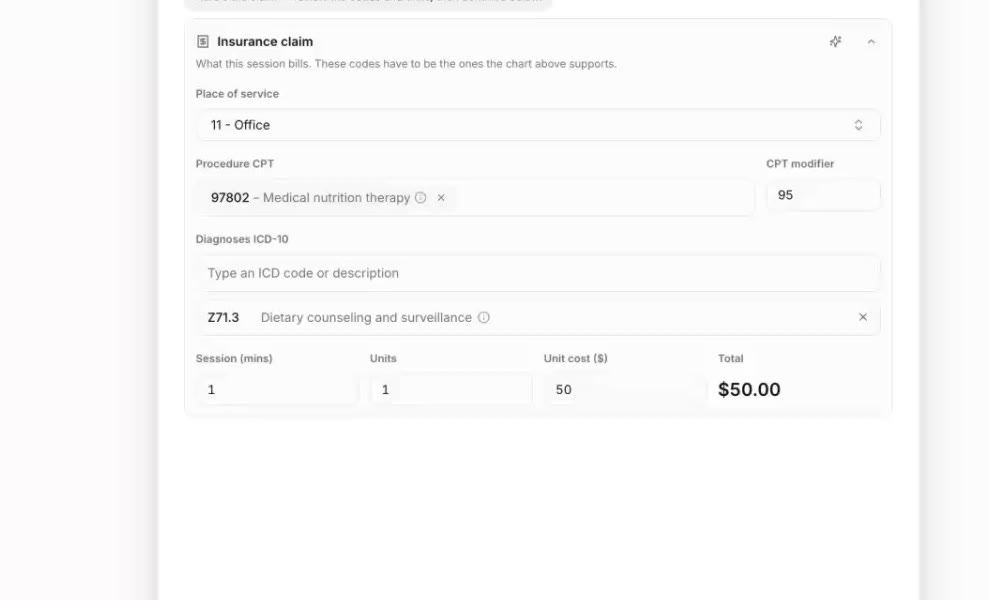
Duo Practice drafts the claim from your recorded session and note, with CPT, units from session time and the ICD-10 codes your documentation supports. Try Duo Practice free
What to document
- The provider's thyroid diagnosis as written, with its source (referral, chart, problem list).
- Thyroid medication and timing, if relevant to your plan. Calcium and iron supplements, for example, are commonly separated from levothyroxine. Follow the prescriber's instructions rather than changing timing on your own.
- The diagnoses that carry the visit, with supporting measurements: height, weight and BMI for a weight diagnosis, and labs as reported.
- Your nutrition diagnosis in PES format, the intervention, and face-to-face minutes for billing.
If a referral says only "hypothyroidism, please see for diet," ask the referring office whether weight, lipid or glucose diagnoses belong on it too. A complete referral costs less than an appeal. Physician referrals for dietitians explains what to request.
Denials and fixes
| What the remit says | Usual cause | Fix |
|---|---|---|
| CO-11 (diagnosis inconsistent with procedure) | E03.9 first on a plan that doesn't accept it for MNT | Resequence with the covering diagnosis first, if documented |
| CO-167 (diagnosis not covered) | E03.9 as the only diagnosis, or on a Medicare claim | Add the documented covering diagnosis; otherwise the visit isn't covered |
| CO-50 (not medically necessary) | Note doesn't show why nutrition therapy treats the condition | Appeal with the referral and note, or strengthen documentation going forward |
| PR-204 (not covered by the plan) | Member has no nutrition benefit | Patient responsibility; tell them before you bill, and verify before the next visit |
| Rejected: invalid code | E03 billed as a three-character code | Bill E03.9 or the specific code |
Whether a counseling code should also appear, and where, depends on the payer. See Z71.3. For every diagnosis code on nutrition claims, see the ICD-10 codes for dietitians reference. For how diagnosis order changes which benefit pays, see preventive vs. medical nutrition benefits.