Billing codes · ICD-10-CM code
K76.0 fatty liver (MASLD) and K75.81 (MASH) on nutrition claims
 By Javier Alvarez · Updated · 4 min read
| Code | K76.0 |
|---|---|
| Descriptor | Fatty (change of) liver, not elsewhere classified |
| Inclusion terms | MASLD; nonalcoholic fatty liver disease (NAFLD) |
| Billable | Yes (FY2026 and FY2027) |
| Excludes1 | Nonalcoholic steatohepatitis (NASH), K75.81, which includes MASH |
| Not K76.0 | Alcoholic fatty liver K70.0; toxic liver disease K71.- |
| MASLD/MASH terms added | FY2026 (Oct 1, 2025), as inclusion terms only |
| FY2027 change | None to K76.0; new K74.0A (moderate fibrosis, F2) and K76.83 (IFALD) |
| Medicare MNT | Does not qualify on its own |
You'll see fatty liver referrals under different names. A hepatologist writes "MASLD" or "MASH." An older note says "NAFLD." Your claim needs one code. The renaming didn't create new codes. Steatosis and steatohepatitis are still separate, and fibrosis coding changed October 1, 2026.
How the renaming changed the codes
In June 2023, a multisociety consensus led by the liver associations (AASLD, EASL and ALEH) renamed nonalcoholic fatty liver disease MASLD (metabolic dysfunction-associated steatotic liver disease) and nonalcoholic steatohepatitis MASH (metabolic dysfunction-associated steatohepatitis). They use the umbrella term steatotic liver disease.
ICD-10-CM followed in the FY2026 update, effective October 1, 2025. It didn't add codes. It added inclusion terms:
| Code | Descriptor | Inclusion terms (FY2026 on) |
|---|---|---|
| K76.0 | Fatty (change of) liver, not elsewhere classified | MASLD; NAFLD |
| K75.81 | Nonalcoholic steatohepatitis (NASH) | MASH |
The index was updated the same way: "Disease, liver, metabolic dysfunction-associated steatotic (MASLD)" and "Steatohepatitis, metabolic dysfunction-associated (MASH)" point to K76.0 and K75.81. "Fatty liver NEC" and "steatosis, liver NEC" also go to K76.0.
Neither code changed in the FY2027 update effective October 1, 2026.
How to code your patient's diagnosis
Code from the provider's documentation. Don't upgrade K76.0 to K75.81 just because labs look inflammatory. Don't call "fatty liver on ultrasound" MASH. If you need more specificity, ask the provider.
MetALD, the consensus category for people with MASLD who also drink more alcohol, has no code or index entry of its own in FY2027. Follow the provider's documentation and the index.
| Provider documents | Code | Notes |
|---|---|---|
| Fatty liver, hepatic steatosis, NAFLD, MASLD | K76.0 | No inflammation documented |
| NASH, MASH, steatohepatitis | K75.81 | K76.0 excludes it; don't code both |
| MASH with fibrosis | K75.81 + K74.0- | The fibrosis code says to code the underlying liver disease first |
| Alcoholic fatty liver | K70.0 | Plus an F10.- code for alcohol use, per the note |
| Cirrhosis | K74.6- | Fibrosis stage F4 is coded as cirrhosis |
Fibrosis codes changed in FY2027
Effective October 1, 2026, the hepatic fibrosis subcategory (K74.0-) was reorganized:
| Code | Descriptor | FY2027 change |
|---|---|---|
| K74.00 | Hepatic fibrosis, unspecified | No change |
| K74.01 | Hepatic fibrosis, early fibrosis | Now stage F1 only (was F1 or F2); adds "mild hepatic fibrosis" |
| K74.0A | Hepatic fibrosis, moderate fibrosis | New: stage F2, moderate hepatic fibrosis |
| K74.02 | Hepatic fibrosis, advanced fibrosis | Stage F3; F4 goes to cirrhosis (K74.6-) |
K75.81 carries a "use additional code, if applicable" note for hepatic fibrosis (K74.0-). If a MASH patient's referral says "stage F2 fibrosis" for a date of service on or after October 1, 2026, that's K75.81 + K74.0A. Before that date, it was K74.01.
The same update added K76.83, intestinal failure-associated liver disease (IFALD), which excludes intestinal failure (K90.83). This code matters for short bowel and home parenteral nutrition patients, not typical MASLD work.
Does insurance cover nutrition care for fatty liver?
- Commercial plans. Aetna's CPB 0049 covers nutritional counseling for gastrointestinal disorders and other chronic conditions where dietary adjustment has a therapeutic role. Whether a specific plan accepts K76.0 as the lead diagnosis varies, so verify.
- Companion diagnoses. MASLD rarely travels alone. Obesity (E66.x with Z68), type 2 diabetes (E11.x), hyperlipidemia (E78.x), metabolic syndrome (E88.810) or hypertension often carry coverage, including preventive routing on plans like UnitedHealthcare that key on those codes.
- Medicare. MNT covers diabetes and renal disease only (NCD 180.1). A beneficiary with MASLD and type 2 diabetes qualifies on the diabetes code, with K76.0 as a secondary diagnosis.
For GI and liver billing strategy, see best nutrition niches for reimbursement. Many MASLD patients also take GLP-1 medications. GLP-1 nutrition billing shows how to code those visits.
Example claim lines (invented)
| Scenario | CPT | Diagnosis order |
|---|---|---|
| MASLD and class 2 obesity, commercial plan, 60-minute initial | 97802 × 4 | A: E66.812, B: Z68.37, C: K76.0 |
| MASH with stage F2 fibrosis, hepatology referral, DOS after Oct 1, 2026 | 97803 × 3 | A: K75.81, B: K74.0A |
| Medicare, type 2 diabetes with fatty liver | 97802 × 4 | A: E11.9, B: K76.0 |
| Fatty liver with mixed hyperlipidemia | 97803 × 2 | A: K76.0, B: E78.2 (or E78.2 first if the plan keys on it) |
See E66 obesity, E11 type 2 diabetes and E78 hyperlipidemia for the companion codes.
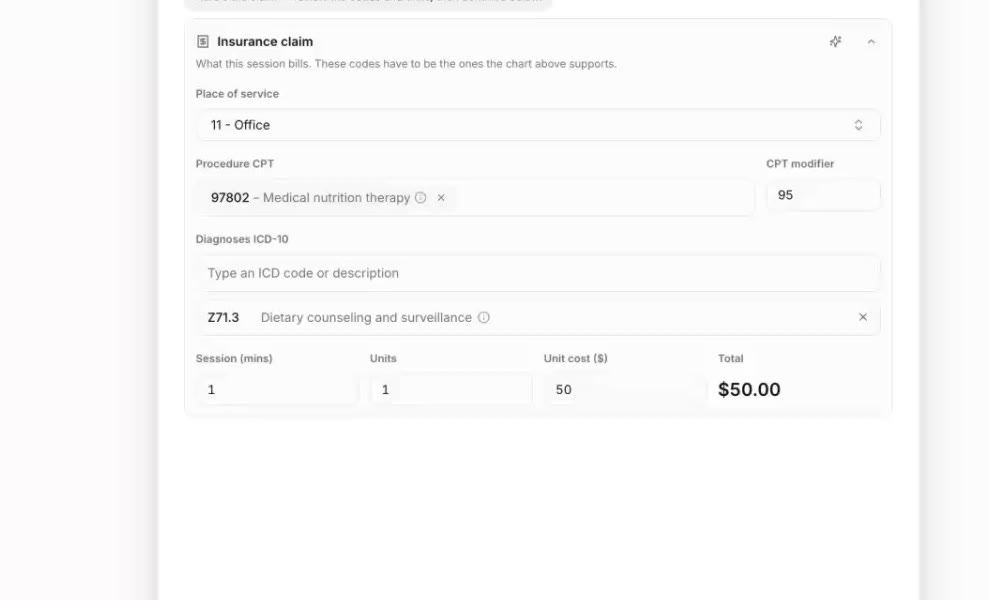
Duo Practice drafts the claim from your recorded session, ICD-10 codes included, and you review it and submit through your own Claim.MD account. Try Duo Practice free
What the note should show
- The provider's liver diagnosis in their words (and the imaging or biopsy result it rests on, as reported), plus any fibrosis stage.
- Weight history, measured weight and BMI, and the metabolic diagnoses that come with it.
- Alcohol intake as reported, since it changes the code.
- Diet pattern, added sugar and beverage intake, activity; your PES statement, plan (weight target, diet pattern), and face-to-face minutes.
Denials and fixes
| What the remit says | Usual cause | Fix |
|---|---|---|
| CO-167 (diagnosis not covered) | K76.0 alone on a plan that doesn't cover it for MNT, or on Medicare | Lead with a documented covering diagnosis |
| CO-11 (inconsistent with procedure) | K76.0 first where the plan keys on weight or metabolic codes | Resequence if documentation supports it |
| Rejected: invalid diagnosis | K74.0 header billed, or an old fibrosis mapping | K74.00, K74.01, K74.0A or K74.02 per the documented stage and date of service |
| Coding review finding | K76.0 and K75.81 on the same claim | Keep the one the provider documented (Excludes1) |
For coding help on other diagnoses, see the ICD-10 codes for dietitians reference.