Billing nutrition counseling alongside GLP-1 care
How dietitians bill MNT for GLP-1 patients: qualifying ICD-10 codes, coverage realities, prescriber partnerships, care-plan structure, and documentation.
 By Javier Alvarez · 5 min read
GLP-1 medications have sent millions of patients into active weight-management treatment, and they've given their physicians a problem prescriptions alone can't solve. Semaglutide can suppress appetite. It can't tell a patient how to hit a protein target on 1,200 calories, manage nausea without eating crackers all day, or keep muscle while losing a pound a week.
That gap is nutrition care, and for insurance-credentialed RDs it's the clearest rise in demand in years. It arrives as ordinary MNT: familiar codes, familiar documentation, an unfamiliar volume of referrals. The RDs who get those referrals can verify benefits fast, structure a care plan that fits GLP-1 treatment, and give prescribers a reason to keep sending patients. Below is how the billing works and how to build the service around it.
Why GLP-1s created RD demand
Four clinical problems recur across nearly every GLP-1 panel, and all four are squarely MNT territory:
- Muscle preservation. Rapid loss with suppressed appetite risks losing lean mass along with fat, so protein strategy and resistance-training coordination are the standing agenda of GLP-1 nutrition care. A free meal plan generator for dietitians can draft a high-protein week at the patient's calorie target for you to adjust.
- GI side effects. Nausea, reflux, constipation and early satiety are the top reasons patients quit. Meal composition, portion pacing and food-timing adjustments keep patients on therapy. The free GLP-1 handout builder puts your logo on a client handout about eating with side effects, for you to review before you share it.
- Plateau management. When loss stalls, the choices are dose escalation, watchful waiting, or tightening nutrition, and prescribers want RD input before reflexively titrating up.
- Discontinuation transitions. Whether by choice, cost or coverage loss, patients coming off GLP-1s regain quickly without a structured maintenance plan. I'd say the off-ramp is where an RD matters most.
The billing is ordinary MNT
There's no GLP-1 code, and you don't need one. You bill the same MNT CPT codes as any other case (97802 for the initial assessment, 97803 for follow-ups, in 15-minute units) with a qualifying diagnosis from the referral:
| Typical GLP-1 scenario | Primary dx | Secondary | Notes |
|---|---|---|---|
| Obesity treatment | E66.9 (or E66.01 if documented) | Z68.3x to Z68.4x BMI code | The most common GLP-1 referral pattern |
| Overweight with comorbidity | E66.3 or the comorbidity | Z68.2x, Z71.3 | Follow the payer's policy on ordering |
| Type 2 diabetes (GLP-1 for glycemic control) | E11.x | Z68.x as applicable | Also the pattern that qualifies for Medicare MNT |
Code from the referring provider's documentation, and mind the ordering rules. Which payers want a medical diagnosis primary versus Z71.3 is covered in the complete ICD-10 reference for dietitians. Medicare's MNT benefit keys on diabetes and CKD, not obesity alone, so a Medicare patient on a GLP-1 purely for weight generally won't qualify under that benefit.
Coverage keeps changing, so verify every time
In 2026, GLP-1 drug coverage and nutrition benefit coverage are separate decisions made by the same plan, and neither implies the other. Coverage for the medications keeps shifting plan by plan. A growing number of employer plans that do cover GLP-1s attach conditions, such as lifestyle-program enrollment or documented nutrition support, that make RD involvement effectively required. That helps you only if you check.
Run full benefits verification before the first visit, every time. Does the plan cover MNT for E66.x, or only for diabetes? Are there visit limits? Is it routed as preventive or medical? Is telehealth allowed? A GLP-1 prescription approval tells you nothing about any of those answers.
Positioning with prescribers
Referrals currently favor you. Physicians and med-spas building GLP-1 panels are managing side effects and plateaus at volume, often in 10-minute visits, and most know their patients need structured nutrition support they can't deliver. They lack a reliable RD to send patients to.
To become that RD, make a one-page referral sheet that says exactly what you handle (protein and muscle preservation, GI side-effect management, plateau workups, discontinuation planning), which insurances you take, and how fast patients get an appointment. Then close the loop with a brief note back after the initial visit. How to build those referral pipelines is in getting physician referrals as a dietitian. GLP-1 prescribers are the warmest version of that audience right now.
Care-plan structure: frequent and short fits the codes
GLP-1 care has a rhythm that fits 97803 well. During titration, patients need brief, regular check-ins (weigh-in trends, side-effect triage, a protein audit, one adjustment) more than occasional hour-long overhauls.
A common pattern, to adapt to the patient and the plan's visit limits:
| Phase | Visit | Billing |
|---|---|---|
| Initial assessment | 60 minutes | 97802 × 4 units |
| Titration | 30 minutes every 2 to 4 weeks | 97803 × 2 units each |
| Maintenance | 30 minutes monthly to quarterly | 97803 × 2 units |
| Discontinuation plan | A denser burst of follow-ups around the transition | 97803, units from documented time |
Units follow documented face-to-face time under the 8-minute rule, so short, frequent visits bill cleanly. Over a year they also bring in more reimbursement than sporadic long sessions, and they serve the clinical need better.
Groups add volume. A monthly GLP-1 group covering shared ground (protein strategies, cooking around side effects, plateau psychology) billed as 97804 in 30-minute units turns one hour into several reimbursed patients. The numbers are in billing group MNT sessions with 97804. Verify group MNT coverage per payer first.
Documentation: tie every visit to the diagnosis and the medication context
GLP-1 caseloads will draw payer scrutiny as volume grows, so chart as if the audit is coming.
Anchor each note to the diagnosis, not the drug: "MNT for E66.01, morbid obesity," with the medication as clinical context ("currently titrating semaglutide, week 8"). Show medical necessity at each visit: the active problem (nausea limiting intake, plateau at week 16, protein below target), your intervention, and the measurable goal. "Discussed diet, doing well" supports nothing.
Track objective markers: weight trend, BMI (update the Z68.x code as it changes), protein intake and side-effect status. Keep the referral current, and match units to documented time.
The full framework is in charting for medical necessity. GLP-1 visits are a high-frequency use of it.
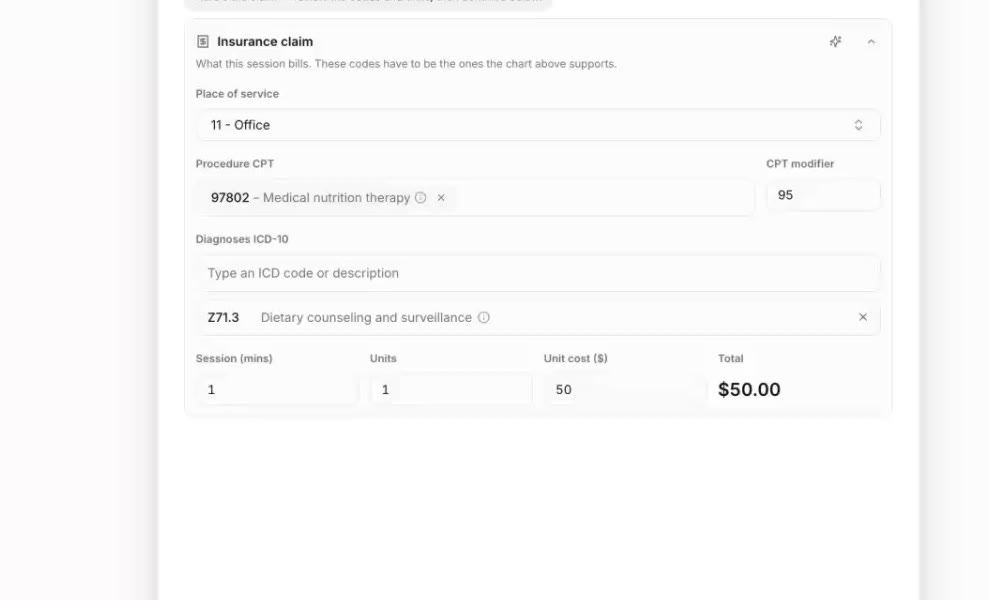
Duo Practice checks each patient's eligibility through your own Claim.MD account, drafts the note from the session, and drafts a coded claim for each of those frequent follow-ups for you to review and submit. Create your free account. The EHR is free; billing is 3.9% of what an insurer pays, plus your own Claim.MD plan.
Frequently asked questions
Can dietitians bill insurance for nutrition counseling with GLP-1 patients?
Yes. You bill standard MNT codes (97802 for the initial assessment, 97803 for follow-ups) with the qualifying diagnosis, typically obesity (E66.x) plus a BMI code (Z68.x), or diabetes (E11.x) when that's the indication. There is no special GLP-1 CPT code; the medication context lives in your documentation.
What diagnosis codes do I use for a patient on semaglutide or tirzepatide?
Code the condition being treated, from the referring provider's documentation: E66.x for obesity with the matching Z68.x BMI code as secondary, or E11.x for type 2 diabetes. Do not code the medication itself as the reason for the visit. The drug supports the diagnosis, and your note ties nutrition care to managing it.
Does insurance cover nutrition counseling for GLP-1 patients?
Coverage follows the plan's nutrition benefit, not the prescription, and it varies widely. Many commercial plans cover MNT for obesity or diabetes diagnoses, and some employer plans now attach nutrition-support requirements to their GLP-1 coverage. Verify each patient's nutrition benefits before the first session instead of assuming the GLP-1 approval implies MNT coverage.
Part of Coverage & benefits.