Bill group nutrition sessions with CPT 97804
How CPT 97804 group MNT billing works: 30-minute units, per-hour revenue math, coverage caveats, per-participant documentation, and group ideas.
 By Javier Alvarez · 5 min read
CPT 97804 bills one hour of your teaching to several patients at once, and many private-practice RDs never use it. The code feels like paperwork multiplied: multiple patients, multiple claims, multiple notes for one hour of teaching. So it sits unused while you repeat the same diabetes basics one patient at a time, five times a week.
The same hour of your time, delivered to six people instead of one, can earn meaningfully more, even though each patient pays less. Group MNT is one of the few levers in an insurance practice that raises revenue per hour without raising your rate or your hours.
How does 97804 work?
CPT 97804 covers two or more patients receiving MNT together. It's billed in 30-minute units, unlike the 15-minute units of 97802 and 97803. A 60-minute class is 2 units, and unit counting follows the same CMS midpoint logic as other time-based codes.
It's billed per patient. Every attendee generates their own claim for the units they attended, with their own ICD-10 code and their own documentation. Standard MNT rules still apply to each patient: referral where required (always for Medicare) and a covered diagnosis. For Medicare, group time draws from the same annual MNT hours as individual visits.
Is group billing more profitable?
Yes, when attendance is strong. Per-unit rates for 97804 are typically lower than individual MNT rates. That's the payer's incentive for the format. The lever is that the group rate multiplies by attendance. The numbers below are illustrative only; your contracted rates will differ, so run this table with your own fee schedule (see dietitian reimbursement rates for how to find them).
| Scenario (60 minutes of your time) | Rate assumption (illustrative) | Revenue for the hour |
|---|---|---|
| 1 individual follow-up, 97803 × 4 units | $35/unit | $140 |
| Group of 4, 97804 × 2 units each | $18/unit | $144 |
| Group of 6, 97804 × 2 units each | $18/unit | $216 |
| Group of 8, 97804 × 2 units each | $18/unit | $288 |
Even at roughly half the per-unit rate, a six-person group out-earns an individual hour by about 50% in this illustration, and the gap widens with every seat. The break-even group size is individual hourly revenue ÷ group revenue per patient. Below that attendance, run individual visits instead.
Count the overhead too: recruiting participants, verifying each one, documenting each one, and no-shows (a group that verifies eight and seats four just halved its revenue). Groups make financial sense when you can reliably fill seats from your existing caseload or a steady referral source. As a cold-start experiment, they rarely do.
Should you verify 97804 coverage separately?
Yes. This is where group programs die quietly. A patient whose plan happily covers 97802/97803 may have no 97804 benefit at all. Group MNT coverage varies widely across commercial plans, and some exclude it entirely. Medicare covers group MNT under its usual MNT conditions, but commercial plans need a code-specific check.
Before the first session, for every participant:
- Verify 97804 by code, not "nutrition counseling" generically.
- Confirm visit limits and whether group units share a limit with individual visits.
- Confirm the diagnosis routing (preventive vs. medical) for each plan.
- Have a self-pay group rate ready for participants whose plans don't cover it, and disclose it before session one, not after the denial.
Eight participants means eight verifications. This is the kind of repetitive pre-visit work worth automating rather than doing by phone.
Do you need individual documentation for group sessions?
Yes. The group is shared; the record is not. Each participant's chart needs:
- Date, session topic, and that patient's time in attendance
- Their diagnosis / reason for participation and referral where required
- Individual observations: questions asked, comprehension, relevant self-reported data ("reports fasting glucose 130 to 150 this week")
- An individual plan or goal, even a brief one
Template the shared curriculum block, then personalize the individual elements. Eight identical notes with the names swapped is the fastest way to turn a group program into an audit finding. And each note still needs the time and signature elements every payer checks.
How many claims do you file per group session?
One per attendee. Each attendee gets their own claim with 97804, the units for their attended time, their own ICD-10, and place of service for where they were. Six attendees, six claims. If one patient's plan denies (wrong benefit routing, no 97804 coverage), it affects only that claim. That's one more reason to verify each patient up front instead of cleaning up later.
What group logistics matter most?
Set clear expectations for confidentiality. Participants will hear each other's names and health talk, so use a group-participation consent covering confidentiality expectations, and set ground rules in session one. If you record sessions for documentation, every participant consents; one holdout means you adjust or don't record.
Telehealth groups follow your usual telehealth billing rules per patient (modifier, POS for each patient's location). Verify that each plan covers 97804 via telehealth, which is a narrower question still. And treat attendance as billing data: a late arrival changes that patient's units.
How do you launch a group program?
Sequence matters more than ambition. A workable first-group plan:
- Pick one topic from your existing caseload: the condition you already see weekly, so recruitment is an invitation, not a marketing campaign.
- Verify 97804 for your top 3 or 4 payers first. If your dominant payers don't cover it, you're building a self-pay group and should price it that way from the start.
- Set a minimum-viable size using the break-even math above, and a cancel-by date if enrollment falls short.
- Build the per-participant packet once: referral request, group and recording consents, benefit verification, and the note template with its individual fields.
- Run a fixed series, not an open drop-in: four to six weeks with a defined curriculum. Fixed series enroll better, document more cleanly, and give plans with visit limits a predictable footprint.
- Debrief after the series: attendance rate, denial rate, revenue per hour vs. your individual baseline. Keep, adjust, or kill it with data.
Which group programs work best?
The programs that sustain attendance come from diagnoses you already treat in volume:
- A diabetes basics series of four to six weekly sessions. It's the natural fit, since diabetes anchors both Medicare MNT and most referral flows.
- GLP-1 support groups on protein intake, GI side effects and muscle preservation. Demand is high and recurring; see billing nutrition care for GLP-1 patients.
- Prediabetes or weight-management cohorts, where the plan's benefit supports it.
- CKD nutrition classes for the stage 3 and 4 referrals nephrology practices send.
Start with one recurring group, seeded from your own caseload, at a time slot your individual schedule doesn't want anyway.
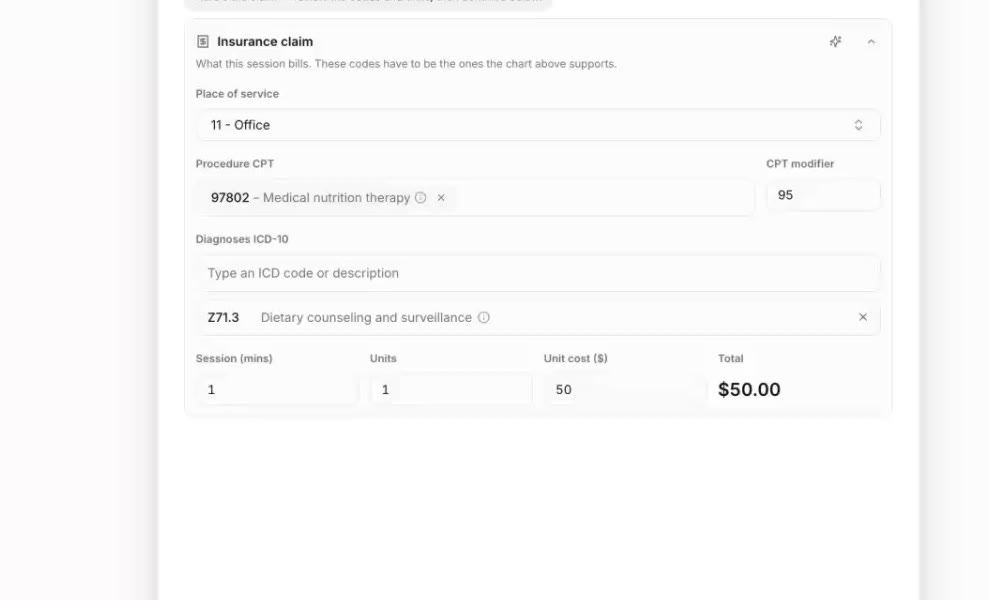
Duo Practice records the session, drafts the note and the claim from it (CPT, units from the session time, ICD-10, modifiers, place of service), and runs eligibility checks through your own Claim.MD account. You review and submit. Try Duo Practice free
Frequently asked questions
What is CPT 97804?
CPT 97804 is the medical nutrition therapy code for group sessions with two or more patients, billed in 30-minute units. Unlike 97802 and 97803, which use 15-minute units for individual visits, 97804 is billed per patient in attendance, with each patient getting their own claim.
Does insurance cover group nutrition sessions?
Sometimes. Medicare covers group MNT under its usual MNT rules, but commercial coverage of 97804 varies widely by plan: some cover it at a per-patient rate, some exclude it entirely. Verify 97804 specifically for each participant before the first session, not just general MNT coverage.
Part of MNT CPT & HCPCS codes.