The 8-minute rule for dietitians: counting MNT units
How the 8-minute rule works for MNT codes 97802 and 97803: the unit table, worked examples, what counts as billable time, and why rounding costs you.
 By Javier Alvarez · 5 min read
Ask ten dietitians how many units a 52-minute follow-up is and you'll get at least three answers. Some bill 2 units "to be safe." Some bill 3. Some bill whatever they billed last time. At typical per-unit rates, one under-billed unit per day quietly removes thousands of dollars from your practice over a year.
The 8-minute rule exists so there's no guessing. It's a mechanical conversion from documented face-to-face minutes to billable units, and once you know the table, unit counting takes no thought.
Below: the rule, the full table, worked examples, and the part people skip, which is what time you're allowed to count in the first place.
Why MNT codes are time-based at all
97802 and 97803 don't describe "a session." They describe 15 minutes of medical nutrition therapy. You don't bill one code per visit. You bill one code with a unit count that reflects how long the visit actually was. (97804, the group code, works the same way in 30-minute units.)
That means a 30-minute follow-up and a 60-minute follow-up are the same CPT code at different quantities, and they pay differently. Payers reimburse per unit, so your time counting is your revenue counting.
The 8-minute rule in one sentence
CMS's rule for time-based codes: you may bill a unit once you've passed the midpoint of that unit. Half of 15 minutes is 7.5, so the first unit starts at 8 minutes, the second at 23, and so on. Each threshold is 15 minutes after the last.
The full unit table
| Face-to-face minutes | Units of 97802/97803 |
|---|---|
| 0 to 7 | 0 (not billable) |
| 8 to 22 | 1 |
| 23 to 37 | 2 |
| 38 to 52 | 3 |
| 53 to 67 | 4 |
| 68 to 82 | 5 |
| 83 to 97 | 6 |
Print it, tape it to your monitor, or better, let your software count for you. Two caveats before you rely on it blindly.
Medicare follows this rule. Most commercial payers follow the same midpoint logic for MNT codes, but some have their own unit policies, so check the payer's MNT policy or provider manual.
Unit caps override the math. A payer that caps MNT at 4 units per visit pays 4 units for your 90-minute session no matter what the table says.
Worked examples
A 52-minute follow-up. 52 minutes falls in the 38 to 52 range: 97803 × 3 units. Note how close the edge is: at 53 minutes you'd bill 4 units. If your sessions habitually run "about 50 minutes," you are one honest scheduling adjustment away from a fourth unit on every visit. Conversely, don't stretch a 50-minute note to 53; bill what happened.
A 90-minute initial assessment. 90 minutes falls in the 83 to 97 range: 97802 × 6 units, if the payer allows 6 units on one date of service. This is why you verify benefits before a long initial: if the plan caps visits at 4 units, you want to know before you give away two units of work, not when the remittance arrives.
A 20-minute quick check-in. 8 to 22 minutes: 97803 × 1 unit. Short visits are billable. Many RDs assume anything under half an hour isn't worth filing. It is.
A 7-minute phone call. Zero units. Under 8 minutes of face-to-face time, the MNT codes don't apply.
What counts as billable time (and what doesn't)
The minutes you count are face-to-face MNT time: direct, live interaction with the patient, in person or over telehealth video. That includes the assessment conversation, nutrition education, reviewing the plan together, and answering the patient's questions during the visit.
What does not count:
- Charting after the visit. Your 20 minutes of note-writing is real work, but it isn't billable time under 97802/97803.
- Scheduling, reminders, and phone tag.
- Reviewing labs or the referral before the session.
- Time the patient spends in the waiting room or fixing their video connection.
- Non-MNT chit-chat. A few minutes of rapport is normal clinical care, but a 20-minute tangent isn't therapy time.
Every minute of charting is unbillable by definition, so the less time notes take, the better your effective hourly rate. That's the premise behind AI charting.
Documentation that supports your units
If a payer audits, the question is simple: does the note support the units on the claim?
Record time in every note, either start and stop times ("2:03 to 2:58 pm") or total face-to-face minutes ("55 minutes face-to-face MNT").
Make the content match the duration. A 4-unit note with two sentences of intervention looks wrong even if the timestamp is right. Your charting should demonstrate medical necessity for the time spent.
Match the claim to the note before it goes out. The units in box 24G and the minutes in the note should give the same number of units, every time. Billing more units than the note supports is an audit and recoupment risk; billing fewer is lost revenue.
The under-billing problem no one audits
Payers audit over-billing. No one audits under-billing, which is why it's the most common and least visible revenue leak in nutrition practices. It usually looks like one of these:
- Fear-based rounding down. A 55-minute session billed as 3 units "so nothing gets questioned." The table says 4, and billing 4 is just accurate.
- Flat-billing every visit at 2 or 3 units regardless of actual length, because that's what a course or a colleague once said was "standard."
- Not billing short encounters at all, when 8+ minutes is a legitimate unit.
- Forgetting the table's edges: treating 38 minutes as 2 units, or 53 as 3.
Run the math on your own schedule: one forfeited unit per day, five days a week, at the per-unit rates in your fee schedules, adds up to a four-figure annual loss for a solo practice, often more. The fix costs nothing: document your minutes, apply the table, bill what you earned.
A 30-second unit-counting workflow
- Note face-to-face start and stop times during or immediately after the visit.
- Convert with the table (or let software convert automatically).
- Check the payer's per-visit and per-year unit caps.
- Confirm claim units match documented minutes.
- Submit.
To apply the rule to a real visit, the CPT code finder turns minutes into units for 97802, 97803 and the G-codes. The code pages for 97802 and the 97802 vs 97803 guide cover which code the minutes go on.
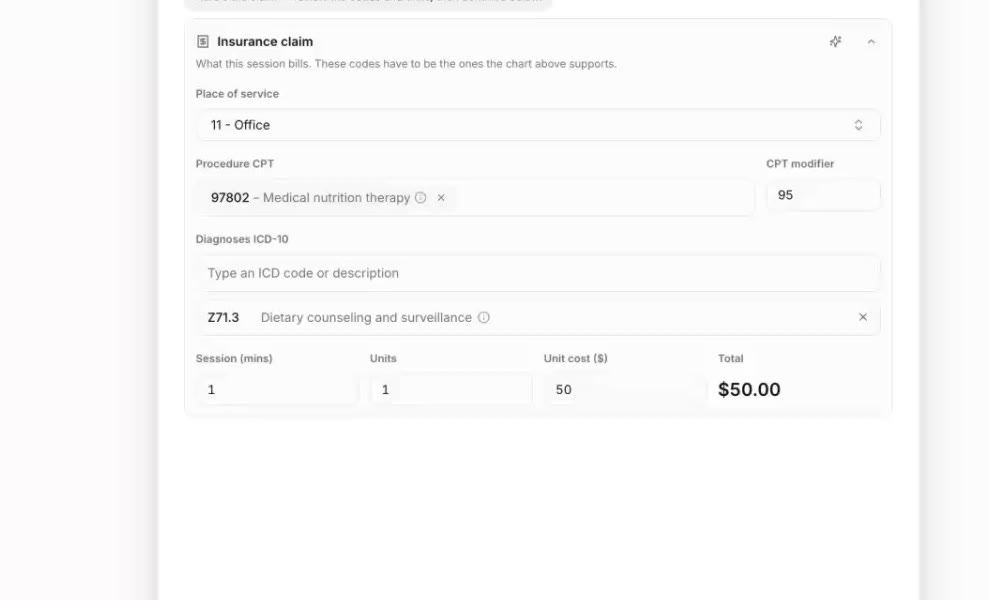
Duo Practice counts your units from the recorded session time, writes the note with the face-to-face minutes documented, and drafts the claim with the same units for you to review and submit. Try Duo Practice free
Frequently asked questions
How many units is a 60-minute MNT session?
Four units. Sixty minutes falls in the 53 to 67 minute range, which bills as 4 units of 97802 or 97803. A 90-minute initial assessment falls in the 83 to 97 range and bills as 6 units, if the payer allows that many per visit.
How many units can I bill per visit?
As many as your documented face-to-face time supports, subject to payer limits. Some payers cap units per visit (4 is a common cap) or per calendar year, and Medicare caps total MNT hours annually. Check each payer's MNT policy and verify benefits before long sessions.
Part of MNT CPT & HCPCS codes.