How much does insurance pay dietitians? What sets your rate
What insurance reimburses dietitians per session, the factors that set your rate, how to find your real fee schedules, and how to negotiate higher.
 By Javier Alvarez · 5 min read
"What will insurance actually pay me?" is the first question every dietitian asks before credentialing, and the one the internet answers worst. Half the numbers floating around are outdated, regional, or copied from someone else's contract. Your actual rate sits in documents you can request today.
This post covers how rates get set, honest ranges you can use for planning, and how to find and improve the numbers that apply to you.
How your rate is actually set
When you join a network, you sign a contract with a fee schedule: a list of allowed amounts per CPT code. That schedule, not your charged fee, determines payment. You can bill $250 on the claim; if the allowed amount is $140, the payer pays $140 (minus any patient cost share) and the rest is written off.
For dietitians the math has one more step, because 97802 and 97803 are time-based: the fee schedule prices a 15-minute unit, and your session reimbursement is per-unit rate × units. A 60-minute visit is 4 units under the 8-minute rule, so:
| Per-unit allowed amount | 30-min visit (2 units) | 60-min visit (4 units) |
|---|---|---|
| $25 | $50 | $100 |
| $30 | $60 | $120 |
| $35 | $70 | $140 |
| $45 | $90 | $180 |
| $50 | $100 | $200 |
This is why two dietitians "in-network with the same payer" can earn very different amounts per hour: different contracts, different regions, different unit counts per visit.
Honest ranges (and where to get exact numbers)
Verify every number below against your own contracts.
| Payer type | What to expect | Where the exact number is |
|---|---|---|
| Commercial | Somewhere around $100 to $200 for a 60-minute (4-unit) session, roughly $25 to $50 per unit. Some contracts fall below that range; strong contracts in high-cost metros can exceed it. | Your contract's fee schedule |
| Medicare | Published annually in the Medicare Physician Fee Schedule, and it varies by geography. | The CMS Physician Fee Schedule lookup tool (search "CMS physician fee schedule lookup"): enter 97802/97803 and your locality |
| Medicaid | Varies enormously by state and is often the lowest payer. | Your state's published fee schedule |
If you treat Medicare patients, read the Medicare MNT billing guide alongside the rates.
Don't build a business plan on ranges from a blog post, this one included. Build it on your fee schedules.
The factors that move your rate
Region. Payers price against local market costs. The same national payer can allow meaningfully different amounts in Mississippi and Manhattan. Medicare does this explicitly through geographic adjustment.
Payer. Within one city, contracts across payers commonly vary by 30 to 50% for identical services. This is the strongest argument for being selective about which networks you join rather than signing everything.
Network status. In-network, the fee schedule rules. Out-of-network, the plan's out-of-network allowed amount rules what the patient gets reimbursed from your superbill. You collect your full fee either way, but the patient's economics change.
Units per visit. Because pay is per unit, your visit length and unit counting discipline directly set revenue. A practice that habitually under-counts by one unit per visit takes a ~25% pay cut on 60-minute sessions.
Benefit routing. The same allowed amount feels very different depending on whether the plan processes nutrition counseling under a preventive benefit (plan pays 100%, patient owes $0) or a medical benefit (copay, coinsurance, deductible). Preventive routing doesn't raise your rate, but it moves your collections from "chase the patient" to "paid in full by the payer," which in practice means faster, more complete payment and happier patients. Which route a claim takes depends on the plan and the diagnosis coding; see preventive vs. medical benefits.
How to find YOUR rates
- At credentialing, request the fee schedule before signing. Ask specifically for allowed amounts on 97802, 97803, and 97804 (and 99401-99404 if the payer reimburses RDs for them). If a payer won't disclose rates before you sign, treat that as information.
- If you're already in-network, ask provider relations. You're entitled to your contracted rates. Get them in writing and keep a simple spreadsheet: payer, code, per-unit allowed, effective date.
- Read your ERAs. Every remittance shows the allowed amount per line. If you read your ERAs for a month, you have an empirical fee schedule, and you'll catch payers paying below contract, which happens more than it should.
Negotiating: yes, you can ask
Rate negotiation isn't just for hospital systems. Your bargaining power is limited but real:
- Ask at the right moments: before signing, at contract anniversary, or when a payer's network is thin in your area or specialty.
- Bring a case, not a complaint. Full caseload with a waitlist, a scarce specialty (pediatric feeding, renal, eating disorders), additional languages, telehealth coverage of rural counties: concrete access value.
- Propose specific numbers per unit per code, in writing, to provider relations or your network contract contact.
- Be willing to say no. A contract whose 4-unit visit pays less than your cost of delivering it is a subsidy you pay the insurer. Declining, or staying out-of-network with that payer, is a valid outcome.
Expect small movements, slowly. But dietitians who never ask get the default schedule forever.
One more lever is easy to miss: check what you're actually being paid. Fee schedules update, contracts amend, and payment systems make mistakes. If an ERA shows an allowed amount below your contracted rate, that's an underpayment you can dispute, and a pattern of them across a quarter is real money. Practices that reconcile payments against contracted rates recover revenue that practices posting payments blindly never even notice losing.
The number that actually matters: effective hourly rate
(For what these rates add up to over a year, see how much private-practice dietitians actually make.)
A $160 session isn't $160/hour if the visit costs you 90 minutes of total work. The honest calculation:
Effective hourly rate = collected revenue ÷ (session time + admin time)
A 60-minute session that pays $160 but drags 30 minutes of charting, claim submission, and payment posting behind it earns $107/hour. Cut that admin tail to 5 minutes and the identical contract earns $148/hour, a 38% raise with no negotiation, no new payers, and no schedule changes.
So the fastest way to raise your rate is usually the unbilled admin time wrapped around every visit, not the fee schedule.
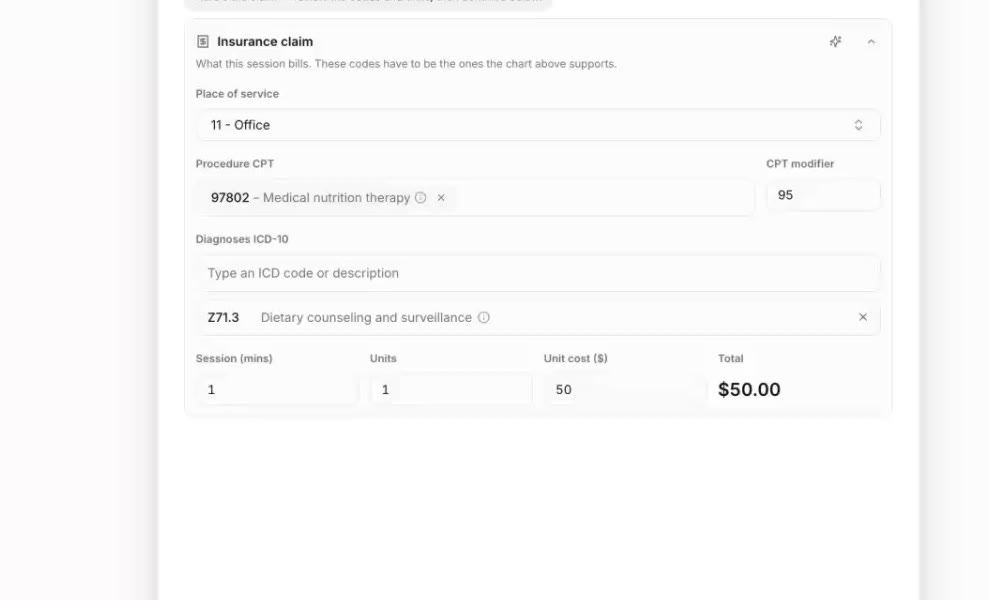
Duo Practice works on the denominator. It runs eligibility checks, drafts the note and the claim from the recorded session for you to review and submit, and matches the ERA, so the unpaid admin after each visit takes minutes. Try Duo Practice free
Frequently asked questions
How much does insurance pay dietitians per session?
There is no single national rate. Commercial payers commonly reimburse somewhere around $100 to $200 for a 60-minute (4-unit) MNT session, but your actual rate depends on your contracted fee schedule, region, and payer. Medicare publishes its MNT rates annually in the Physician Fee Schedule, which you can look up on the CMS website by code and locality.
Why did my patient owe nothing but I still got paid?
Many plans cover nutrition counseling as a preventive benefit, which means the plan pays 100 percent of the allowed amount with no patient cost share when the claim is coded to route through that benefit. The same service coded under a medical benefit may apply a copay or deductible, shifting part of the payment to patient collections.
Part of Coverage & benefits.