How to fill out a CMS-1500 as a dietitian (box-by-box guide)
CMS-1500 guide for dietitians: referring provider (box 17), ICD-10 codes (box 21), service lines (box 24), and common rejection errors explained.
 By Javier Alvarez · 5 min read
Every insurance claim you file as a dietitian follows the CMS-1500 form. You type it into a payer portal, send it through a clearinghouse, or (rarely) mail it on paper. The portals and software are friendlier screens over the same 33 boxes. When a claim rejects, the error message almost always points to one of those boxes.
You'll probably never fill one out by hand. Learning the form once still helps, though. When a clearinghouse rejects a claim for "invalid referring provider NPI" or "diagnosis pointer error," you'll know those mean box 17b and box 24E. Below is the form, box by box, for dietitians.
CMS-1500 vs. 837P: same claim, two formats
The CMS-1500 is the standardized paper claim form for professional (non-institutional) providers. The 837P is its electronic twin: the file format clearinghouses and payers exchange. Every field exists in both. When your software asks for a "rendering provider NPI," it's filling box 24J. When a clearinghouse rejects a claim for a "missing diagnosis pointer," that's box 24E.
File electronically: it's faster, cheaper, and clearinghouses validate claims before payers see them. The boxes are the same either way.
The top of the form: patient and insured (boxes 1 to 13)
These boxes identify the patient and whose insurance is paying:
| Box | What goes there | What goes wrong |
|---|---|---|
| 1 / 1a | The type of insurance and the member ID exactly as printed on the card | Typos here are the most common rejection there is. Copy the ID character for character, including letter prefixes. |
| 2, 3, 5 | Patient name, date of birth, sex, address | Must match the payer's enrollment record; "Bob" on the claim and "Robert" in the payer's system can be enough to reject. |
| 4, 6, 7, 11 | The insured (subscriber) and their relationship to the patient | When a patient is on a spouse's or parent's plan, the subscriber is that other person. Mixing these up causes "patient not found" rejections. |
| 12 / 13 | Patient signature authorizations | Typically "Signature on File" once your intake form captures it. |
A benefits check before the first visit catches most of these problems early. If the eligibility check comes back clean, the demographic data on your claim will too.
Box 17 and 17b: the referring provider
This pair matters more than its size suggests for dietitians. Box 17 holds the referring provider's name, preceded by qualifier DN (referring provider). Box 17b holds their individual (Type 1) NPI.
For Medicare MNT, a physician referral is required, and the claim must include the referring physician's name and NPI. No referral on the claim means no payment. Many commercial payers require or expect it too. Get the NPI from the referral or look it up in the free NPPES registry. Use the individual NPI, not the clinic's Type 2 NPI. An invalid or mismatched NPI here is a common MNT denial.
Box 21: diagnosis codes (ICD-10)
Box 21 holds up to twelve ICD-10 codes, labeled A through L. For nutrition claims:
- Put the medical diagnosis driving the visit first when you're working from a referral: E11.9, N18.31, E78.5, whatever the referring provider documented. (Since FY2021, CKD stage 3 is coded N18.30, N18.31 or N18.32; the bare N18.3 isn't billable. See N18 CKD codes.)
- Z71.3 (dietary counseling) and Z68.x BMI codes are common companions, but some commercial payers won't pay Z71.3 as the primary code. Check the payer's policy before putting it in position A.
- Only code diagnoses that are documented. You code from the referral and your assessment, not from what pays best. Our ICD-10 guide for dietitians covers the pairings in depth.
Box 24: the service lines
Box 24 carries the services themselves, one row per service. Each row has lettered sub-boxes:
| Sub-box | What goes there | Dietitian notes |
|---|---|---|
| 24A | Date(s) of service | One visit per line |
| 24B | Place of service | 11 office, 10 telehealth patient home, 02 telehealth other |
| 24D | CPT code + modifiers | 97802/97803/97804; modifier 95 (or GT for some payers) for telehealth |
| 24E | Diagnosis pointer | Letters referencing box 21 (e.g., "A" or "AB"), not the ICD-10 code itself |
| 24F | Charges | Your full fee for the line, even in-network; the payer applies the contract |
| 24G | Units | Time-based: count them with the 8-minute rule |
| 24J | Rendering provider NPI | The individual (Type 1) NPI of the dietitian who saw the patient |
Three classic errors happen here:
- Units that don't match documented time (24G). Bill 4 units and chart 40 minutes, and you invite an audit.
- Telehealth mismatch (24B + 24D): POS 11 with modifier 95, or POS 10 with no modifier. The combination has to be internally consistent and match the payer's telehealth policy.
- Diagnosis pointer mistakes (24E): writing the ICD-10 code instead of the pointer letter, or pointing to a diagnosis position that's empty.
Boxes 25 to 33: money and identity
- Box 25: your tax ID, EIN or SSN, with the matching checkbox. Use an EIN if you have one; it keeps your SSN off every claim you ever file. This must match what the payer has on file from credentialing.
- Box 26: your internal patient/account number (echoed back on the ERA, which helps with payment posting).
- Box 27: accept assignment. For Medicare MNT, yes.
- Box 28 and 29: total charges and amount already paid (for example, a copay collected).
- Box 31: the rendering provider's signature/name and date.
- Box 32: the service facility location, where care actually happened, if different from box 33.
- Box 33 / 33a: the billing provider: the name, address, phone, and NPI that should receive payment. Solo without an entity: your name and Type 1 NPI. Billing as a business: the practice name and Type 2 NPI, with your Type 1 in 24J as rendering. Getting the Type 1 vs. Type 2 relationship wrong, or using an NPI the payer hasn't credentialed, is a top rejection for new practices.
The box-level errors that cause most dietitian rejections
If you build a pre-submission checklist from this post, check these:
- Member ID or patient demographics don't match the payer's records (1a, 2 to 7).
- Missing or invalid referring provider NPI (17/17b) on MNT claims that require a referral.
- Z71.3 primary for a payer that doesn't accept it (21).
- POS/modifier telehealth mismatch (24B/24D).
- Units unsupported by documented time (24G).
- Rendering or billing NPI not on file with the payer (24J/33a). This is usually a credentialing gap, not a form error.
- Tax ID mismatch (25) against your credentialing record.
Every one of these can be checked before submission. Practices that validate claims manually or with software see far fewer rejections.
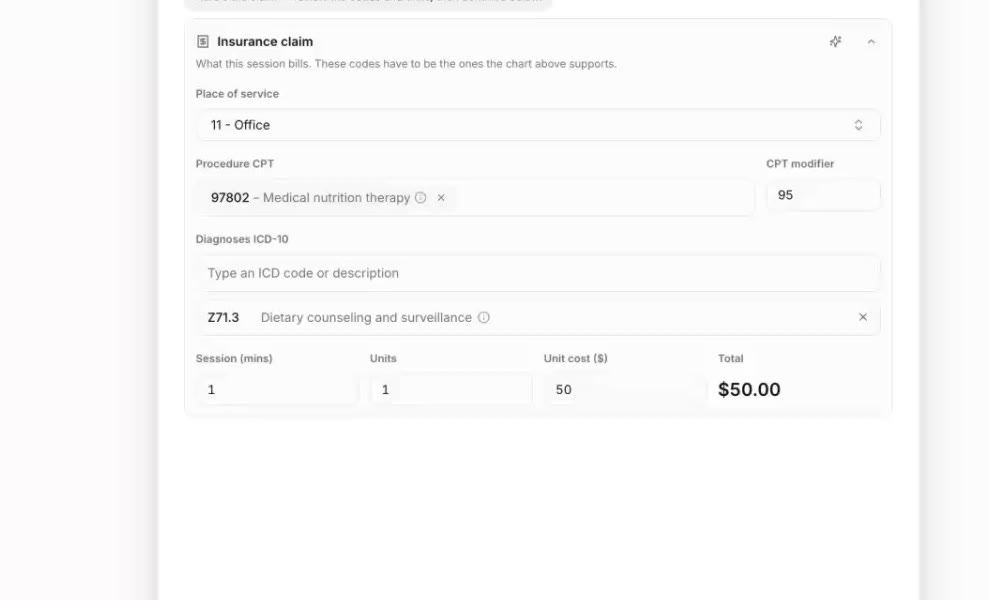
Duo Practice fills the CMS-1500/837P for you: CPT and units from session time, ICD-10, referring provider, place of service, and modifiers. You review it and press Submit, and it goes out through your own Claim.MD account. Create your free account. The EHR is free; billing is 3.9% of what an insurer pays, plus your own Claim.MD plan.
Frequently asked questions
Should I file CMS-1500 claims on paper or electronically?
File electronically, almost always. Electronic claims (837P) through a clearinghouse are cheaper, faster, and validated before the payer sees them. Medicare generally requires electronic filing for most providers. Paper CMS-1500 forms are a fallback for the rare payer that demands them.
Do dietitians need a referring provider on the claim?
For Medicare MNT, yes: the claim must include the referring physician's name and NPI in boxes 17 and 17b or it will be denied. Many commercial payers also require or expect a referring provider for medical nutrition therapy. When you have a referral, include it, since it supports medical necessity either way.
Part of MNT CPT & HCPCS codes.