NPI type 1 vs. type 2 for dietitians: LLCs & group NPIs
NPI Type 1 vs Type 2 for dietitians explained: which one you need, when an LLC and group NPI make sense, and how mismatches cause claim denials.
 By Javier Alvarez · 5 min read
Mix up these two numbers and your claims get denied for months. The NPI Type 1 vs. Type 2 question sounds like trivia until you form an LLC, keep billing the old way, and every claim bounces with a provider-mismatch denial for care you delivered right.
The rule itself is short: every RD needs a Type 1; only practices that bill as an entity need a Type 2. The complexity is in the transitions: when to form an entity, how the two numbers map onto a claim form, and how to switch without a gap in payment.
The two types, side by side
| Type 1: Individual | Type 2: Organization | |
|---|---|---|
| Identifies | You, the human clinician | A legal entity (LLC, PLLC, corporation, group) |
| Who needs it | Every RD who bills insurance | Only practices billing under an entity |
| Tied to | Your SSN (or ITIN) | The entity's EIN |
| How many you'll ever have | One, for life. It follows you across jobs and states | One per entity (an entity can have more than one in complex setups) |
| On claims, it's the… | Rendering provider | Billing provider |
| Cost / where | Free, at NPPES | Free, at NPPES |
Two facts to remember. Your Type 1 is permanent: new employer, new state, new LLC, and the number never changes. Guard the NPPES login because you'll update that record for the rest of your career.
And a Type 2 doesn't replace your Type 1. In a group setup, both appear on every claim: the entity bills, and you render.
When a Type 2 (and usually an entity) starts to matter
(If you're still at the very start, the NPI decision sits inside the bigger sequence in how to start a dietitian private practice.)
A solo RD with no entity can run an entire insurance practice on a Type 1: contracts in your name, claims under your SSN, payments to you. It works. A Type 2 enters the picture when:
- You form a legal entity and want to bill under it. If the LLC is the business (contracts in its name, payments to its bank account, revenue on its EIN), the entity needs its own NPI.
- You plan to hire. This is the big one. With a group contract under a Type 2, adding your first hire means linking their Type 1 to your existing contract, which is much faster than credentialing a new practice from zero. Solo-forever practices can skip this; practices with growth plans should build the group structure early.
- A payer requires it. Some payers contract with groups/entities as a matter of policy, or handle entity-based practices only through group agreements. If your target payer works that way, the structure question is answered for you.
- You want clean separation between practice revenue (EIN) and personal finances (SSN) for accounting and liability reasons.
Entity formation is a business and legal decision
Whether to form an LLC or PLLC at all, which one, in your state, with what tax election, is not a billing question, and nothing here is legal or tax advice. The billing-relevant facts are narrow: an entity gets an EIN from the IRS, can get a Type 2 NPI, and can hold payer contracts and receive payments in its own name. Some states require licensed professionals to use a professional entity (PLLC or similar) rather than a standard LLC; formation costs, annual fees, and tax treatment vary by state.
Talk to an accountant or attorney before forming anything. Decide the business structure with a professional first, then do the NPI and payer paperwork that follows. Not the reverse.
How the numbers map to a CMS-1500 claim
Mismatch denials start with this mapping. On the CMS-1500 form:
| Field | What goes there | Which NPI |
|---|---|---|
| Box 24J | Rendering provider: who delivered the care | Always a Type 1 |
| Box 33a | Billing provider: who gets paid | Type 2 if billing as a group; your Type 1 if solo with no entity |
| Box 25 | Federal Tax ID | EIN if billing as a group; SSN if solo |
Solo with no entity, your Type 1 appears in both 24J and 33a, and box 25 is your SSN. As a group or entity, your Type 1 goes in 24J, the entity's Type 2 in 33a, and the EIN in box 25.
The payer validates this trio (billing NPI + Tax ID + rendering NPI) against your contract on file. All three must match as a set. A valid Type 1, a valid Type 2, and a valid EIN in the wrong combination is still a denial.
The classic denial: NPI/Tax ID mismatch after forming an entity
This scenario produces more preventable denials than any other in this topic:
- You've been billing solo (Type 1, SSN) without trouble for a year.
- You form an LLC in March, get an EIN, get a Type 2 NPI.
- Your billing setup starts putting the EIN and Type 2 on claims in April.
- Every claim denies. The payer's contract file still says Type 1 + SSN. The claim says Type 2 + EIN. No match, no payment, usually with a remark code about the billing provider not being on file or not matching the contract.
The reverse fails too: payer updated to the entity, claims still going out under SSN. Either way the fix is alignment, and until it happens, revenue stops. These denials sit alongside the other eligibility and enrollment failures we cover in common nutrition claim denials, and like most of those, they're 100% preventable with sequencing. If the box 24J and 33a fields were wrong, fix the claim fields; if the payer's file is stale, fix the file. Then resubmit.
How to update payers after forming an entity, in order
The safe sequence, before a single claim goes out under the new entity:
- Entity and EIN first. Form the entity (with professional guidance) and get the EIN from the IRS.
- Type 2 NPI at NPPES, using the entity's exact legal name and EIN. Update your Type 1 record's practice address at the same time if it changed.
- Update CAQH with entity name, Tax ID, and practice info, then re-attest. Payers pull this during the update, and a stale profile stalls the process (the usual CAQH failure modes apply).
- Notify every contracted payer with their required forms: usually a new W-9 under the EIN and a demographic or Tax ID change form. Some payers process this as an administrative update; others require re-contracting under a group agreement, which can take weeks to a few months per payer. Ask each one which it is, and get the effective date of the change in writing.
- Update your clearinghouse and EFT/ERA enrollments so payments land in the entity's bank account and remittances route to the right Tax ID.
- Only then switch your claims to Type 2 + EIN in box 33a/25, payer by payer, as each confirms the change. During the transition, bill each payer under whichever configuration that payer currently has on file.
Payers pay the configuration they have on record, not the one that's legally true. Change the record first, the claims second.
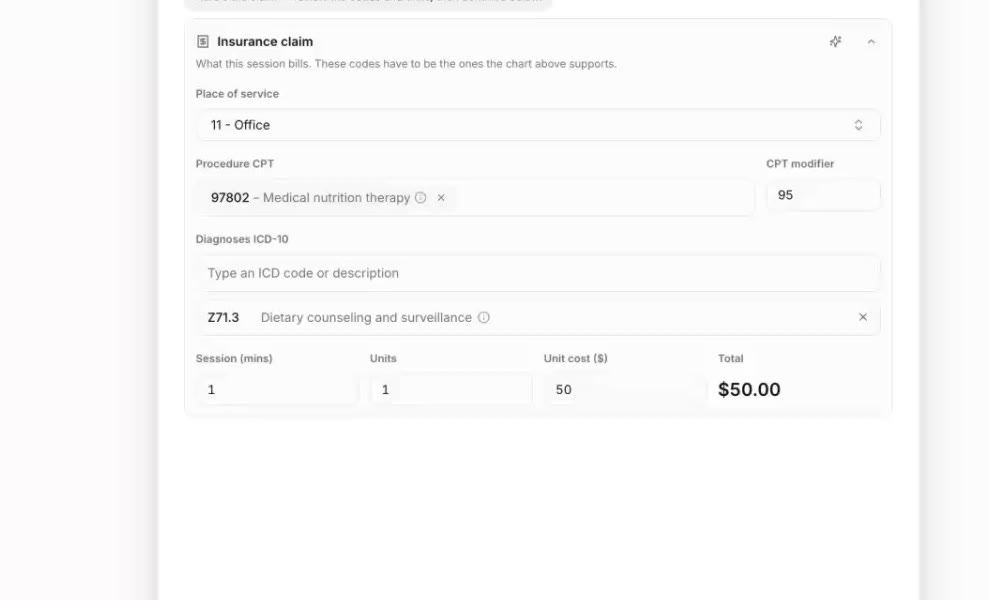
When a claim comes back rejected or denied for an NPI or Tax ID mismatch, Duo Practice explains which field didn't match and fixes and resends the claim once your setup and the payer's file agree. Try Duo Practice free
Frequently asked questions
Does forming an LLC automatically give my practice a Type 2 NPI?
No. Forming an entity and getting an EIN happens with your state and the IRS; the Type 2 NPI is a separate free application at NPPES using the entity's legal name and EIN. You also have to notify every payer you're contracted with, and often re-contract, before billing under the new entity.
Is getting an NPI free?
Yes. Both Type 1 and Type 2 NPIs are free through the NPPES website, and issuance usually takes days. Anyone charging you for basic NPI registration is charging for a form you can complete yourself in under 30 minutes.
Part of Credentialing & enrollment. Start with Insurance credentialing for dietitians: step by step (2026).