Free EHR for dietitians: what each one gives you free, and the catch
Duo Practice, in short
- What it is
- Duo Practice is a free EHR with insurance billing built in. It drafts the note and the claim from the visit, files the claim under your NPI once you approve it, matches the payment and explains denials.
- Who it's for
- Independent registered dietitians who bill insurance.
- Price
- The chart is free. Billing is 3.9% of what the insurer pays on each claim, with no monthly fee, so a claim paid $0 costs $0. You pay Claim.MD directly for your own clearinghouse plan.
- How it differs
- Practice Better, Healthie and SimplePractice give you claim tools and leave the claim work to you. Duo Practice does that work, and it can run on top of the EHR you already use.
 By Javier Alvarez · Updated · 6 min read
| Practice Better Sprout | Free up to 3 clients; no Claim.MD connection |
|---|---|
| CharmHealth Free | 1 provider, 50 encounters and 50 claims a month; e-claims add-on from $25/mo |
| Carepatron Free | Unlimited clients, 100 appointments, 1 GB; claims on paid plans |
| OpenEMR | Free open-source software; you host it or use its hosted option |
| Duo Practice | Chart free (20 transcription hours a month); billing 3.9% of what the insurer pays |
| Trials, not free plans | Healthie 14 days, SimplePractice 30, Kalix one month, Nutrium 14 |
| Prices checked | October 13, 2026, on each vendor's own pricing page |
Disclosure: Duo Practice is on this list, and we wrote it. Every other product's limits and prices come from its own pricing page, checked October 13, 2026, billed monthly. Vendors change plans often; confirm before you move client records.
You're opening a practice, or trimming costs in one, and "free EHR" sounds like the easiest win. It can be. But every free EHR is free in a different way, and the difference usually shows up the first time you bill insurance: the claim that needs a clearinghouse, the add-on that unlocks claims, the fourth client that moves you to a paid plan. So this page leads with the catch. Put your practice's numbers in the cost check above to see which free plans you still fit and what each option costs once you bill.
Five kinds of "free"
- Free with a cap. Free until you pass a client, visit or claim limit.
- Free plan without billing. Charting is free; claims need a paid plan.
- Free software, paid transactions. The app costs nothing; claims, eligibility or the EHR itself are charged.
- Free and open source. No license fee, but someone has to host, secure and update it.
- Free chart, paid billing. Charting is free; you pay only when insurance pays.
None of these is a trick. They fit different practices.
The free options compared
| What's free | The limit | Billing insurance costs | |
|---|---|---|---|
| Practice Better, Sprout | A limited Practice Better account | Up to 3 clients | The Claim.MD connection is on paid plans (Starter $35/mo and up), plus your Claim.MD plan |
| CharmHealth, Free plan | EHR for 1 provider, up to 5 users | 50 encounters, 50 claims and 1,000 patient records; 5 GB | E-claims add-on: $25/mo for up to 50 transactions, then $0.25 each; ERAs aren't counted |
| Carepatron, Free plan | Unlimited clients, telehealth, client portal, AI scribe | 100 appointments, 1 GB storage | No claims on Free; Plus is $31/mo regular price (currently discounted) with claims from $0.25 each |
| Office Ally, Practice Mate | Practice management (scheduling, billing), $0 | Not an EHR; "transactional fees may apply" | EHR 24/7 is $44.95/mo per provider; eligibility $10/mo for the first 100 checks |
| OpenEMR | Open-source EHR with billing; a free hosted option for US providers | Setup, support and security are on you | Clearinghouse arranged and paid separately |
| Duo Practice | Chart, clients, scheduling, session recording and AI notes | 20 transcription hours a month; no client portal or programs | 3.9% of what the insurer pays, plus your own Claim.MD plan (from $30/mo) |
Trials, not free plans: Healthie (14 days; from $18/mo billed annually), SimplePractice (30 days; from $49/mo), Kalix (one month; from $27/mo) and Nutrium (14 days; from $25/mo billed monthly).
Who each free option fits
Practice Better Sprout fits students, new grads and anyone testing a practice with a couple of clients. You can send superbills for out-of-network reimbursement. The fourth client, or the first claim you want to send yourself, moves you to a paid plan. If you're already there, our page on Practice Better insurance billing maps which steps its Claim.MD connection leaves to you.
CharmHealth's free plan fits a part-time RD who sees few patients and wants a general medical EHR. Fifty encounters a month is real room for a side practice, and its billing add-on is one of the cheapest ways to send claims. It's built for medical practices broadly, so MNT templates are yours to set up.
Carepatron's free plan fits a cash-pay practice that wants a client portal and telehealth at $0. Insurance claims start on its paid plans.
Office Ally fits the budget-first RD who is comfortable typing claims. Practice Mate is free and eligibility is cheap, but the charting is a separate paid product.
OpenEMR fits someone technical, or someone with an IT person. The software is free "always and forever," per its site, and includes billing. Running it safely is the price.
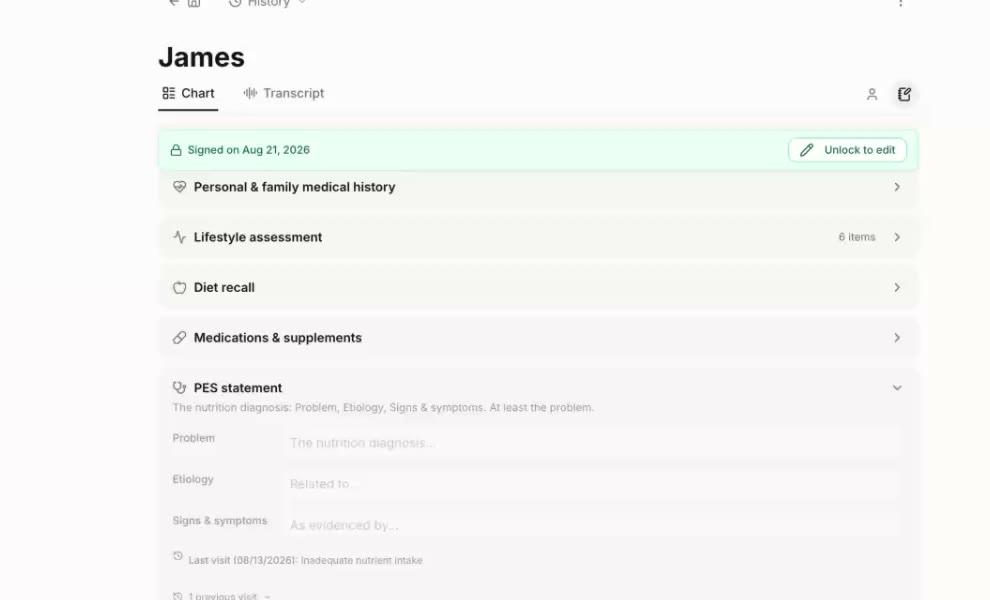
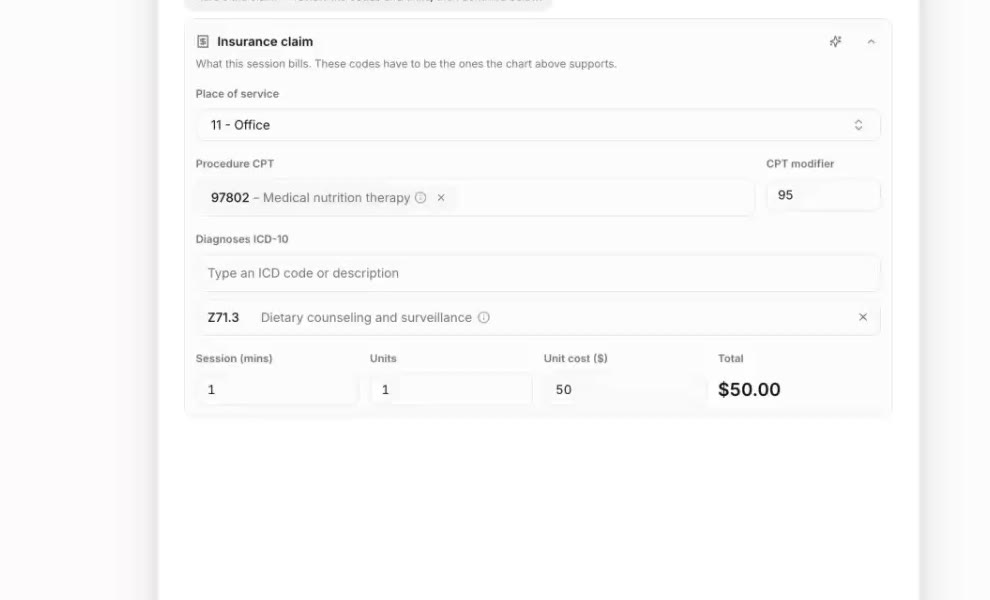
Duo Practice fits the RD who bills insurance and wants the chart free and the billing on autopilot. Duo records the visit (video in Duo, in person or by phone), writes the structured MNT note with a PES statement, and drafts the claim with units counted from the visit time. You approve it and it goes out under your NPI through your own Claim.MD account; Duo reads the ERA and explains denials in plain English. If you never bill insurance, you never pay.
The catch with Duo Practice, stated plainly
- Billing is the paid part: 3.9% of what the insurer pays on each claim. A denied claim, or one the insurer pays $0 on because of a deductible, costs $0.
- You need your own Claim.MD account and payer enrollments. You pay Claim.MD directly, from $30 a month on its pricing page. Our Claim.MD page walks through the setup.
- It doesn't do prior authorizations, appeals or credentialing. Those stay with you.
- It isn't a client portal. No programs, meal plans or food journals. Practice Better is built for that, and Duo can sit on top of it: clients and insurance come over, nothing is written back.
What 3.9% means at your volume is on our billing service page, with a calculator. Across two practices since May 2026, it has meant 333 paid claims and about $42,000 collected, about $126 a claim.
Where Duo Practice is not the best free option
- You want a client portal, meal plans or programs. Practice Better or Carepatron's free plan fit better.
- You only do cash-pay coaching. Any of these works; pick the client experience you like.
- You bill a lot and want the lowest dollar cost. A percentage grows with your collections. At steady volume, a flat subscription plus a clearinghouse often costs less in dollars, if you do the claim work yourself. Compare in best billing software for dietitians.
The costs "free" doesn't cover
- Clearinghouse. Claim.MD lists $30/month pay-per-use ($0.30 a claim and $0.30 an ERA), $60 with 100 claims, ERAs and eligibility checks a month, or $120 for unlimited claims and ERAs. Our clearinghouse guide compares Claim.MD, Office Ally and Availity.
- Eligibility checks. Some tools include them, others charge per check. Electronic checks rarely return nutrition visit limits, so budget time for calls with the benefits verification checklist.
- AI notes. On paid EHRs, AI scribes are often add-ons. Check the hours included and the overage rate.
- Storage and telehealth. Some free plans cap file space or appointments.
- Your time. The biggest line. We added it up in the true cost of a DIY billing stack.
Plan for outgrowing it
- Export. Find the export before you need it. Client lists usually export cleanly; notes and forms often come out as PDFs you can't re-import.
- Claims in flight. If you switch mid-year, finish open claims in the old system. Timely filing limits keep running during a migration.
- Your clearinghouse. If you own your Claim.MD account, it moves with you to any tool that connects to it. If the EHR owns it, ask how you'd take it back.
A quick way to decide
- Fewer than 4 clients and no insurance yet: Practice Better Sprout.
- Part-time medical practice, under 50 visits a month: CharmHealth free.
- Cash-pay, want a portal and telehealth at $0: Carepatron free.
- Comfortable typing claims, budget first: Office Ally.
- Technical and want full control: OpenEMR.
- Billing insurance and want to pay only when insurers pay: Duo Practice.