Insurance coverage · Coverage
Blue Cross Blue Shield reimbursement for dietitians: coverage by Blue plan
 By Javier Alvarez · Updated · 6 min read
| Who decides | The member's own Blue plan and group, not a national BCBS policy |
|---|---|
| Your rate | From your local Blue contract and fee schedule, per 15-minute unit |
| Example: Florida Blue | MNT medically necessary for any appropriate diagnosis, with a treating-physician referral; 3 hours first year, 2 after (MCG 01-99000-05) |
| Example: BCBS of Illinois | Preventive processing needs a preventive diagnosis and preventive procedure code (RP006) |
| Example: Anthem | MNT codes on the healthy-diet preventive row, with Z71.3 among the listed diagnoses (ACA coding guide, Aug 2026) |
| Example: Blue Cross NC | Many plans include up to 30 preventive dietitian visits a year (member page) |
| Out-of-state members | File with your local Blue plan (BlueCard) |
| Eligibility line | BlueCard Eligibility 1-800-676-BLUE (2583) |
| Last verified | October 13, 2026 |
The short answer
Many Blue plans pay registered dietitians for medical nutrition therapy: 97802 for the first visit and 97803 for follow-ups, per 15-minute unit, at the rate in your contract with your local Blue plan. But "Blue Cross Blue Shield" is not one insurer. The Blue Cross Blue Shield Association describes itself as an association of 33 independent, community-based and locally operated companies (Anthem, Florida Blue, Highmark, BCBS of Texas, Blue Cross NC, Regence and many more), plus the Federal Employee Program. Each one publishes its own medical and reimbursement policies, and each employer group picks its own benefits on top of that.
So "does Blue Cross cover nutrition counseling?" has two layers:
- The Blue plan's policy: does it consider MNT by a registered dietitian medically necessary, and when does it process as preventive?
- The member's benefit: is nutrition counseling included, how many visits, with what cost share, and does it need a referral?
Many Blue plans do cover it. Below are four real, current policies that show how differently they do it, then the steps to verify any Blue member. The planner above runs a patient's year with your own rate and the limit the member's Blue plan gave you. Nothing in it assumes a rate.
Four Blue plans, four different rules
Florida Blue (MCG 01-99000-05, Outpatient Medical Nutrition Therapy, reviewed January 2026). Coverage applies only under contracts that include MNT and preventive benefits. MNT by a registered dietitian or nutrition professional, referred by the treating physician, meets medical necessity "for any appropriate diagnosis," with examples including diabetes, cardiovascular disease, renal disease, HIV, obesity and eating disorders. Codes: 97802 to 97804, G0270, G0271, S9470. The reimbursement section covers three hours in the initial calendar year and two hours in later years with a proper referral, with more when medically necessary (for example, a change in diagnosis). It also says the codes are payable when billed by the dietitian, not "incident to" a physician.
BCBS of Illinois (RP006 Preventive Services Policy, effective April 1, 2026). Lists 97802 to 97804 (with G0270/G0271 on the CVD-risk row) under the USPSTF rows for healthy diet counseling with cardiovascular risk factors and for adults with a BMI of 30 or more. For a claim to process at the preventive level with no member cost share, it must include a preventive diagnosis code and a preventive procedure code, meet medical policy criteria and fall within USPSTF, ACIP, HRSA or Bright Futures guidelines. Z71.3 is not on its preventive Diagnosis List 1; R73.03 is. An RP006 policy with the same number is also posted by BCBS of Texas and BCBS of Oklahoma, so check your own plan's version.
Blue Cross NC (member nutrition page). Tells members that many of its plans include up to 30 preventive care visits a year with an in-network licensed dietitian at no cost, in person or by telehealth, and that every plan is different.
Anthem (ACA preventive care coding guidelines, commercial, August 2026). Lists 97802 to 97804, S9470, G0270 and G0271 under the USPSTF healthy diet and physical activity row for adults with cardiovascular risk factors, with Z71.3 and Z83.42 among that row's diagnosis codes. It says a listed diagnosis is required for the preventive benefit when the service is billed outside a preventive visit. Compare that with BCBS of Illinois, where Z71.3 is not on the preventive list. More in Anthem nutrition counseling.
So you have four models: a physician-referred MNT benefit counted in hours, a diagnosis-gated preventive benefit, a generous preventive visit allowance, and a preventive row that accepts Z71.3. Each is a separate company's rule, and none of them binds another Blue plan. Verify every Blue member, every time.
Preventive vs medical at Blue plans
Under the ACA, non-grandfathered plans must cover USPSTF A and B services in network without cost sharing (HealthCare.gov). For dietitians that means healthy diet counseling for adults with cardiovascular risk factors and intensive behavioral interventions for adults with obesity and children with high BMI.
Blue plans implement it with their own diagnosis lists. Some route on the condition (R73.03, E78.x, E66.x plus Z68.x), some accept Z71.3, some want a referral even for preventive visits. Everything outside the preventive rows is the medical benefit: the diagnosis is the condition you treat, and the deductible, copay or coinsurance apply. Read preventive vs medical benefits for the mechanics.
Out-of-state Blue members: BlueCard
If a patient carries a Blue card from another state, you still file the claim with your local Blue plan, the one you're contracted with. Your plan routes it to the member's home plan using the three-character prefix at the start of the member ID, and pays you under your local contract. The BlueCard Program Provider Manual is explicit: include the prefix, don't alter the ID, and don't make up prefixes. The BCBS prefix lookup shows the home plan for the prefixes a plan publishes.
Exceptions to watch: the Federal Employee Program (IDs start with "R"), stand-alone Medicaid products and Medicare Advantage, which runs on its own platform. Full walkthrough: BlueCard for dietitians.
How Blue reimbursement works for dietitians
Your contract with your local Blue plan sets the rate, even for an out-of-state member (that's BlueCard). We don't quote Blue rates here, because they differ by plan and contract.
Units come from minutes. 97802 and 97803 are 15-minute codes, counted with the CPT midpoint rule: 8 minutes for the first unit, then 23, 38, 53. The MNT units calculator has the full table, and 97802 vs 97803 covers which code goes when.
The member's Blue plan sets the limit. It may be hours (Florida Blue's guideline), visits (Blue Cross NC's member page) or nothing published at all, so use what the benefits check gives you. And the route decides who pays: preventive usually means the plan pays the contracted amount, while medical means the deductible and coinsurance come out of it first.
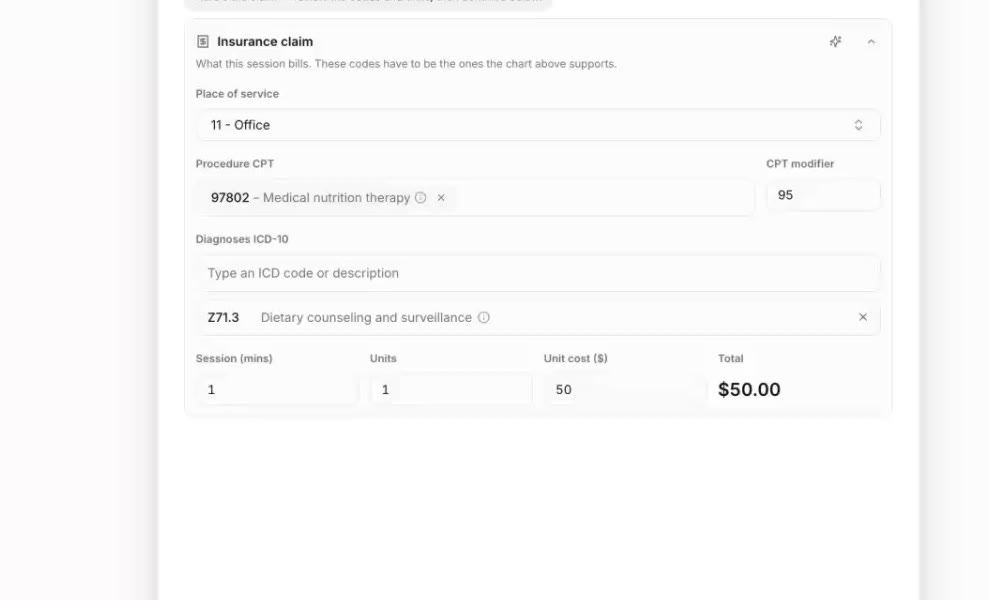
At Duo Practice, insurance billing on autopilot means Duo charts the visit and builds the claim with the member ID and prefix as entered. You approve it before it goes out through your own Claim.MD account.
Limits: visits, referral, prior authorization
Visits or hours range from a few hours a year to dozens of preventive visits, depending on the Blue plan and the group, so ask for the number and how much is used. Florida Blue's MNT guideline requires a treating-physician referral, and HMO products at many Blues require a PCP referral. None of the policies above describes a prior authorization for routine outpatient MNT, but groups differ, so ask about both.
Timely filing comes from your local Blue contract, not the member's plan. See timely filing limits by payer.
How to verify a Blue member's benefits
- Which Blue? Read the prefix and the product: commercial, FEP, Medicare Advantage or Medicaid.
- Check eligibility through your local Blue's portal or electronically (270/271 checks), or call BlueCard Eligibility at 1-800-676-BLUE (2583) for out-of-area members.
- Covered codes: 97802/97803 (and 97804) when a registered dietitian provides them?
- Preventive or medical? Which diagnoses process as preventive? Is Z71.3 accepted?
- Limits: visits or units per year, calendar or plan year, shared with other providers?
- Referral or prior authorization?
- Telehealth to the home: covered, and with which POS and modifier?
- Cost share for each route, and the rep's name, date and reference number.
Our insurance verification call script has the wording. For a two-page version of all of this, download the free Blue Cross billing cheat sheet for dietitians.
Duo runs eligibility checks through your own Claim.MD account and drafts the claim from the recorded visit for you to review. Try Duo Practice free
For dietitians: claim tips for Blue plans
- Member ID exactly as printed, prefix included. A missing prefix is a fast route to CARC 31 or a rejection.
- Z68 BMI codes are secondary only, paired with the weight diagnosis the provider documented.
- Units from this visit's minutes. A 71-minute intake is 5 units of 97802; see the 8-minute rule for dietitians.
- Telehealth: home = POS 10 + modifier 95 on most commercial plans. Check the Blue plan's telehealth policy.
- Self-funded groups on a Blue network follow the employer's plan document; see billing self-funded ERISA plans.
Billing Aetna as well? Its rules are one national policy plus the member's plan: see Aetna reimbursement for dietitians.
Not legal or billing advice. Duo Practice is not affiliated with the Blue Cross Blue Shield Association or any Blue plan.