Insurance coverage · Coverage
Does insurance cover a dietitian for weight loss?
 By Javier Alvarez · Updated · 4 min read
| Preventive basis (adults) | USPSTF B: intensive behavioral interventions for BMI 30+ (2018); diet counseling with CVD risk factors (2020) |
|---|---|
| Preventive basis (children) | USPSTF B: intensive behavioral interventions, age 6+ with BMI at or above the 95th percentile (2024) |
| Common diagnosis codes | E66.x obesity (incl. E66.811 to E66.813 classes), E66.3 overweight, Z68.x BMI (secondary) |
| Plan exclusions | Some plans exclude diet and weight-control services (e.g., Aetna CPB 0039 note) |
| Example visit limit | Aetna: up to 26 visits per 12 months for adults with BMI 30+ (CPB 0039) |
| Original Medicare | No dietitian-billed weight-loss benefit; obesity IBT is primary-care only (NCD 210.12) |
| Last verified | September 28, 2026 |
The short answer
On commercial plans, weight management is one of the most commonly covered reasons to see a dietitian, and one of the most commonly excluded. Two different rules meet here:
- The ACA preventive-services rule. Non-grandfathered plans must cover services with a USPSTF "A" or "B" grade, in network, with no copay, coinsurance or deductible. Two B recommendations cover weight-related counseling for adults, and one covers children.
- The plan's own benefit design. Outside the preventive mandate, a plan can exclude weight-control services, limit visits or require a referral.
So coverage depends on the patient's BMI and risk factors, how you code the claim, and what the plan document says.
The preventive benefit: what the USPSTF covers
| Recommendation (grade, year) | Who it covers |
|---|---|
| Weight loss to prevent obesity-related morbidity and mortality in adults (B, 2018) | Adults with a BMI of 30 or higher: intensive, multicomponent behavioral interventions |
| Healthy diet and physical activity counseling for adults with CVD risk factors (B, 2020) | Adults with hypertension or elevated blood pressure, dyslipidemia, or mixed risk factors such as metabolic syndrome |
| High BMI in children and adolescents (B, 2024) | Age 6 and older with a BMI at or above the 95th percentile: intensive behavioral interventions |
HealthCare.gov lists these for patients as "obesity screening and counseling" and "diet counseling for adults at higher risk for chronic disease" among adult preventive benefits. The healthy-diet recommendation is marked as being updated on the USPSTF site; the current B grade applies until a new one replaces it.
Payers turn those recommendations into billing rules, and they don't all do it the same way:
- UnitedHealthcare lists 97802 to 97804 under its obesity row only with a BMI 30+ code (Z68.30 to Z68.45) or an obesity diagnosis (E66.x), and under its CVD-risk row with codes such as overweight (E66.3 with Z68.25 to Z68.29), hyperlipidemia or hypertension. See UnitedHealthcare.
- Cigna lists 97802 to 97804 for the same populations but with a designated wellness diagnosis such as Z71.3; illness diagnoses go to the medical benefit. See Cigna.
- Aetna considers nutritional counseling a medically necessary preventive service for obese children and adults and for overweight adults with CVD risk factors. See Aetna.
Exclusions and limits
Even with the preventive mandate, plans can still limit coverage.
Start with exclusions. Aetna's CPB 0039 opens with a note that many Aetna plan benefit descriptions specifically exclude services for obesity or for diet and weight control. Other carriers' plans can carry the same kind of exclusion, so it's the first thing to ask.
Visit limits come next. Aetna's CPB 0039 considers up to 26 individual or group visits per 12 months, combined across providers, medically necessary for weight-reduction counseling in adults with a BMI of 30 or more. TRICARE covers 12 to 26 sessions a year for intensive behavioral interventions (see TRICARE). Many commercial plans set lower numbers or count nutrition visits together.
Aetna's policy also excludes commercial weight-loss programs by name. A dietitian's individual counseling is a different service, but plans may read "weight loss programs" broadly, so ask. Grandfathered plans don't have to follow the ACA preventive rule at all.
Medicare and Medicaid
Original Medicare does not pay a dietitian for weight loss alone. The MNT benefit covers diabetes and kidney disease only (Medicare nutrition counseling). Medicare's intensive behavioral therapy for obesity (BMI 30+, weekly then biweekly then monthly visits, with a 3 kg weight-loss check at six months) must be furnished by a qualified primary care physician or practitioner in a primary care setting. Some Medicare Advantage plans add broader nutrition benefits; check the plan.
Medicaid varies by state and managed-care plan. Some programs exclude obesity without a comorbidity; Texas's children's benefit, for example, says counseling for obesity without a comorbid condition is not a benefit. See Medicaid nutrition counseling.
GLP-1 patients
Patients on semaglutide or tirzepatide often want nutrition support, and prescribers increasingly refer them. Drug coverage and counseling coverage are separate: a plan can cover the medication and exclude weight-control counseling, or the reverse. The counseling visit follows the same rules as any other nutrition visit. For coding and documentation specifics, see GLP-1 nutrition billing.
How to verify weight-loss coverage
Ask on the benefits call (script: insurance verification call script):
- Is nutrition counseling (97802/97803) by a registered dietitian covered?
- Does the plan have an exclusion for weight loss, obesity, or diet and weight-control services?
- With a BMI of [X] and these diagnoses (E66.x, Z68.x, plus any risk factor), does the visit process as preventive or medical?
- How many visits per year, and how many are used? Shared with other providers?
- Referral or prior authorization?
- Telehealth covered to the home?
- Cost share for each route; rep name, date, reference number.
Once coverage is confirmed, the CPT code finder picks the code, units and telehealth modifier for the visit, and 97802 vs 97803 covers when a visit counts as initial.
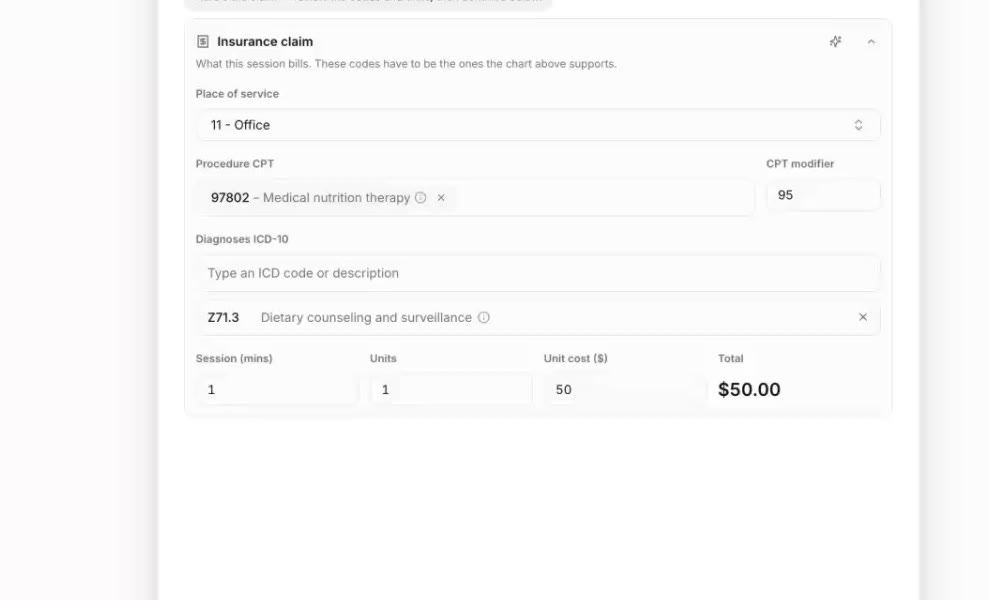
Duo drafts the claim from the recorded visit with the weight diagnosis and BMI you documented, and checks eligibility through your Claim.MD account. Try Duo Practice free
For dietitians: coding weight-management visits
Code the obesity or overweight diagnosis the provider documented, to the highest specificity: E66.811, E66.812, E66.813 (obesity class 1 to 3, added October 2024), E66.9, E66.3. See E66 obesity codes. BMI (Z68.x) is secondary only and needs an associated reportable diagnosis; it is not used in pregnancy. See Z68 BMI codes.
Risk factors (E78.x, I10, R73.03) belong on the claim when documented, because they can change how the claim processes. Bill 97802 for the initial assessment and 97803 for follow-ups, by time. Some plans also accept G0447 or 99401-99404; check your contract before using them.
Deciding whether to build a practice around weight management? Compare it with other specialties in nutrition niches and reimbursement.
Not legal or billing advice. Verify the member's benefits before the first visit.