How to start a dietitian private practice: the roadmap
A phase-by-phase roadmap to starting a dietitian private practice: entity and NPI, credentialing timelines, tool stack, first clients, first-year budget.
 By Javier Alvarez · 5 min read
You know the clinical work. What stands between you and a working practice is a series of administrative gates: entity, NPI, insurance contracts, tools, and referral flow. The order you clear them matters more than most guides admit.
This roadmap covers six phases. The critical rule: if you plan to take insurance, start credentialing in month one. At 60 to 120 days per payer, credentialing is your longest step. Begin applications early and let everything else run in parallel.
Phase 0: Validate the leap
Write a one-page plan before you spend anything. Our one-page business plan template is built for RD practices, and what private-practice dietitians actually make keeps the revenue line honest.
Before paperwork, decide how you're starting. A side-start is the most common choice and usually the right one: keep your job, see clients evenings or one day a week, and quit when practice income covers a threshold you set in advance. It's lower risk with slower growth. A full-time leap gives faster momentum and full calendar availability, but you'll need roughly 6 to 12 months of living expenses saved, because insurance revenue in particular arrives on a lag.
Sketch a niche hypothesis now (GI, diabetes, eating disorders, renal, prenatal). Niche drives payer choice, referral sources, and marketing. You can adjust later; you can't market "everything" effectively on day one.
Phase 1: Legal and administrative foundation
Knock these out in the first few weeks. None is hard, and all are prerequisites:
- Business entity. An LLC (or PLLC, where states require it for licensed professionals) is the common choice. Rules vary by state, so a brief consult with an accountant is money well spent.
- EIN from the IRS (free, minutes online).
- NPI Type 1: your individual provider number, free at NPPES. If you form an entity you'll bill under, add an NPI Type 2 for the organization (Type 1 vs. Type 2 explained).
- State licensure/certification verified for where your clients are located. This matters double for telehealth.
- Professional liability insurance. Inexpensive for RDs, non-negotiable, and payers will require proof during credentialing.
- Business bank account. Separate from day one; your accountant and your sanity will thank you.
Phase 2: Choose your revenue model and start credentialing
This is the fork that shapes everything downstream: cash-pay, insurance, or hybrid. In short, insurance gives you access to clients who would never pay $150 out of pocket and makes physician referrals dramatically easier; cash-pay gives you simplicity and an immediate launch.
If insurance is in your plan, even eventually, act immediately:
- Set up your CAQH ProView profile completely and accurately (most payer applications pull from it).
- Pick 2 to 4 initial payers based on your state's dominant plans and your niche.
- Submit applications and calendar the follow-ups.
Credentialing typically runs 60 to 120 days per payer, and it runs in parallel with everything else in this roadmap. Every week you delay the application is a week added to your first reimbursed session. Our step-by-step credentialing guide walks through the process.
Phase 3: The minimal viable tool stack
Resist the urge to buy everything. The launch stack needs scheduling plus an EHR for documentation (charts, portal, appointment management), HIPAA-appropriate video for telehealth, and intake forms and e-signatures with a BAA behind them. If you take insurance, add a billing pipeline: eligibility verification, coding, claim submission and ERA posting, either assembled from parts or in one platform. Client meal plans don't need a paid tool at launch; a free meal planner for dietitians covers the first months.
The rule for every tool: no BAA, no PHI. Build against our HIPAA-compliant tool stack guide and you'll avoid the expensive re-platforming later.
Phase 4: First clients
Marketing for a clinical practice is narrower than it looks. In rough order of payoff:
- Physician referrals. For insurance practices this is the engine: MDs need somewhere to send patients, and Medicare MNT requires a referral anyway. Build a one-page fax-able referral sheet and visit offices in your niche. (How to build physician referral flow.)
- Directories and insurance panels. Once credentialed, payer directories send clients without any marketing effort.
- A simple website that states niche, insurance accepted, and booking link.
- One community channel you'll actually sustain: local talks, a newsletter, or one social platform. Depth beats spread.
Phase 5: Operations that scale
(When the caseload outgrows you, the next step is hiring your first dietitian under a group contract.)
This is where new practices quietly sink. Every insurance client generates a pipeline of admin: verify benefits before the first session, document to medical-necessity standards, code and submit the claim, track it, post the payment, collect the copay. Done manually, this consumes 15 to 25 hours a month at a full caseload, and those hours don't bill.
So automate from day one rather than building manual habits you'll have to unlearn. A practice that starts with automated verification, charting, and claims scales by adding clients; a manual practice scales by adding evenings.
Timeline and budget
| Phase | Typical timing | Key outputs |
|---|---|---|
| 0: Validate | Weeks 1 to 2 | Model chosen, niche hypothesis |
| 1: Legal/admin | Weeks 1 to 4 | Entity, EIN, NPI, insurance, bank |
| 2: Credentialing | Apply weeks 2 to 4; approval months 2 to 5 | CAQH complete, 2 to 4 payer apps in |
| 3: Tools | Weeks 3 to 6 | Compliant minimal stack live |
| 4: First clients | Months 2 to 4 | Referral sheet out, site live, first sessions |
| 5: Scaling ops | Months 3 to 6+ | Automated verification-to-payment pipeline |
First-year budget, hedged and lean: entity and licenses $100 to $800 (state-dependent), liability insurance a few hundred per year, tool stack $100 to $350 per month, marketing basics $300 to $1,500. Most lean launches land somewhere in $2,000 to $6,000 for year one. Verify against your own state and choices.
Common first-year mistakes
Credentialing late is the classic: applications in month four mean revenue in month eight. Close behind are underpricing or skipping benefit verification, then eating denials and surprise client balances. Then comes building the practice around manual billing, then hitting a time wall at 15 to 20 clients.
No niche makes physician referrals vague and marketing generic. And tool sprawl leaves you with five subscriptions and yourself as the integration layer.
None of these is fatal. All of them are cheaper to avoid than to fix.
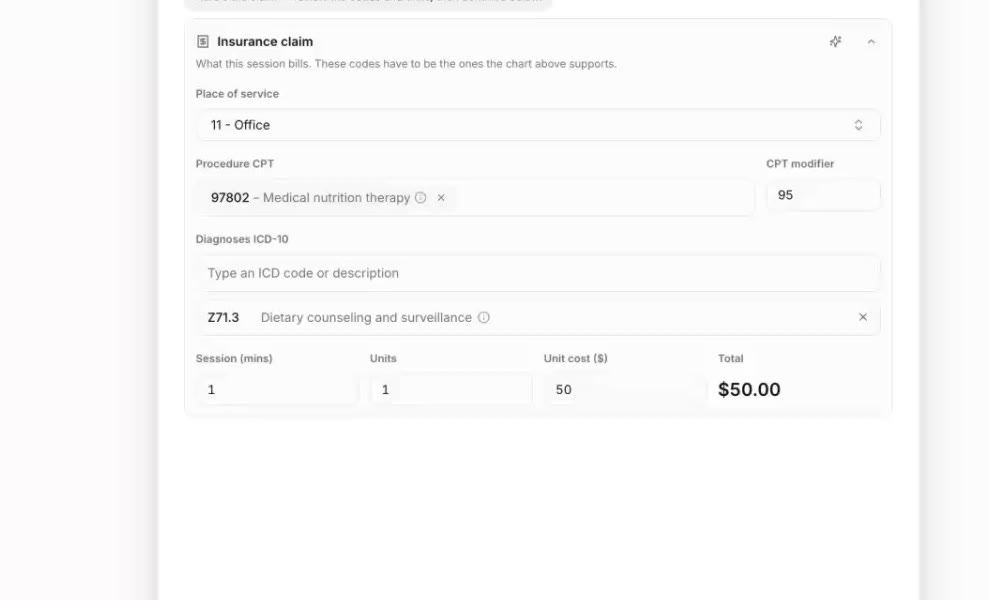
Duo Practice is a free EHR with insurance billing built in. It records the session, drafts the note and the claim for you to review and submit through your own Claim.MD account, runs eligibility checks there, matches each payment from the ERA, and fixes and resends denied claims. It does not do credentialing.
Frequently asked questions
How long does it take to start a dietitian private practice?
You can complete the legal and administrative setup in a few weeks, but if you plan to accept insurance, credentialing typically takes 60 to 120 days per payer. Most RDs should plan on 3 to 6 months from decision to first insurance-reimbursed session, which is why credentialing applications should go in as early as possible.
How much does it cost to start a private practice as an RD?
A lean solo launch commonly runs $2,000 to $6,000 in year one: entity formation and licenses, professional liability insurance, a HIPAA-compliant tool stack, and basic marketing. Costs vary meaningfully by state and by how much you outsource, so treat these as planning ranges rather than quotes.
Do I need an LLC to practice as a dietitian?
You can practice as a sole proprietor, but most owners form an LLC (or PLLC where required) for liability separation and cleaner finances. Entity rules for licensed professionals vary by state, so check your state's requirements and consider a brief consult with an accountant or attorney before filing.
Part of Credentialing & enrollment. Start with Insurance credentialing for dietitians: step by step (2026).