Billing codes · CPT code
CPT 97802: the initial MNT assessment code
 By Javier Alvarez · Updated · 7 min read
| Code | 97802 (CPT, Category I) |
|---|---|
| What it covers | Initial MNT assessment and intervention, one patient, face-to-face |
| Unit length | 15 minutes (1 unit from 8 minutes) |
| When to use | First MNT visit only; later visits are 97803 |
| 2026 relative values | Work 0.53, practice expense 0.56 (office) or 0.25 (facility), malpractice 0.01 |
| Medicare pays a dietitian (2026) | $31.23 per unit in an office or at home, $22.43 in a facility (national); $28.85 to $39.78 by locality |
| Medicare MUE | 12 units per day (practitioner table effective Oct 1, 2026) |
| Medicare coverage | Diabetes, non-dialysis kidney disease, 36 months after kidney transplant; physician referral |
97802 is the first medical nutrition therapy visit with a patient, billed per 15 minutes of face-to-face time. You assess the patient, name the nutrition problem, set goals and start the plan. Every individual visit after that is 97803. This page covers what is specific to the first visit: what it pays, what its note has to show, and the denials that only happen on 97802.
| You want to know | Answer |
|---|---|
| What it is | MNT initial assessment and intervention, one patient, face to face (in person or live video) |
| Unit | 15 minutes; a unit counts from 8 minutes |
| A 60-minute first visit | 97802 × 4 |
| How often | Once per new patient under Medicare's manual; commercial plans set their own rule |
| What Medicare pays in 2026 | $31.23 per unit at the national office rate, $124.92 for 4 units; $28.85 to $39.78 by locality |
| How it compares to a follow-up | $4.26 more per unit than 97803 |
Choosing between the two codes for a given visit, including a patient who comes back after a year, has its own page: 97802 vs 97803.
What "initial" means on a claim
The CPT descriptor for 97802 names an initial assessment and intervention, for one patient, face to face, counted in 15-minute units. CMS reprints it in its claims manual, ch. 4, §300.4, and adds the rule that matters most: 97802 is used only once, for the initial assessment of a new patient. Every later individual visit is 97803.
Two words in the descriptor matter. "Assessment" means the visit has to contain one, not only counseling. "Intervention" means the visit also starts treatment. A visit that only gathers intake data and ends is weak support for the code.
A 2002 CMS memo allowed 97802 "once a year"; the current manual dropped that wording (Program Memorandum A-02-115), which is why a returning Medicare patient is billed 97803.
What Medicare pays for 97802 in 2026
Medicare bases 97802 pricing on three relative value units (RVUs) in the CMS RVU26D file, released in October 2026:
| Part of the price | 97802 | 97803, for comparison |
|---|---|---|
| Work RVU | 0.53 | 0.45 |
| Practice expense RVU, office | 0.56 | 0.49 |
| Practice expense RVU, facility | 0.25 | 0.20 |
| Malpractice RVU | 0.01 | 0.01 |
| Fee schedule amount, office (national) | $36.74 | $31.73 |
| A dietitian is paid 85%, office | $31.23 | $26.97 |
| A dietitian is paid 85%, facility | $22.43 | $18.73 |
The math is the sum of each RVU times its geographic index (GPCI), times the 2026 conversion factor of $33.4009 for clinicians outside an advanced APM (CY 2026 final rule). At the national index of 1.0, 1.10 RVUs × $33.4009 equals $36.74. A registered dietitian gets 85% of that, or your actual charge if it's lower (42 CFR 414.64). MNT has no deductible or coinsurance for the patient, so Medicare pays the full amount.
Use the office rate for visits in your office and for telehealth when the patient is at home (POS 10). The lower facility rate applies when the visit happens in a facility setting, such as a hospital outpatient department, where the facility bills its own share separately.
What a first visit pays, by length (2026, national):
| Face-to-face minutes | Units | Office or home | Facility |
|---|---|---|---|
| 23 to 37 | 2 | $62.46 | $44.86 |
| 38 to 52 | 3 | $93.69 | $67.29 |
| 53 to 67 | 4 | $124.92 | $89.72 |
| 68 to 82 | 5 | $156.15 | $112.15 |
| 83 to 97 | 6 | $187.38 | $134.58 |
The units follow the CPT midpoint rule. The 8-minute rule for dietitians explains edge cases, and the MNT units calculator does the conversion.
Your location changes the rate by about 38%. Across Medicare's 109 payment localities, the 2026 office rate for 97802 runs from $28.85 per unit in Arkansas to $39.78 in the San Jose area of California, with a median of $31.59. Alaska ($39.66) and San Francisco ($39.02) are near the top; Mississippi ($28.94), the rest of Missouri ($29.03), and Alabama ($29.12) are near the bottom. Each state's page in Medicare MNT rates lists every locality.
What a full first year is worth. Medicare's first-year MNT allowance is 3 hours, 12 units. If the first visit is 60 minutes (4 units of 97802) and the other 8 units are 97803 follow-ups, the year pays $340.68 at the national office rate: $124.92 from 97802 and $215.76 from 97803.
What the first visit's note has to show
Because 97802 pays more than 97803 and can be billed once, the first note is the one an auditor reads most closely. The code's own words tell you what the note must prove: that an assessment happened, that treatment started, how long you spent face to face, and, for Medicare, that a physician referred the patient for a covered diagnosis.
| The note should show | Why 97802 needs it |
|---|---|
| The referral and the diagnosis it names | Medicare covers MNT only on a physician's referral for diabetes or renal disease, and the physician records the diagnosis (42 CFR 410.132(c)) |
| The assessment data you collected | Food and nutrition history, anthropometrics, labs from the referral, medications, and the patient's history: the "assessment" in the descriptor |
| A nutrition diagnosis | Usually written as a PES statement (problem, etiology, signs and symptoms); see PES statement examples |
| The intervention you started | Education, a meal pattern, goals agreed with the patient: the "intervention" in the descriptor |
| Face-to-face minutes, or start and stop times | 97802 is timed; the units on the claim must match the minutes in the note |
| The plan for follow-up | Shows where 97803 picks up, and supports the hours the patient still has |
These rows follow the Academy's Nutrition Care Process, which has four steps: assessment, diagnosis, intervention, and monitoring and evaluation. A first visit covers the first three and sets up the fourth. The MNT documentation guide and an ADIME note example show the same structure in practice.
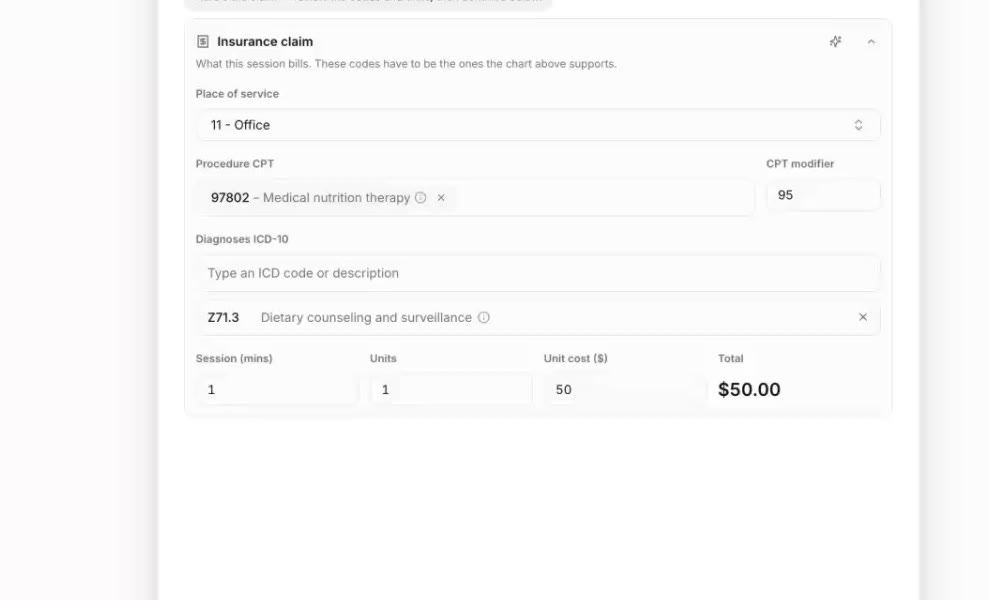
Duo Practice drafts the note and the 97802 claim from your recorded session, with units from the minutes, and you submit it through your own Claim.MD account. Try Duo Practice free
Who can bill 97802
CPT doesn't limit 97802 to one profession. Payers do. For Medicare Part B, only a registered dietitian or nutrition professional can furnish and bill MNT (42 CFR 410.134). The dietitian must be enrolled in Medicare and accept assignment. MNT can't be billed incident to a physician's service. In a physician group, the group bills with your NPI as the rendering provider (claims manual §300.5).
Commercial plans and Medicaid programs credential their own way. Most credential licensed RDs. A few route nutrition counseling to other codes such as S9470. See CAQH for dietitians for the credentialing process.
Medicare limits that start with this visit
The first 97802 opens the patient's Medicare MNT year, so three limits start counting from this visit:
- Hours. 3 hours in the first calendar year and 2 hours each year after, shared with 97803. The 97802 units count toward them.
- Units per day. The CMS practitioner MUE table effective October 1, 2026 caps 97802 at 12 units per day, which is the whole first-year allowance. MUE values change quarterly; check the current table.
- DSMT on the same day. MNT and diabetes self-management training can't be billed on the same date for the same patient. See G0108 and G0109.
Covered diagnoses, referral forms, and what happens when the hours run out are in the Medicare MNT coverage guide.
Commercial plans and telehealth
Commercial plans use the same code and units but define "initial" their own way: once per patient, once per plan year, or once per episode. Ask on the benefits call by code, using the insurance verification call script. Compare plans one by one: Aetna and Blue Cross Blue Shield.
97802 is on the CY 2026 Medicare telehealth list. Use POS 10 when the patient is at home and POS 02 when they are somewhere else, per CMS's MLN telehealth booklet. Many commercial and Medicare Advantage plans also ask for modifier 95. Details in Medicare telehealth for MNT.
Denials that are specific to 97802
| What went wrong | What it usually looks like | Fix |
|---|---|---|
| 97802 billed again for a patient the payer already knows | Denied as a frequency or code-choice issue | Rebill the visit as 97803 if the payer's rules call for it |
| Referring NPI missing (Medicare) | Claim returned as unprocessable, often CO-16 | Add the referring physician's NPI and resubmit |
| Diagnosis isn't diabetes or renal (Medicare) | Denied as not covered, see CO-50 and CO-167 | Medicare won't cover it; check for a commercial or self-pay path |
| Units above the MUE or the plan's cap | Line cut back or denied | Bill what's allowed and split care across visits |
| 97802 and 97803 billed on the same date | Some payers deny the 97803 line | Bill the whole first visit as 97802 |
For the rest, see nutrition claim denials, or use the denial code checker by pasting in a remittance code.
Example claim line (invented)
A new Medicare patient with type 2 diabetes, referred by her physician, joins a video visit from home. Face-to-face time is 58 minutes, and the practice is in a locality paid at the national rate.
| Field | Value |
|---|---|
| CPT | 97802 × 4 units (58 minutes falls in 53 to 67) |
| Diagnosis pointer | A → E11.9 (from the referral) |
| POS | 10 (telehealth, patient at home), paid at the office rate |
| Referring provider | The physician's name and NPI in item 17/17b |
| Expected Medicare payment | 4 × $31.23 = $124.92 |
| Hours used | 1 of 3 for this calendar year |
Her next visit, four weeks later, is billed as 97803. For a self-pay patient the same line goes on a superbill instead; the superbill guide has a filled 97802 sample. And if you'd rather not build these lines yourself, our insurance billing service for dietitians drafts them from the recorded visit for you to review, for 3.9% of what the insurer pays on each claim.