BMI to Z68 code finder
 By Javier Alvarez · Updated · 3 min read
| Adult codes | Z68.1 to Z68.45, age 20 and older |
|---|---|
| Pediatric codes | Z68.51 to Z68.56, age 2 to 19 |
| Obesity class codes | E66.811, E66.812, E66.813 (added FY2025) |
| Sequencing | Secondary only, never first or alone |
| Who documents | RD may document BMI; the provider documents the diagnosis |
A BMI code on its own never gets an MNT claim paid, and a BMI code in the first diagnosis slot is one of the most common reasons nutrition claims come back. This finder gives you the right Z68 code for the number you measured, the weight-class diagnosis it usually travels with, and the rules for putting them on the claim in the right order.
How to use the finder
- Choose adult (age 20 or older) or child (ages 2 to 19). Each uses different codes.
- For adults: enter height and weight in pounds and feet/inches, or in kilograms and centimeters, or type a BMI you already have. The tool calculates BMI as 703 × lb ÷ in² (or kg ÷ m²), rounds to one decimal place like on a chart, then picks the code.
- For children: find the BMI-for-age percentile on the CDC growth chart or in your EHR and enter it. If the child is at or above the 95th percentile, also enter the BMI as a percent of the 95th percentile.
- Copy the code. The result also shows the diagnosis code that pairs with it when the provider has documented that diagnosis.
Everything runs in your browser; nothing is stored or sent.
Adult Z68 codes
| BMI | Code |
|---|---|
| 19.9 or less | Z68.1 |
| 20.0 to 29.9 | Z68.20 to Z68.29 (one code per whole number) |
| 30.0 to 39.9 | Z68.30 to Z68.39 (one code per whole number) |
| 40.0 to 44.9 | Z68.41 |
| 45.0 to 49.9 | Z68.42 |
| 50.0 to 59.9 | Z68.43 |
| 60.0 to 69.9 | Z68.44 |
| 70 or greater | Z68.45 |
The FY2025 update added three obesity class codes that the BMI now supports: E66.811 (class 1, BMI 30 to 34.9), E66.812 (class 2, 35 to 39.9) and E66.813 (class 3, 40 or more). Overweight is E66.3 and underweight is R63.6. Which one goes on the claim depends on what the provider documented, not on the BMI alone. Our E66 obesity codes page covers the rest of the category.
Children and teens
Pediatric codes are based on the child's BMI-for-age percentile by sex and age using CDC growth charts:
| Percentile | Code |
|---|---|
| Less than 5th | Z68.51 |
| 5th to less than 85th | Z68.52 |
| 85th to less than 95th | Z68.53 |
| 95th to less than 120% of the 95th | Z68.54 |
| 120% to less than 140% of the 95th | Z68.55 |
| 140% of the 95th or more | Z68.56 |
Z68.54 was narrowed and Z68.55 and Z68.56 were added in FY2025, so older code lists that stop at "Z68.54, 95th percentile or greater" are out of date.
Duo Practice drafts the note and the claim, diagnoses included, from your recorded session, and you review it before you press Submit. Try Duo Practice free
The sequencing rule
The ICD-10-CM Official Guidelines set three rules that matter on an MNT claim:
- BMI codes are secondary only. Put the condition you treated first, such as E11.9 or E66.811, then the Z68 code.
- Report BMI only with an associated, reportable diagnosis, such as obesity or overweight. A healthy-range BMI with no weight diagnosis is usually not coded.
- Don't assign BMI codes during pregnancy.
The guidelines also say who documents what. A dietitian can document the BMI itself. The associated diagnosis, such as obesity, must be documented by the patient's provider. If your note says "BMI 33.9" but the physician's record never mentions obesity, query the provider before you code E66.811.
Why this matters for payment
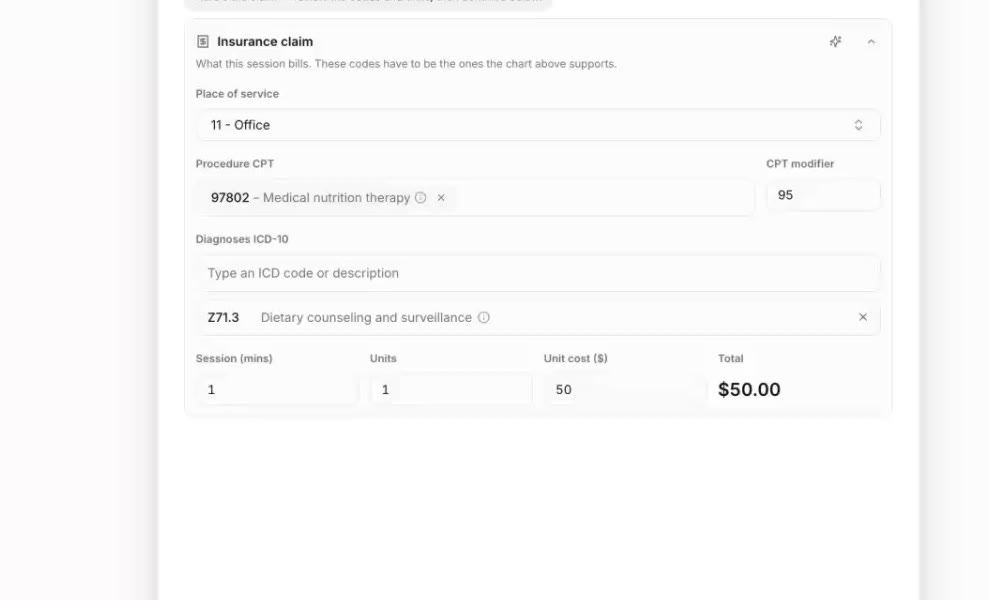
A claim with only a Z68 code lists no condition that justifies medical nutrition therapy, so payers reject or deny it. A claim with Z68 first can be rejected for sequencing. And a claim for weight-related counseling may pay under the preventive benefit (often with Z71.3) rather than the medical one, depending on the plan. Our guide to ICD-10 codes for dietitians and the post on Z71.3 denials walk through the combinations that get paid.
Related
- ICD-10 codes for dietitians
- Z68 BMI codes explained
- Preventive vs medical nutrition benefits
- MNT units calculator