ADIME vs. SOAP notes for dietitians: which format fits?
ADIME vs. SOAP notes for dietitians, section by section: the same visit written both ways, where each format fits, and what payers check.
 By Javier Alvarez · 5 min read
Most dietitians leave training with an opinion about note formats, usually the one their internship drilled in. Private practice muddies it. Referring physicians think in SOAP, your NCP training speaks ADIME, and your billing depends on whatever you wrote down at 9pm.
Start with the part that settles most of the worry: payers don't care which format you use. They care what's in the note. The format choice comes down to who reads your notes and how you organize a visit in your head. Below are the two formats side by side, the same visit written both ways, and a simple way to decide.
The two formats at a glance
| ADIME | SOAP | |
|---|---|---|
| Stands for | Assessment, Diagnosis, Intervention, Monitoring/Evaluation | Subjective, Objective, Assessment, Plan |
| Origin | Nutrition Care Process (dietetics-native) | General clinical medicine (universal) |
| Nutrition diagnosis | Explicit: the PES statement is the D | Folded into the Assessment |
| Who reads it fluently | Other RDs, clinical nutrition teams | Physicians, NPs, PTs, therapists: everyone |
| Natural habitat | Hospitals, clinical/inpatient settings, NCP-driven practices | Referral-heavy outpatient and private practice |
| Structure mirrors | The nutrition care workflow | The visit conversation |
ADIME is the Nutrition Care Process turned into a note. It requires a formal nutrition diagnosis (the PES statement: problem, etiology, signs/symptoms) and builds monitoring into the structure. SOAP is the common language of clinical documentation. Any provider in any discipline can pick up a SOAP note and know where to look.
Section by section: the same visit, twice
Meet a fictional patient (fictional persona for illustration): a 52-year-old referred by her PCP for type 2 diabetes, follow-up visit, 60 minutes of MNT.
The visit in ADIME
A (Assessment): Reports improved breakfast consistency since last visit; still drinking 2 to 3 sweetened coffees daily. Food log shows ~3 carb-heavy dinners per week. Weight 198 lb (down 2 lb). Recent A1c 7.9% per patient report. Readiness to change: high.
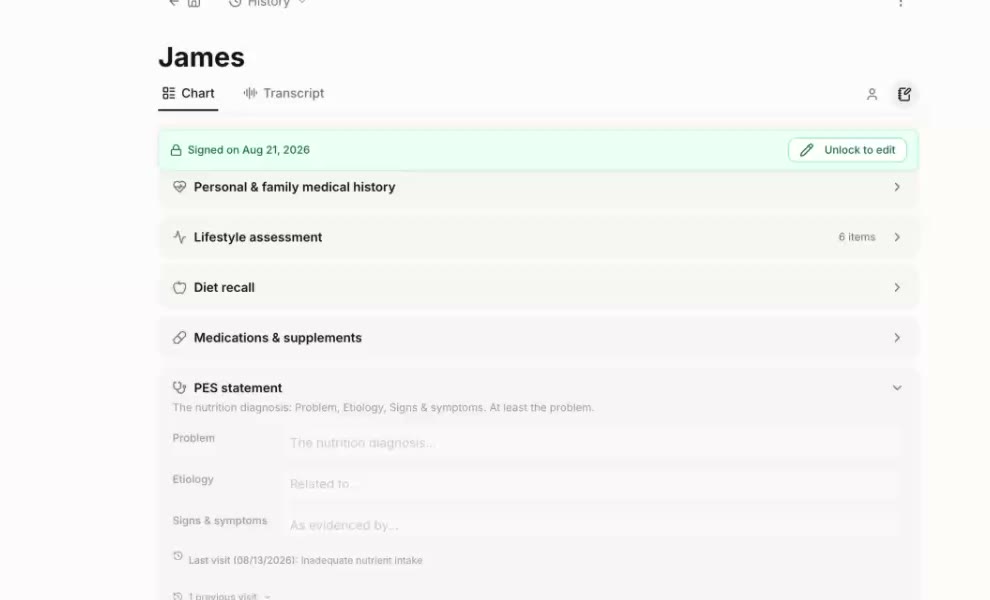
D (Diagnosis, PES): Excessive carbohydrate intake related to limited knowledge of carbohydrate sources in beverages and evening meals, as evidenced by food log showing 2 to 3 sweetened beverages daily and A1c of 7.9%.
I (Intervention): Carbohydrate education focused on beverages; collaboratively set goal of ≤1 sweetened coffee daily, replaced with approved alternatives. Reviewed plate method for dinners; patient built two sample dinner plans.
M/E (Monitoring & Evaluation): Track beverage log and dinner composition; reassess weight and log at next visit in 3 weeks; request updated A1c at next PCP draw. Progress toward prior goal (breakfast consistency): met.
The same visit in SOAP
S (Subjective): Patient reports breakfast routine "finally sticking"; admits 2 to 3 sweetened coffees daily and difficulty with dinner choices. Motivated, no new symptoms.
O (Objective): Weight 198 lb (−2 lb from last visit). Food log reviewed: sweetened beverages daily, ~3 high-carbohydrate dinners weekly. A1c 7.9% per patient report. 60-minute follow-up MNT visit (97803, 4 units), dx E11.9.
A (Assessment): Type 2 diabetes with excessive carbohydrate intake driven by beverages and evening meals; good adherence to prior breakfast goal and high readiness to change. Trending positively on weight.
P (Plan): Beverage-swap goal (≤1 sweetened coffee/day); plate-method dinner planning, two sample plans built in session. Follow-up in 3 weeks; request updated A1c from PCP. Continue weekly food log.
Same clinical content, two containers. Look at what moved. The PES statement becomes part of the SOAP Assessment. SOAP's Subjective/Objective split disappears into ADIME's single Assessment. Monitoring gets its own section in ADIME and lives inside the Plan in SOAP. Nothing was lost either way. (If your PES statements feel clunky, our library of PES statement examples is the fastest fix.)
Where each format fits
ADIME earns its keep in clinical and inpatient settings, where nutrition teams chart in NCP language and expect a formal nutrition diagnosis. It also suits longitudinal, goal-driven care: the Monitoring/Evaluation section makes you close the loop on every goal you set, visit after visit. And it mirrors the clinical reasoning process you were trained in.
SOAP earns its keep in referral-heavy practices. When you send visit summaries back to the referring physician, a SOAP note needs no translation and raises no "what's a PES statement?" questions. That readability helps your physician referral relationships. It's also what therapists, NPs and PAs on a multidisciplinary team read, and it's fastest for a new hire or virtual assistant to learn when they help with your documentation.
My recommendation: if you're a solo RD in private practice living on physician referrals, SOAP is usually the practical pick. If your workflow is NCP through and through, ADIME will produce better notes because you'll write them more willingly. Both answers are correct.
What payers and auditors actually require
No payer policy we know of mandates ADIME or SOAP. Audits ignore the format; the reviewer checks whether the note supports the claim. Whatever container you choose, every billable visit's note needs:
- Date of service (and place of service consistent with the claim, including patient location for telehealth)
- Time: start/stop or total minutes that support the units you billed (a 4-unit 97803 claim needs a note that shows ~53 to 67 minutes)
- Diagnosis consistent with the ICD-10 code on the claim and, where applicable, the referral
- What you actually did: the intervention, education, or counseling delivered, not just "MNT provided"
- Plan and medical necessity for continued care
- Your signature with credentials
Those elements, not the section headers, are what stand between you and a recoupment letter. The full checklist is in our guide to charting for medical necessity.
Pick one and template it
In the ADIME vs. SOAP debate, the format matters far less than the consistency. A practice that writes every note from the same template gets three things. Notes get faster, because filling headers beats composing from a blank page; a good template turns a 25-minute note into a 10-minute one. Audits get safer, because fields for time, diagnosis and signature make the required elements hard to forget. And six months from now, or when you hire your first associate, every chart reads the same way.
So choose the format your readers speak, build it into a template, and stop reopening the decision. We've done the template work: grab our SOAP note templates for dietitians and adapt the headers to ADIME in ten minutes if that's your pick.
Duo Practice records the session (with consent) and drafts a structured note from it, with time, diagnosis and intervention, plus the claim codes for you to review. Try Duo Practice free
Frequently asked questions
Do insurance payers require ADIME or SOAP notes for dietitians?
Neither. Payers and auditors don't care about the format. They check that the note supports the claim: date of service, time that supports the units billed, a covered diagnosis, the intervention delivered, and the provider's signature with credentials. Any format that captures those elements every time will pass.
Which note format is better for a private practice dietitian?
SOAP tends to fit referral-heavy private practices because physicians read it fluently. ADIME fits clinical and inpatient settings, and RDs who work strictly within the Nutrition Care Process. In practice, the better format is the one you'll use every time from a template.
Can I switch between ADIME and SOAP notes in my practice?
Nothing prohibits it, but don't switch from visit to visit. Pick one format for the practice, build a template from it, and use it for every encounter. Consistent notes are faster to write, easier to audit, and safer to hand off.
Part of MNT documentation. Start with How to write an MNT note that gets paid.