Best AI scribes for dietitians: Heidi, Twofold & the gap
AI scribes for dietitians: what Heidi and Twofold do well, how to evaluate a scribe, and the note-to-claim gap that insurance practices still pay for.
 By Javier Alvarez · 4 min read
Disclosure: this article is written by the team at Duo Practice, which offers AI charting as part of a broader billing platform, so we compete with the products below on one feature. We've tried to be fair; verify details with each vendor.
AI scribes solved a real problem for dietitians. After every session came 15 to 20 minutes of charting: turning a 60-minute conversation into an ADIME or SOAP note while the next client waits. Tools like Heidi and Twofold fixed that. Record the session with consent, get a structured draft note minutes later, edit, sign.
For a cash-pay practice, the answer is straightforward: buy a good scribe and enjoy your evenings. If you bill insurance, there's a second question scribe marketing doesn't raise: what happens after the note? The answer determines whether the scribe actually saved your time.
What scribes do well
Credit where it's due. The better scribes on the market, Heidi and Twofold included, are solid products:
- Audio to note, reliably. Modern medical-grade transcription handles clinical vocabulary well, and the structuring layer produces coherent SOAP or ADIME drafts instead of raw transcripts.
- Templates. Both support customizable templates, so you can shape output toward nutrition assessment, PES statements, and follow-up formats instead of a generic medical H&P.
- BAAs. On appropriate paid tiers, established scribe vendors sign Business Associate Agreements, the non-negotiable requirement for putting PHI through any tool.
- Speed. The realistic outcome is turning 15 to 20 minutes of charting into 2 to 5 minutes of review and editing. Multiplied across 20+ sessions a week, that's real hours.
How to evaluate a scribe
Pricing and features change often, so treat this as a rubric to fill in with current vendor information rather than a fixed scoreboard:
| Criterion | What to check | Why it matters |
|---|---|---|
| Accuracy on nutrition content | Trial it on real (consented) sessions | Generic medical models can fumble diet recall detail |
| Nutrition-specific templates | ADIME, PES statements, MNT follow-up formats | Editing a mis-structured note erases the time savings |
| BAA | Included on your tier, in writing | No BAA means no PHI |
| EHR integration | Copy-paste vs. true sync | Manual transfer is a small daily tax |
| Consent workflow | Built-in recording consent capture | Consent rules vary by state |
| Price | Commonly ~$50 to $120/mo, tier-dependent | Verify current pricing directly |
Both Heidi and Twofold score respectably on this rubric for dietitian use; the right pick depends on which templates match your documentation style and what your budget tier includes. We've written more on what to look for in AI charting for dietitians.
The note-to-claim gap
Scribe vendors don't advertise this: a scribe's pipeline ends where your billing pipeline begins.
For an insurance practice, the deliverable is the paid claim. Between the note and the payment sits everything the scribe leaves untouched:
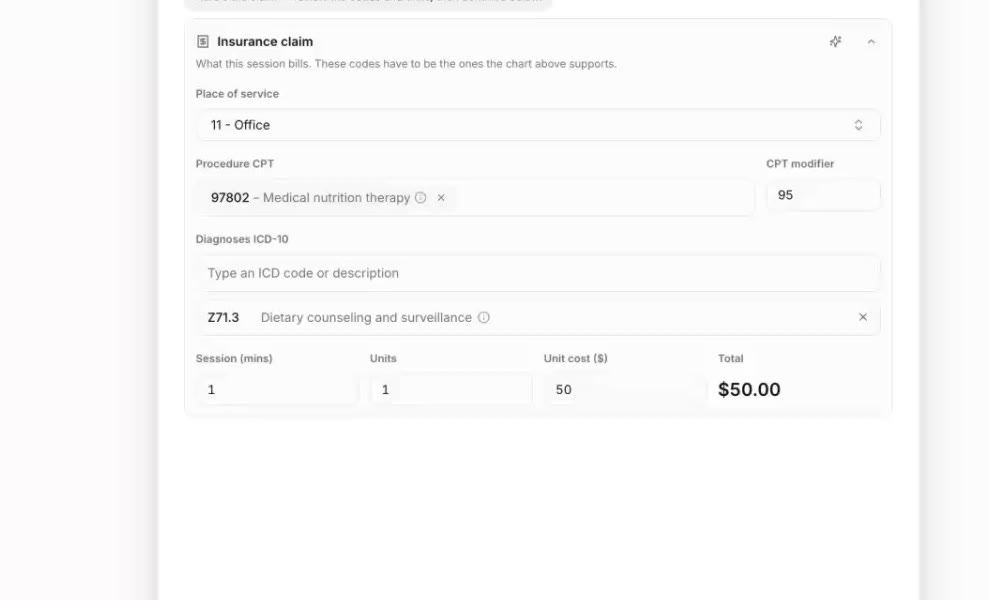
- Choosing 97802 vs. 97803 and counting time-based units correctly
- Pairing ICD-10 codes to the payer's coverage policy
- Confirming the documentation supports medical necessity
- Filling and submitting the CMS-1500 through a clearinghouse
- Tracking the claim, catching rejections, working denials
- Posting the ERA and reconciling the payment
The scribe compresses step zero, writing the note, from 20 minutes to 3. Steps one through six, which commonly take 15 to 25 minutes per claim plus batch time for tracking and posting, remain exactly as manual as before. For an insurance-based RD, the scribe optimized the cheapest segment of the workflow and left the expensive one alone.
Worse, the gap is where the money leaks. A beautifully written note with the wrong unit count still gets denied, and a denial costs a full session's revenue until someone reworks it.
A decision framework
If you're cash-pay: a scribe is probably all you need. Your documentation burden ends at the note; there is no claim pipeline to feed. Pick whichever of the credible vendors matches your template style, confirm the BAA, and stop reading vendor comparisons.
If you bill insurance (or plan to): do the math on the whole pipeline, not the note. A $75/month scribe that saves 5 hours of charting while leaving 15 hours of coding, submission, and posting untouched has solved a quarter of your problem, and you'll still be shopping for the rest of the stack, with yourself as the glue between the pieces.
If you're hybrid: weight by revenue. If insurance is where your growth is, the note-to-claim gap grows with you.
Note-to-paid-claim, as one system
The alternative architecture is a platform where the recorded session doesn't stop at a note: the same pipeline that drafts the chart also generates the CPT/ICD codes and units from it, checks the claim, sends it once you approve it, tracks it, and posts the payment when the ERA arrives. Duo Practice was built that way: the scribe is one stage of the pipeline instead of the whole product. For scale, one recorded 37-minute visit took 6:35 in Practice Better (with its AI summary) and 1:56 in Duo (watch it, with a transcript). That's one visit, not a benchmark.
That doesn't make standalone scribes bad products. It makes them partial products for one specific audience: the insurance-based RD, for whom the note was never the finish line.
Duo Practice drafts the note from your recorded session and keeps going: it drafts the claim from the same visit (CPT, units, ICD-10), you review it and press Submit, and it matches the payment when the ERA arrives. No re-keying between the note and the claim.
Some general-purpose scribes now suggest billing codes too; Freed vs Duo Practice and Heidi vs Duo Practice compare what each does after the note, and the AI scribe that files the claim explains Duo's side. If you would rather have the notes inside an EHR, compare EHRs with AI notes for a solo dietitian.
Frequently asked questions
What is the best AI scribe for dietitians?
Heidi and Twofold are both credible options: they turn session audio into structured clinical notes, offer customizable templates, and sign BAAs on paid healthcare tiers. Which is best depends on your template needs, EHR, and budget; most scribes run roughly $50-120 per month. If you bill insurance, also weigh what happens after the note, because scribes stop there.
Are AI scribes HIPAA compliant for nutrition sessions?
They can be, if the vendor signs a Business Associate Agreement and you use a tier that includes one. Free or consumer tiers often don't. You also need client consent to record sessions, and recording-consent rules vary by state, so check both the vendor's terms and your state's requirements.
Is an AI scribe worth it for a cash-pay dietitian?
Usually yes. If your documentation burden is the note itself (no claims, no coding), a good scribe can turn 15-20 minutes of after-session charting into a 2-minute review. At $50-120 a month, it pays for itself quickly in a documentation-heavy caseload.
Part of Software & workflow. Start with Best practice management software for dietitians (2026).