Guides · Billing guide
How do you use an AI scribe for medical nutrition therapy and bill 97802 or 97803?
 By Javier Alvarez · Updated · 4 min read
| 97802 | First MNT visit with the patient, individual, each 15 minutes |
|---|---|
| 97803 | Individual follow-ups, each 15 minutes (Medicare: G0270 for extra hours after a second referral) |
| Units | From the minutes in the note: 8 to 22 minutes is 1 unit, 23 to 37 is 2, 38 to 52 is 3 |
| Medicare | Diabetes or kidney disease, MD or DO referral, 3 hours the first year and 2 after |
| Telehealth POS | 10 when the patient is at home, 02 anywhere else; modifier as the payer asks |
This guide is for registered dietitians billing US insurance for medical nutrition therapy with an AI scribe. Payer rules differ by plan and change every year, so check your payer's current policy too. Which code fits which visit is covered in depth in CPT 97802 vs 97803.
What the MNT note has to carry for the claim
| In the note | Why the claim needs it | What to check in an AI draft |
|---|---|---|
| The minutes, or a start and end time | 97802 and 97803 are billed per 15 minutes, so the units come from the time (CMS, Ch. 4 §300) | The time matches the visit, not the length of the recording |
| First visit or follow-up | 97802 is for the first visit with the patient, 97803 for individual follow-ups | The scribe didn't call a returning patient "initial" |
| An assessment that supports the diagnosis | The payer pays on the diagnosis, and the note has to back it up | Every condition in the note was said in the visit or is in the record |
| A PES statement | It states the nutrition problem, its cause and the evidence, in the Nutrition Care Process | The evidence part quotes real findings, not invented numbers |
| The referral, on Medicare | Medicare pays MNT only on an MD or DO referral (42 CFR 410.132) | The referring physician and NPI are on file |
| Telehealth details | Place of service and modifier depend on where the patient was | The patient's location and the video or audio mode are in the note |
Step 1: review the draft before you sign
Read the AI draft against the visit, not against what you expected to hear. The usual errors are a fact said by one person credited to the other, a lab value the patient guessed written as a measured one, and a condition listed because it came up in passing. Fix them, then sign. Once you sign, the note is your documentation for that date of service. Our AI scribe checklist for dietitians has a 20-minute test to run before you trust any scribe.
Step 2: pick the code and count the units
Use 97802 for the first visit with the patient and 97803 for individual follow-ups, both per 15 minutes. On Medicare, extra hours after a second referral in the same year are billed as G0270. Under the CMS midpoint rule for 15-minute codes, 8 to 22 minutes is 1 unit, 23 to 37 is 2, 38 to 52 is 3 and 53 to 67 is 4 (CMS, Ch. 5 §20.2). Some commercial plans want a full 15 minutes per unit, so check the contract. The MNT units calculator does the arithmetic.
Step 3: diagnoses in the payer's order
Medicare covers MNT for diabetes, kidney disease not on dialysis, and up to 36 months after a kidney transplant (NCD 180.1), with 3 hours in the first calendar year and 2 after. Commercial plans vary: some cover Z71.3 as preventive counseling, some need a chronic condition. A Z68 BMI code is always secondary under the ICD-10-CM guidelines. An AI scribe can list the conditions discussed; the order on the claim is the payer's rule, not the scribe's.
Step 4: place of service, modifier and provider details
For telehealth, use POS 10 when the patient is at home and POS 02 anywhere else (CMS POS code set), with the modifier the payer asks for, often 95. Add your NPI, the payer ID and, on Medicare, the referring physician's NPI. The full pre-submit list is in how to bill 97802 and 97803 without denials.
Note-only scribe or a scribe that files the claim?
With a note-only scribe, steps 2 to 4 are yours: you read the note, then fill in the claim in your EHR or clearinghouse. Some general-purpose scribes, such as Freed on Premier and Heidi on paid plans, suggest ICD-10 and CPT codes, and you still count the units and build the claim (best AI scribe for dietitians).
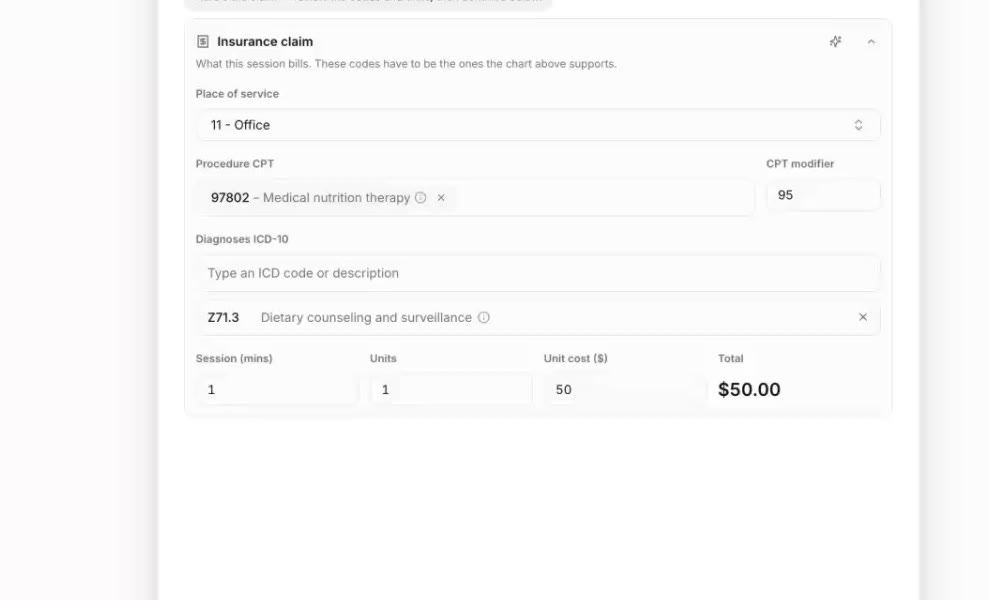
Duo Practice is the AI scribe that files the claim. It writes the MNT note in ADIME form with a PES statement, then drafts the claim from the note: the code, units from how long the session ran, ICD-10 codes and pointers, modifier and place of service. It warns about payer rules it knows, such as Medicare's referral, and shows the rule's source. You approve, and the claim goes out under your NPI through your own Claim.MD account. You still check the code against your records and the diagnosis order against the payer's policy before you approve. See how it works, or watch one visit go from recording to claim.
Duo Practice drafts the claim from the same note, with units from the session length, and files it through your Claim.MD account once you approve. Try Duo Practice free