AI scribe for dietitians: what to check before you trust it
Test an AI scribe before using it for MNT notes: facts traced to transcript, units from real time, valid PES statement, and failures it can't hide.
 By Javier Alvarez · 5 min read
Disclosure: Duo Practice includes AI notes, so we have a stake here. This checklist applies to any scribe, including ours. For a comparison of specific scribes, see best AI scribes for dietitians.
The note looks perfect. Clean ADIME, a tidy PES statement, a plan with measurable goals. Then you read it slowly. It says the client "eats fast food five times a week." But she said she used to, before her diagnosis. It lists 45 minutes of counseling; the call ran 38. And there's an A1c in the assessment she never mentioned.
For a wellness check-in, none of that matters much. For medical nutrition therapy billed to insurance, it matters a lot, because the note is the evidence behind your claim. The minutes support the units, the assessment supports the diagnosis, and a payer who requests your records reads it as your statement, signed by you.
Before you trust an AI scribe with MNT notes, test it on the things that break claims.
Why are MNT notes a harder test than therapy or primary care notes?
- Time is billing. 97802 and 97803 are billed per 15 minutes. The time in the note has to support the units on the claim, in both directions.
- The nutrition diagnosis has a strict shape. A PES statement follows the Academy's Nutrition Care Process, with standardized terms (NCPro). A scribe trained on general medical notes often writes a medical diagnosis there.
- Medicare adds its own rules. MNT needs a referral from a treating MD or DO and covers diabetes and kidney disease, with 3 hours in the first year and 2 after (42 CFR 410.130-410.134).
- You sign it. Medicare's Program Integrity Manual expects notes to be authenticated by the author, and corrections to be clearly marked amendments with a date, not silent rewrites.
The checklist
| Check | Why it matters for MNT | How to test it in a trial | Red flag |
|---|---|---|---|
| 1. Every fact traces to the transcript | Invented details become your signed statement | Pick 5 sentences; find each one in the transcript | A number (weight, A1c, grams) nobody said |
| 2. Tense and negation survive | "Used to" and "doesn't" flip the clinical picture | Say one past habit and one denial in the mock visit | Past behavior written as current |
| 3. Speakers are kept apart | A parent or spouse often talks in pediatric and geriatric visits | Have a second voice add one fact | Family member's words attributed to the client |
| 4. Time comes from the recording | Units must match face-to-face minutes | Run a 52-minute mock visit | Calendar slot used as visit time; charting time counted |
| 5. Units follow the CPT midpoint rule | 52 minutes is 3 units; 53 is 4 | Check the units at 22/23 and 52/53 minutes | Units rounded "to be safe" or missing |
| 6. PES is a real nutrition diagnosis | Payers and auditors read it for medical necessity | Compare with the PES statement builder | "Type 2 diabetes related to..." as the problem |
| 7. Interventions address the billed diagnosis | The note has to justify the claim | Read the Intervention section against the ICD-10 code | Generic advice unrelated to the diagnosis |
| 8. Diagnosis codes stay suggestions | A scribe can't know the referral | See if it invents codes the referral doesn't support | Z68 BMI code listed as primary |
| 9. Failures are loud | A silent failed recording means writing the note from memory that night | Cut the connection mid-session | No warning; a short note that looks complete |
| 10. Edits and sign-off are tracked | Amendments must be identifiable and dated | Edit a signed note | Changes overwrite the original without a trace |
A 20-minute trial protocol
Don't evaluate a scribe on a real client first. Write a short mock visit script with a colleague and plant the traps:
- Two numbers: a weight and a meal count. Leave one lab value unspoken.
- One past habit ("I used to skip breakfast") and one denial ("I don't drink soda").
- A second speaker who adds one fact.
- A known length: stop at exactly 52 minutes of face-to-face time.
- A referral diagnosis you give the scribe, like E11.9.
Then grade the note against the table above. A scribe that gets 9 or 10 right is a time saver. One that invents a lab value or adds a unit is a liability, however good the prose.
Record the trial the same way you'd record a client: with written consent, and in line with your state's rules. Our recording consent guide has the details.
What should you do with the result?
If the note is good but the tool stops there, you have a scribe. You'll still move the time into units, choose 97802 or 97803, pair the diagnosis and build the claim. That's fine for cash-pay practices and for RDs who like their current EHR's billing. Our AI charting guide covers that setup.
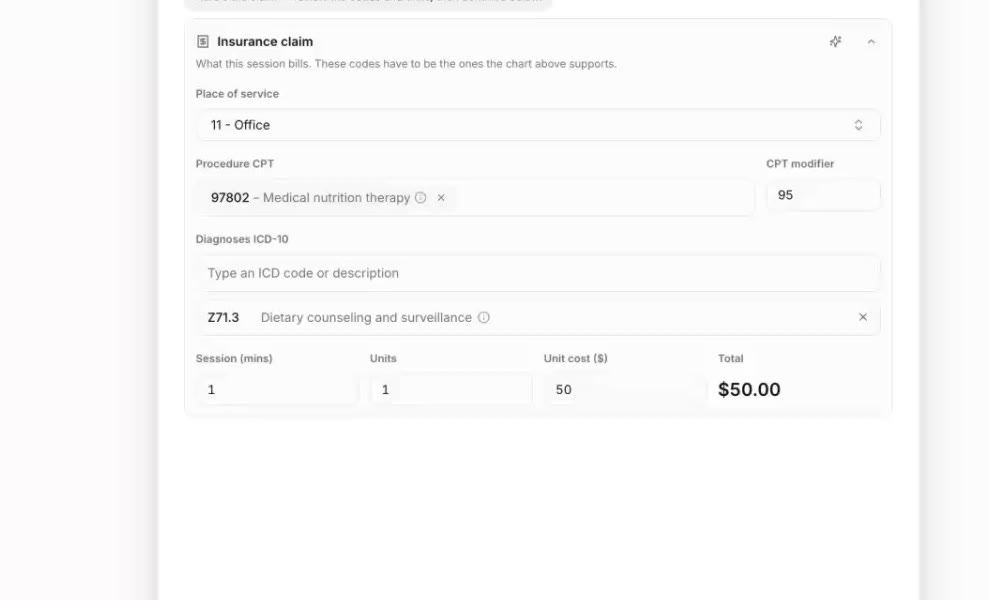
If you bill insurance and the note is only half the work, check whether the tool carries what it measured into the claim. Duo Practice records the visit (video in Duo, in person or by phone), writes the structured MNT note, counts units from the visit time, and drafts the claim with CPT, ICD-10, modifiers and place of service for you to review and submit through your own Claim.MD account.
Where Duo Practice is not the best fit: if you don't bill insurance, a general scribe may be all you need. If you want to stay in your current EHR and only paste notes into it, a standalone scribe is simpler. And if your clients need a portal or app, Duo Practice isn't a patient-facing EMR.
Questions to ask the vendor
The note is only part of the evaluation. Before real clients, get written answers to these:
- Where is the audio stored, and for how long? Is it deleted after the note is written, or kept?
- Is my data used to train models? If so, can I opt out?
- Will you sign a Business Associate Agreement? Don't record a real client before you have one.
- What happens when the recording fails? Do I get an alert during the visit or only find out afterwards?
- Can I export the note, the transcript and the audit trail if I leave?
What habits keep any scribe honest?
Read the note the same day, while you still remember the visit. Check the time line first: minutes, then units, then the rest. If the PES is weak, rewrite it yourself; our PES examples show what strong ones look like.
After signing, amend instead of overwriting, and date the amendment with the reason. Keep the transcript until the note is signed, and know the vendor's retention rules for audio.
To see the difference on a real visit, the Practice Better alternative page has a side-by-side recording of the same 37-minute session charted in two tools. If you're choosing between the two big dietitian platforms and their AI note add-ons, see Practice Better vs Healthie.
In Duo Practice the note and the claim come from the same recording, so the units on the claim match the minutes in the note. Try Duo Practice free
Sources
- CMS Medicare Program Integrity Manual, Ch. 3 §3.3.2.4 to 3.3.2.5 (signatures, amendments, delayed entries)
- CMS MLN905364: Complying with Medicare Signature Requirements
- CMS Medicare Claims Processing Manual, Ch. 5, §20.2 (counting timed units)
- Academy of Nutrition and Dietetics: Nutrition Care Process
- NCPro: Freely available NCP terms
- 42 CFR 410.130-410.134 (MNT definitions and referrals)
Sources checked . Payer rules change; verify the member's benefits.
Frequently asked questions
Can you use an AI scribe for insurance-billed MNT notes?
Yes, if you review, correct and sign every note. Once you sign, the note is your documentation and backs up the claim. The documented time supports the units and the assessment supports the diagnosis, so check those closely before signing.
What makes an AI-generated PES statement acceptable?
The same things that make yours acceptable: the problem is a nutrition diagnosis you can resolve (not a medical diagnosis), the etiology is a cause your intervention can change, and the signs and symptoms are measurable things you can recheck at follow-up. Reject a PES that restates the referral diagnosis.
Do you need client consent to record a session for an AI scribe?
Get it every time, in writing, before recording. Some states require every party to consent to recording, and telehealth adds the client's state to the question. Our recording consent guide lists the rules by state.
Part of Software & workflow. Start with Best practice management software for dietitians (2026).