Duo Practice: the AI scribe that files the claim
 By Javier Alvarez · Updated · 4 min read
| What it is | An AI scribe for dietitians that writes the MNT note and drafts the insurance claim from the same visit |
|---|---|
| Who sends the claim | You approve it; Duo files it under your NPI through your own Claim.MD account |
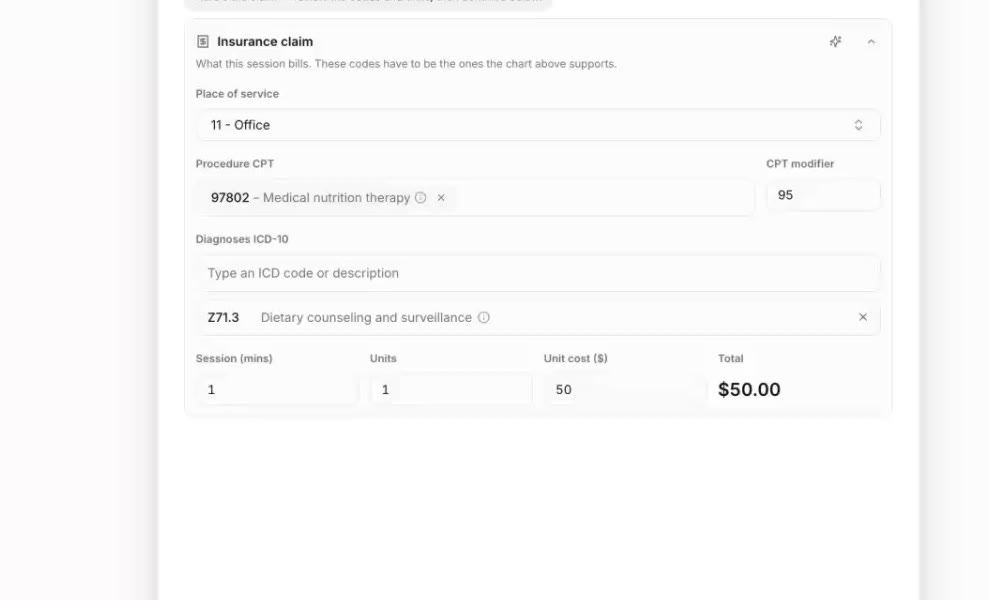
| What goes on the claim | CPT (97802 or 97803), units from the session length, ICD-10 codes and pointers, modifier, place of service |
| Price | Free chart and AI notes (20 transcription hours a month); 3.9% of what the insurer pays on each claim |
| Not included | Prior authorizations, appeals, credentialing, programs or a client app |
What "the AI scribe that files the claim" means
An AI scribe listens to the visit and writes the note. For a dietitian who bills insurance, the note is only half the work: someone still has to pick the code, count the units, pair the diagnoses, set the place of service and send the claim. Duo Practice does that second half from the same recording. The note and the claim come from one visit, so the units match the minutes and the diagnoses match the assessment.
You stay in charge of what leaves. Duo drafts, you approve, and only then does it file the claim under your NPI through your own Claim.MD account.
From the session to a filed claim
- Record the visit. Run it as a video visit in Duo, or record alongside the call tool you already use.
- The note. Duo writes the MNT note from the transcript, in ADIME form with a PES statement. You edit and sign it before the claim goes out.
- The claim draft. From the note, Duo drafts the claim: 97802 or 97803, units from how long the session ran, ICD-10 codes and pointers, telehealth modifier and place of service.
- The checks. Duo checks the claim against the payer rules it knows, such as Medicare's referral requirement, and shows any warning with the rule's source.
- Your approval. You review the claim and approve it. Nothing is sent before this step.
- Filed. The claim goes out under your NPI through your own Claim.MD account.
- Paid or fixed. When the ERA arrives, Duo matches the payment to the claim and explains any denial in everyday words.
We recorded one 37-minute visit and timed it: the chart and the claim draft were ready to review 1 minute 56 seconds after we opened the calendar, with real-time timers and no cuts. It is one visit, recorded by us, so read it as a demo and not a benchmark. Watch the recording-to-claim demo, with a full text transcript.
How it differs from a scribe that only writes notes
General-purpose AI scribes such as Freed, Heidi and Nabla write strong notes for many specialties, and some suggest billing codes. Freed's Premier plan lists ICD-10 and CPT code suggestions (Freed pricing). Heidi's help center lists ICD-10-CM and CPT code sets and asks you to review every suggestion (Heidi help center). Nabla lists E/M and ICD-10 coding suggestions through to the code that is submitted (Nabla). The Freed and Heidi pages we checked on October 26, 2026 don't describe building or submitting an insurance claim, and Nabla's describes coding, not building the claim.
A suggested code still leaves the claim to build: the units from the minutes, the diagnosis order the payer wants, the place of service, your NPI and the payer ID, and a clearinghouse to send it. That is the part Duo adds. If you don't bill insurance, a note-only scribe is enough, and the comparisons below say when one of them is the better pick.
How it differs from billing software with no scribe
A clearinghouse such as Claim.MD sends the claims you build, rejects the ones with missing or malformed data and returns the ERAs. It doesn't know what happened in the visit, so you still choose the codes and count the units (what a clearinghouse checks). Practice software with a claims module works the same way: you fill in the claim. Duo starts from the visit itself, so the claim draft arrives with the note.
| Note-only AI scribe | Billing software or clearinghouse | Duo Practice | |
|---|---|---|---|
| Writes the visit note | Yes | No | Yes, an MNT note in ADIME form |
| Suggests codes | Some do | No | Yes, from the visit |
| Counts units from the session length | Not described | No | Yes |
| Builds the claim | Not described | You build it | Yes, you approve |
| Sends the claim | Not described | Yes | Yes, through your own Claim.MD account |
| Matches the payment | Not described | Shows the ERA | Yes, with denials explained |
"Not described" means the scribe pages we checked on October 26, 2026 don't mention it.
What it costs and what it doesn't do
The chart and 20 transcription hours a month are free, with no monthly fee. Billing is 3.9% of what the insurer pays on each claim, so a denied or $0 claim costs nothing. You also pay Claim.MD directly for your own account. Duo doesn't do prior authorizations, appeals or credentialing, and it has no programs or client app. It is built for solo and small dietitian practices in the US. Create a free account and start today.
Compare it with the scribe you're considering
- Best AI scribe for dietitians: the options side by side, for practices that bill insurance and practices that don't.
- Freed vs Duo Practice and Heidi vs Duo Practice: head to head, including where each one is better.
- AI scribe for medical nutrition therapy: what the note needs so the 97802 or 97803 claim holds up.
Duo Practice drafts the claim from the same recording and files it through your own Claim.MD account once you approve. Try Duo Practice free